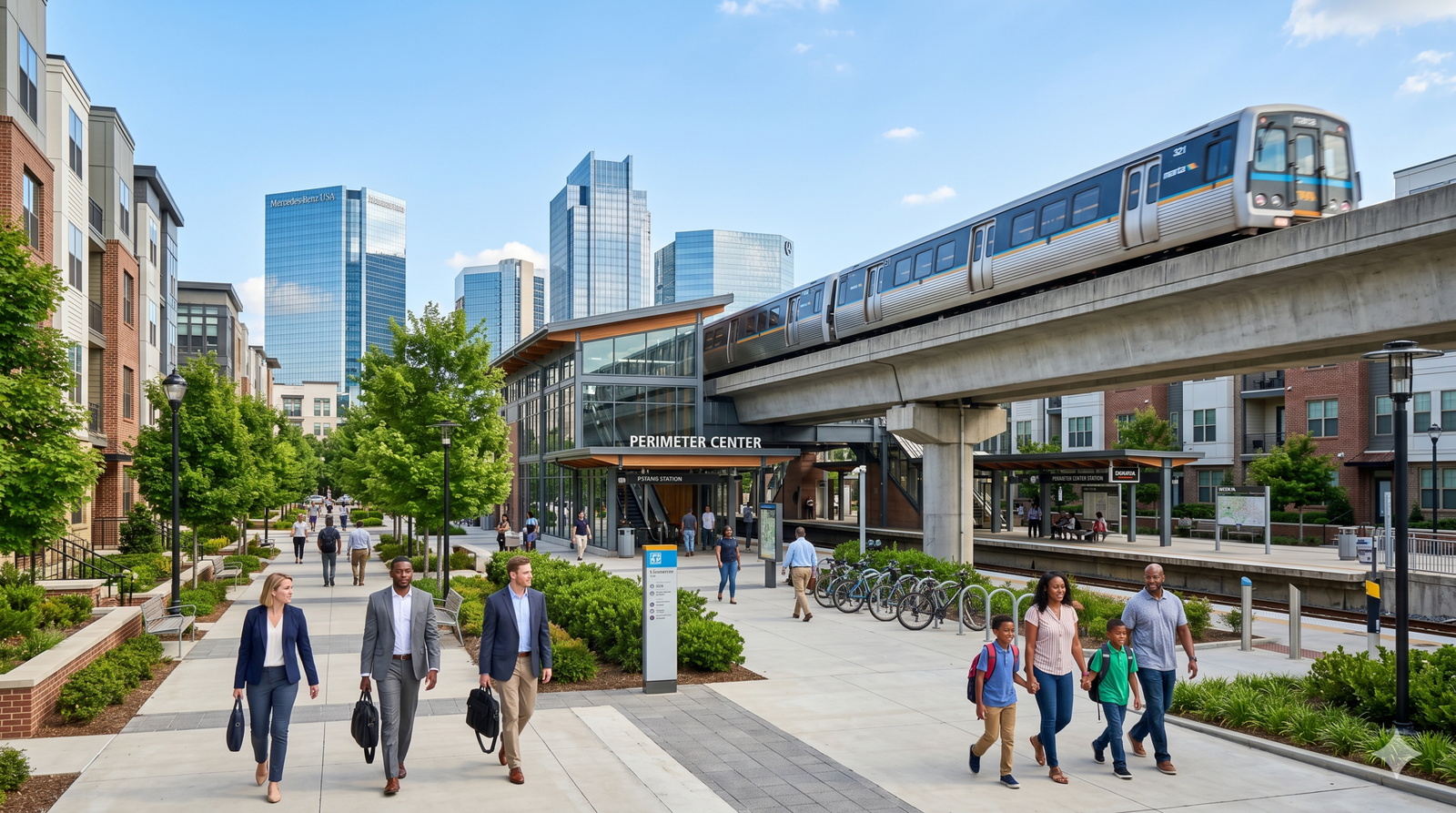
Atlanta Family Commute Control Board
Best Atlanta Suburbs for Commuting to Midtown, Buckhead & Perimeter
A suburb that looks close to the office on a map can still create the wrong weekday. This 2026 comparison matches seven practical suburban zones to the actual job center, road and transit backup options, housing-cost tradeoffs, school logistics, and the effect of hybrid work on the household commute.
Midtown
Rail, I-75/85 and closer-in routes
Buckhead
Red/Gold Line, GA-400 and Peachtree
Perimeter
I-285, GA-400 and rail access
Family load
School, childcare, activities and budget
Published and reviewed: June 11, 2026
Build the suburb shortlist from the office address outward. Midtown, Buckhead and Perimeter are different commute destinations, and even two offices inside the same job center can favor different roads or stations. Travel time should therefore be treated as a property-level test rather than a permanent suburb score. ATL Local Insider is operated from South Korea and uses structured remote due diligence rather than first-hand commute reporting; see our Research Methodology.
Best Atlanta Suburbs for Commuting: Quick Answer
For families searching for the best neighborhoods and suburbs for commuting in Atlanta, match the actual job location to a starting zone before comparing suburb reputation. Midtown, Buckhead and Perimeter should be treated as different commute destinations.
| Your job is in… | Start with | Why |
|---|---|---|
| Perimeter | Dunwoody / Sandy Springs | Strong combination of rail access and north-side road flexibility. |
| Buckhead | Brookhaven / Sandy Springs | Gold or Red Line access and north-side road connections without starting as far out as North Fulton. |
| Midtown | Brookhaven / Chamblee / Decatur | Rail access or comparatively direct approaches into the central core. |
| Cumberland / West Midtown | Smyrna / Vinings | Useful I-75 and I-285 geography for west-side destinations. |
| GA-400 corridor jobs | Roswell / Alpharetta | Strongest when employment itself is concentrated on the northern GA-400 corridor. |
Roswell and East Cobb can also make sense for Perimeter and selected north-Buckhead commuters who value established family neighborhoods and accept a road-dependent commute.
Peachtree Corners and Norcross deserve consideration when the household wants Gwinnett-side housing options while remaining relatively well positioned for Perimeter and northeast employment.
Alpharetta and Johns Creek become much more practical when the job itself is in North Fulton, the schedule avoids the heaviest travel periods, or hybrid work reduces the number of long intown trips. For the broader relocation decision, the Best Atlanta Suburbs pillar guide compares schools, cost, housing and lifestyle alongside commuting.
Route Index
1. Start With the Exact Job Center
“I work in Atlanta” is not enough information to build a suburb shortlist. Midtown, Buckhead, and Perimeter behave like different destinations. Midtown may reward a household for practical Red or Gold Line access, proximity to I-75/85, or an office close enough to a station to avoid another long first- or last-mile segment.
Buckhead can mean Lenox, Phipps, Peachtree Road, Piedmont Road, North Buckhead, or a GA-400-oriented office. Those locations do not produce the same commute map.
Perimeter varies too. An office next to Dunwoody Station, a medical campus near Medical Center Station, and a building that still requires a substantial drive or shuttle after rail all create different calculations.
The commute decision is not simply, “Which suburb should I move to?” It is, “Which route still works after school drop-off, childcare, parking, and evening activities are added?” That is why the office address comes before the suburb shortlist.
Destination-first rule
Use the actual building entrance and required arrival time. A suburb that works well for Perimeter can become a difficult Midtown choice, while a property with practical station access can outperform a physically closer address that depends on one congested road.
2026 Commute Reality Check: The Regional Pattern Has Changed
The Atlanta Regional Commission’s 2025 Regional Commuter Survey, released in February 2026, surveyed nearly 6,000 employed residents across the 20-county region. ARC reported that average commute times were about five minutes shorter than in 2019, while telework and non-traditional schedules had become more common and congestion was spreading more evenly through the day.
| 2026 regional signal | What ARC found | What it means for a home search |
|---|---|---|
| Average commute time | About five minutes shorter than 2019 | Do not assume an older pre-pandemic commute rule still describes the household’s actual schedule. |
| Telework | More common than before 2020 | A farther suburb can work differently for a two-day office schedule than for a five-day schedule, so test both scenarios. |
| Peak pattern | Non-traditional schedules spread congestion more broadly through the day | “Rush hour” is no longer one simple window; test the exact route at the actual departure and return times. |
ATL Local Insider analysis: these are regional averages, not promised commute times for any suburb or address. Their value is methodological: they show why a 2019-style rule of thumb or a single map estimate is weak evidence for a 2026 housing decision. The finalist address still needs a real route test in both directions.
Source: Atlanta Regional Commission — 2025 Regional Commuter Survey.
2. Housing Cost Changes the Commute Decision
The June 2026 Zillow snapshots used for this guide illustrate the housing spread across the commuter zones. Alpharetta was roughly $731,000, Sandy Springs about $702,000, Dunwoody about $686,000, Roswell about $667,000, Peachtree Corners about $557,000, Chamblee about $517,000, Smyrna about $450,000, and Norcross about $315,000.
These figures are dated market context, not recommended purchase prices or estimates for a specific property. The point is the spread: a household moving closer to rail or Perimeter may trade money or square footage for route flexibility, while a household moving farther northeast or northwest may gain housing flexibility while accepting greater transportation dependence.
For a serious property, replace broad market snapshots with current comparable sales, parcel taxes, an insurance quote, HOA documents, property condition, and the full household transportation cost.
Before allowing a cheaper or more expensive suburb to change the shortlist, run the full ownership calculation in the Atlanta Housing Affordability Guide.
3. Seven Commuter Areas at a Glance
| Area | Best destination fit | Backup strength | Main family tradeoff |
|---|---|---|---|
| Sandy Springs / Dunwoody | Perimeter first; Buckhead and Midtown when rail or GA-400 aligns. | Strong combination of MARTA stations and major roads. | Higher housing pressure and intense local traffic near Perimeter. |
| Brookhaven / Chamblee | Buckhead and Midtown. | Gold Line, Peachtree Road and I-85. | Smaller lots, older housing and street-level variation. |
| Smyrna / Vinings | Midtown, Buckhead and Cumberland. | Several road options but no direct MARTA rail station in the communities. | Road dependence and variable interchange delays. |
| Decatur / North Decatur | Midtown, Emory, CDC, Downtown and east-side jobs. | Rail in parts of Decatur plus surface routes. | City-boundary, tax, school and older-home differences. |
| Roswell / East Cobb | Perimeter and selected north-Buckhead offices. | Multiple roads exist, but river crossings and major corridors create choke points. | Established suburban lifestyle with peak-hour road exposure. |
| Peachtree Corners / Norcross | Perimeter, northeast employment and selected northern Buckhead destinations. | Peachtree Industrial, Holcomb Bridge and I-285. | Address-specific school, housing and route quality. |
| Alpharetta / Johns Creek | North Fulton and northern GA-400 jobs first; Perimeter depending on schedule and address. | GA-400 plus North Springs as a possible rail connection for some trips. | Strong family amenities with substantially greater intown distance. |
4. Sandy Springs and Dunwoody: The Strongest All-Around Base
For a household with a Perimeter office, Sandy Springs and Dunwoody deserve an early test. Dunwoody, Sandy Springs, and Medical Center MARTA stations serve the district, while North Springs can support selected park-and-ride patterns farther north. GA-400 and I-285 provide the road side of the network.
The combination becomes particularly useful when two adults travel in different directions. One household member may have a practical rail trip toward Buckhead or Midtown while another drives locally to Perimeter or a medical campus.
The tradeoff is local congestion. A house only a few miles from work can still depend on Hammond Drive, Ashford Dunwoody Road, Peachtree Dunwoody Road, Mount Vernon Road, or another busy local segment.
Perimeter test
Do not stop timing the commute when the highway exit appears. Measure the local-road segment between the interchange or station and the actual home and office.
Read Dunwoody vs Sandy Springs before narrowing the housing and school search.
5. Brookhaven, Chamblee, Decatur and North Decatur: Closer-In Efficiency
Brookhaven and Chamblee
These areas offer one of the stronger combinations of Buckhead and Midtown proximity, rail access, and selected neighborhoods that still provide a suburban residential pattern.
A property with practical access to Brookhaven/Oglethorpe or Chamblee Station can reduce dependence on I-85 or other highway segments for certain trips.
The housing trade can involve lot size, housing age, redevelopment, aircraft noise, school geography, or block-level differences in walkability. Test the exact property rather than assuming those conditions apply uniformly.
Decatur and North Decatur
These areas can fit Midtown, Downtown, Emory, CDC, and east-side jobs particularly well.
Some addresses gain useful rail access. Others rely on surface roads that appear short on a map but become less predictable around schools, hospitals, major intersections, or events.
Always separate City of Decatur from unincorporated DeKalb and surrounding postal areas. School systems, taxes, services, and housing stock can differ substantially.
6. Smyrna and Vinings: The West-Side Compromise
Smyrna and Vinings can work for Cumberland, west Midtown, Midtown, Buckhead, and selected Perimeter destinations depending on the exact property and route.
Vinings generally places the household closer to the river and several intown job centers, while Smyrna gives buyers a broader housing search.
The June 2026 Zillow snapshot used for this guide placed Smyrna near $450,000, below several north-side areas in this comparison. That housing difference matters only if the route still works for the household.
I-75, I-285, Cobb Parkway, bridge approaches, and local interchanges can produce very different morning and evening results.
These communities also remain predominantly car-dependent for many household routines because they do not have direct MARTA rail stations. Xpress or employer flexibility may improve some trips, but they should be tested against the actual work schedule rather than treated as guaranteed substitutes for driving.
7. Roswell, East Cobb, Alpharetta and Johns Creek: Lifestyle First
Roswell and East Cobb attract households looking for established neighborhoods, mature trees, larger homes, and a traditional suburban environment. They can be workable for Perimeter and selected north-Buckhead offices, especially when departure times or hybrid schedules reduce exposure to the heaviest peak periods.
Their main transportation risk is the surface-road and river-crossing network. Roswell Road, Johnson Ferry Road, Holcomb Bridge Road, GA-400, and I-285 can create very different trip times depending on the property and destination.
Alpharetta and Johns Creek add strong parks, restaurants, family amenities, schools, and North Fulton employment. But those benefits should not be confused with proximity to Midtown or central Atlanta.
The June 2026 Zillow snapshot used in this guide placed Alpharetta around $731,000, illustrating an important tradeoff: a household can pay a substantial housing premium while still accepting greater distance from central job centers.
These areas become strongest commute candidates when the employer is already in North Fulton or along northern GA-400, when the household has meaningful schedule flexibility, or when the family consciously accepts longer regional travel in exchange for the local lifestyle.
Compare Roswell vs Alpharetta, the Alpharetta Relocation Guide, and the Johns Creek Relocation Guide.
8. Peachtree Corners and Norcross: Gwinnett Value With Perimeter Access
Peachtree Corners and Norcross keep households closer to Perimeter, Chamblee, Doraville, Duluth, and northeast employment than farther-out Gwinnett communities.
The June 2026 Zillow snapshots used for this guide showed a large gap between Peachtree Corners at roughly $557,000 and Norcross near $315,000. Those city-level snapshots should not be treated as one housing market or as a substitute for current property comps.
Peachtree Industrial Boulevard, Holcomb Bridge Road, Buford Highway, and I-285 provide several possible routes. That flexibility is valuable, but the exact side of a corridor matters. A property that avoids one repeated bottleneck can outperform a seemingly more attractive home that requires crossing it twice every weekday.
School assignment, municipality, neighborhood condition, and traffic exposure can change considerably from one address to another. Use the Best Suburbs in Gwinnett County guide before narrowing the shortlist.
9. Three Commute Failure Patterns to Test
The most useful commute warnings are not fixed travel-time estimates. They are recurring ways an otherwise attractive property can fail once a household begins living the full weekday.
The evening is worse than the morning
A route can feel manageable on the trip to work and become much less predictable on the return because traffic direction, school pickup, incidents, events, or local intersections behave differently.
Time both directions separately.
One corridor carries the entire household
A property becomes fragile when work, school, childcare, shopping, and activities all depend on the same interchange, river crossing, or major arterial.
Identify a realistic backup route before assuming the mileage is acceptable.
The commute works only under today’s schedule
A hybrid schedule can make a farther-out suburb reasonable, but employer policies can change. The same is true for childcare hours, school assignments, and a second adult’s job location.
Test whether the property remains workable if required office days increase.
Failure-pattern rule
A route does not need to be fast every day. It needs to be resilient enough that a normal disruption does not break the household’s school, childcare, work, and evening schedule.
10. Test the Route Before Making an Offer
- Pin the office entrance. Use the actual building, parking entrance, or station exit rather than the neighborhood name.
- Test the required office days. Drive on the days and during the hours the household will really travel.
- Run both directions. Morning success does not prove the evening return is acceptable.
- Add the school chain. Include drop-off, pickup, daycare, tutoring, and at least one recurring activity.
- Identify the failure point. Find the bridge, interchange, left turn, school entrance, or arterial most capable of controlling the trip.
- Test the backup route. Measure it during the same travel window rather than assuming an alternate road solves the problem.
- Measure first-mile transit access. Include the drive or walk to the station, parking, platform wait, transfer, and final walk to the office.
- Check MARTA and Xpress schedules. Make sure the service supports the household’s actual arrival, departure, and late-meeting needs.
- Price the commute. Include fuel, parking, tolls where relevant, vehicle wear, and any childcare cost created by the longer day.
- Stress-test hybrid work. Ask whether the home still works if required office days or commute windows change.
| Route Scenario Matrix | Primary Route | Backup / Transit | Household Test |
|---|---|---|---|
| Normal office day | Home → office at required arrival time | Second road or rail/Xpress option | Does the full door-to-door trip fit the weekday? |
| School-chain day | Home → school/childcare → office | Alternate pickup plan or second adult route | Can drop-off and pickup occur without schedule failure? |
| Incident day | Primary corridor disrupted | Real tested alternate during the same peak window | Does one crash or closure break work and family obligations? |
| Late-meeting day | Office → home after normal departure | Transit schedule or alternate driver plan | Do childcare, station hours, and evening activities still work? |
| More-office-days scenario | Current route repeated more often | Rail, carpool, flex-time, or closer parking option | Would the address still work if hybrid flexibility decreases? |
ATL Local Insider analysis: record the result for each finalist address rather than assigning a permanent commute score to an entire suburb. A route is resilient when normal, school-chain, disruption, and schedule-change scenarios remain workable without relying on one fragile corridor or one temporary employer policy.
Use 511 Georgia to review current incidents, construction, and road conditions while testing a finalist route.
Once a candidate zone survives the commute test, run the address through the full Atlanta relocation roadmap. Work access is only one part of the final decision; school assignment, household budget, taxes, utilities, housing condition, and the move itself still need verification.
Frequently Asked Questions
What is the best Atlanta suburb for commuting to Midtown?
Brookhaven, Chamblee, Decatur, and North Decatur are strong places to begin testing because of their closer-in geography and, for some properties, practical rail access. Smyrna, Vinings, Sandy Springs, and Dunwoody may also work depending on the exact Midtown office and route.
What is the best suburb for commuting to Buckhead?
Brookhaven, Chamblee, Sandy Springs, and Dunwoody deserve early consideration. The best choice depends on whether the office aligns better with MARTA, GA-400, Peachtree Road, or another local approach.
What is the best suburb for a Perimeter job?
Sandy Springs and Dunwoody are usually the most direct starting points. Roswell, East Cobb, Peachtree Corners, Norcross, Alpharetta, and Johns Creek may also work depending on the office side, household schedule, and exact home location.
Is Alpharetta too far for a Midtown commute?
It can be demanding for a frequent peak-hour commute. It becomes more practical when office days are limited, travel occurs outside the heaviest periods, or the household accepts the extra distance in exchange for North Fulton housing and lifestyle priorities.
Is MARTA always faster than driving?
No. Rail is most useful when both the home-to-station trip and the station-to-office trip are practical. Include parking, waiting, transfers, and the final walk when comparing transit with driving.
Should I buy a cheaper home farther out?
Only after comparing the complete ownership and transportation cost. A lower purchase price can be offset by additional driving, parking, vehicle wear, childcare logistics, or the need for another vehicle.
Official and Market Sources
- MARTA — Train Stations and Schedules
- MARTA — Interactive System Map
- Xpress — Routes
- Xpress — Park-and-Ride Locations
- 511 Georgia
- Georgia Commute Options
- Atlanta Regional Commission — Transportation Planning
- Zillow — Alpharetta Housing Market
- Zillow — Brookhaven and Nearby Market Context
- Redfin — Georgia Housing Market
Research note: This guide is a destination-first planning tool, not a permanent commute-time ranking. The seven commuter areas, route comparisons, and commute failure patterns are ATL Local Insider research frameworks built around official MARTA, Xpress, 511 Georgia, regional transportation resources, and dated housing-market context. Housing figures are snapshots from the period identified in the article and should not replace current property-level comparable sales.
Traffic, transit schedules, construction, parking, employer policies, school schedules, housing markets, and household routines can change. Test any finalist route from the actual home to the actual office entrance during the travel windows the household will use before buying or renting.