Metro Atlanta Relocation JournalIndependent decision guides built around the address, commute, school path and monthly household cost.
Georgia Property Risk File • Mature Trees
Mature Tree Liabilities in Georgia: Build the Evidence File Before the Storm
When a large tree fails, ownership of the trunk is only one fact. Tree condition, prior notice, storm circumstances, damage location, insurance language, local rules, and documentation can all become part of what happens next.
Last reviewed for local-source accuracy: July 2026
Do not wait for the tree to fall before building the record. Mature-tree risk is easier to manage when a homeowner can show what the tree looked like, whether anyone raised concerns, what professional evaluation occurred, which property was damaged, and what happened immediately after the event.
File 01
Tree Condition
Record visible health, defects, changes, and professional findings.
File 02
Prior Notice
Preserve emails, arborist reports, HOA notices, photos, and dates.
File 03
Failure Event
Document weather, roots, trunk, canopy, and immediate conditions.
File 04
Damage Location
Identify where debris and property damage actually occurred.
File 05
Insurance File
Record claim instructions, deductible, coverage questions, and receipts.
File 06
Local Authority
Check municipal, county, right-of-way, and HOA requirements.
File 07
Future Risk
Use the event to evaluate remaining mature trees and home exposure.
Georgia Tree Risk Record
Document the Tree Before You Debate Liability
After a tree falls, neighbors often begin with ownership: “That was your tree.”
For a practical Georgia homeowner file, condition matters just as much. What did the tree look like before the failure? Were there visible warning signs? Had its condition changed recently? Had a qualified professional evaluated it?
No Obvious Warning
The tree appeared alive and structurally normal to an ordinary observer before a weather event.
Preserve any earlier yard or listing photos that show its pre-event condition.
Concern Worth Evaluating
The tree showed changes such as dead branches, cavities, fungal growth, bark loss, altered lean, root disturbance, storm damage, or decline.
This is the point where professional evaluation becomes useful.
Documented Hazard Concern
An arborist, HOA, neighbor, tenant, contractor, municipality, or another source had already identified a specific concern.
The written record becomes important evidence if a later failure occurs.
A homeowner is not expected to diagnose every hidden structural defect. That is exactly why a written professional assessment can be more useful than guessing whether a mature oak “looks dangerous.”
Georgia Forestry Commission homeowner resources can help identify tree-care warning signs and when professional assistance may be appropriate.
Build the Prior-Notice Record
The practical question is not only whether a tree had a defect. It is also whether anyone had identified that concern before the failure and whether the owner had a reasonable opportunity to respond.
Record 01
Routine photos
Keep periodic yard photos showing the trunk, canopy, major limbs, and surrounding structures. They can provide a pre-event condition record later.
Record 02
Written neighbor or tenant concern
If a specific tree appears hazardous, document the location and the specific concern rather than relying only on a verbal conversation.
Record 03
Qualified assessment
Keep written arborist findings, recommendations, estimates, photographs, and dates.
Record 04
Owner response
Preserve pruning invoices, removal estimates, scheduled work, HOA approvals, permit correspondence, and any other record showing what happened after the concern was raised.
Use specific documentation, not escalation.
A short written message identifying the tree, visible concern, and request for professional evaluation is more useful than emotional claims about who will be sued if something happens.
Separate the Storm Event From the Preexisting Risk
Georgia Consumer Ed provides general guidance indicating that responsibility for a fallen tree can depend heavily on whether the event was an ordinary natural occurrence or whether a known hazardous condition existed beforehand.
That distinction makes the failure event itself worth documenting carefully.
Mobile: swipe horizontally to review the evidence categories.
Evidence
What to Record
Why It Matters
Weather
Date, approximate time, wind, rain, lightning, nearby storm damage, and relevant weather alerts.
Helps establish the circumstances surrounding the failure.
Leaf condition, dead limbs, prior pruning, broken branches, and canopy imbalance.
May help compare the fallen tree with earlier photographs.
Nearby trees
Other failures, snapped limbs, or storm damage in the immediate area.
Provides context about event severity.
Photographs cannot by themselves determine legal responsibility, but they preserve facts that can later help an insurer, arborist, contractor, or attorney understand what happened.
Record Where the Tree Landed and What Was Damaged
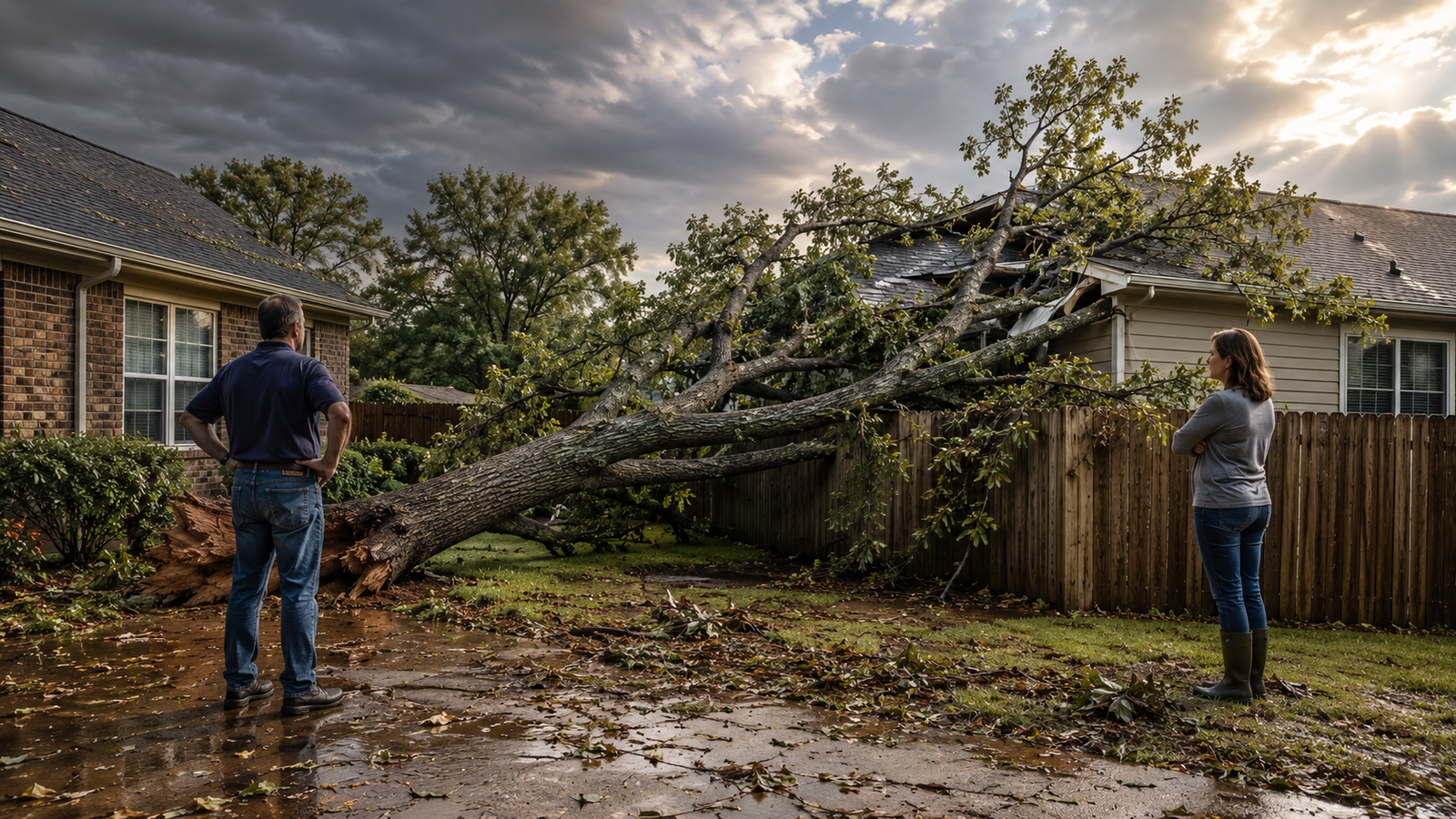
A mature tree failure can create several separate issues at once: tree ownership, debris removal, structural damage, property insurance, vehicle insurance, emergency safety, and neighbor communication.
Build a property-damage map before cleanup begins.
Mobile: swipe horizontally to review the damage file.
What does the property policy require before permanent repair?
Fence or exterior structure
Impact point, property line, pre-loss condition if available, and repair quote.
Is the damaged item covered under the applicable policy?
Vehicle
Vehicle location, tree contact, photographs, registration, and insurance information.
Which policy should be contacted for the vehicle damage?
Open yard
Tree location, access limitation, debris volume, root damage, and removal quote.
Does the policy provide relevant debris-removal coverage under these facts?
Utility or access area
Power lines, driveway blockage, road obstruction, meter damage, and emergency access.
Does the utility company, municipality, emergency service, or another authority need to respond first?
Open the Insurance File Early
Insurance often determines the first operational steps even when it does not resolve a neighbor-liability dispute.
After documenting the scene, contact the relevant insurer and ask specific questions rather than assuming every tree-removal or repair expense is covered.
Claim Instructions
Ask whether the insurer wants photographs, estimates, an adjuster inspection, emergency mitigation, or particular documentation before permanent repairs.
Deductible
Confirm the applicable deductible and whether different forms of property damage may be handled differently.
Debris Removal
Ask whether and under what circumstances removal of the fallen tree is included under the actual policy.
Receipts and Temporary Work
Save emergency tarping, temporary stabilization, tree-service, contractor, hotel, and other receipts that the insurer instructs you to preserve.
The Georgia Office of Commissioner of Insurance and Safety Fire provides consumer guidance on preparing for and responding to storm-related insurance claims.
Do not destroy evidence unnecessarily.
Safety comes first, but when conditions allow, photograph the tree and damage before sections are cut apart or hauled away. Ask the insurer whether an adjuster needs to inspect before permanent repairs or major cleanup.
Preserve the First-Day Evidence
1. Safety
Stay away from downed power lines, unstable branches, compromised structures, standing water, and other immediate hazards.
2. Scene Record
Photograph the tree, roots, trunk, canopy, damage, property line, nearby structures, and wider scene before conditions change.
3. Claim Contact
Notify the appropriate insurer and record the claim number, representative, instructions, and requested documents.
4. Stabilize
Take reasonable safety measures needed to prevent additional damage while preserving receipts and following claim guidance.
Keep neighbor communication factual. A storm event is usually not the best time to argue responsibility at the property line.
Handle Neighbor Trees and Overhanging Limbs Carefully
Overhanging branches are different from a tree that has already failed.
A branch may create leaves, shade, acorns, or nuisance without creating an immediate structural hazard. When trimming is being considered near a property boundary, avoid treating the tree as though ownership gives unlimited self-help rights.
Aggressive cutting of roots, the trunk, or major structural limbs can damage or destabilize a mature tree.
Tree work can create new risk.
Before major pruning near a property line, confirm the boundary, applicable local rules, and appropriate pruning method. For valuable or structurally complex mature trees, qualified arborist guidance is preferable to aggressive DIY cutting.
UGA Warnell resources emphasize that professional tree-risk evaluation can help distinguish trees that require removal from trees whose risk may be reduced through other treatment.
Check HOA and Local Tree Rules Before Cutting
State-level liability questions are only one part of a Georgia tree decision.
A property may also be subject to:
municipal tree ordinances;
county requirements;
right-of-way rules;
stream or buffer restrictions;
historic-area controls;
development conditions;
HOA architectural or landscape approval;
replacement-tree requirements.
The existence and details of these rules are highly location-specific.
Before removing or substantially altering a mature tree, identify the actual jurisdiction and check the current city, county, and HOA requirements that apply to the parcel.
Emergency work after a dangerous failure may also be treated differently from routine elective removal, so do not assume the same procedure applies in every situation.
Add Tree Exposure to the Homebuying File
Tree liability is easier to manage before closing than after the first storm.
A buyer should not evaluate mature trees only as landscaping.
During the property review, note whether large trees could affect:
the roof;
driveway;
neighboring structures;
retaining walls;
sewer or private utility lines;
septic tank or drainfield areas;
foundation drainage;
fences;
power or service lines;
future additions or pools.
Ask whether the seller has arborist reports, tree-service invoices, HOA correspondence, storm-damage records, or removal estimates involving major trees.
The goal is not to eliminate every mature oak from the property. Mature trees can be valuable landscape assets. The goal is to know which trees create ownership obligations that should be inspected, maintained, insured, or budgeted.
Use the Georgia Home Inspection Checklist to connect tree exposure with drainage, roof, foundation, moisture, and site-risk questions.
If this tree failed tonight, could you prove what was visible beforehand, who knew about the concern, where the damage occurred, and what your insurer and local rules require next?
If the answer is yes, the household has transformed a vague landscape risk into a documented property-management issue.
If the answer is no, the next useful step may be photographs, an arborist evaluation, insurance review, boundary confirmation, or local-rule research before another storm tests the property.
Frequently Asked Questions
Who pays when a neighbor’s tree falls on my property in Georgia?
Do not assume tree ownership alone answers the question. Georgia consumer guidance indicates that the starting point can depend on where the tree lands and whether a hazardous condition and prior knowledge may be involved. The exact facts, insurance policy, damage, and legal circumstances should be reviewed with the appropriate professionals.
Does a storm automatically eliminate the tree owner’s responsibility?
Not necessarily. A weather event and the tree’s preexisting condition are different facts. Prior visible defects, professional findings, or notice may become relevant. Specific responsibility requires fact-specific legal and insurance analysis.
Does homeowners insurance always pay to remove a fallen tree?
No. Coverage depends on the actual policy, cause of loss, damaged property, deductible, debris-removal provisions, and other claim facts. Contact the insurer before assuming removal or repair is covered.
Should I notify a neighbor in writing about a dangerous-looking tree?
A factual written record can be useful when there is a specific concern. Identify the tree, describe the observable issue, preserve photographs, and consider requesting professional evaluation rather than making legal conclusions yourself.
Can I trim branches that cross my property line?
Boundary-tree and pruning situations can be fact-specific. Avoid cutting the trunk, roots, or structural parts in a way that could damage or destabilize the tree. Confirm applicable local rules and consider arborist or legal guidance when the stakes are significant.
Should a homebuyer worry about mature trees?
Mature trees are not automatically defects. They can add shade, landscape value, and character. Buyers should instead identify trees that could affect structures, neighboring property, utilities, septic areas, drainage, or future construction and investigate those risks during due diligence.