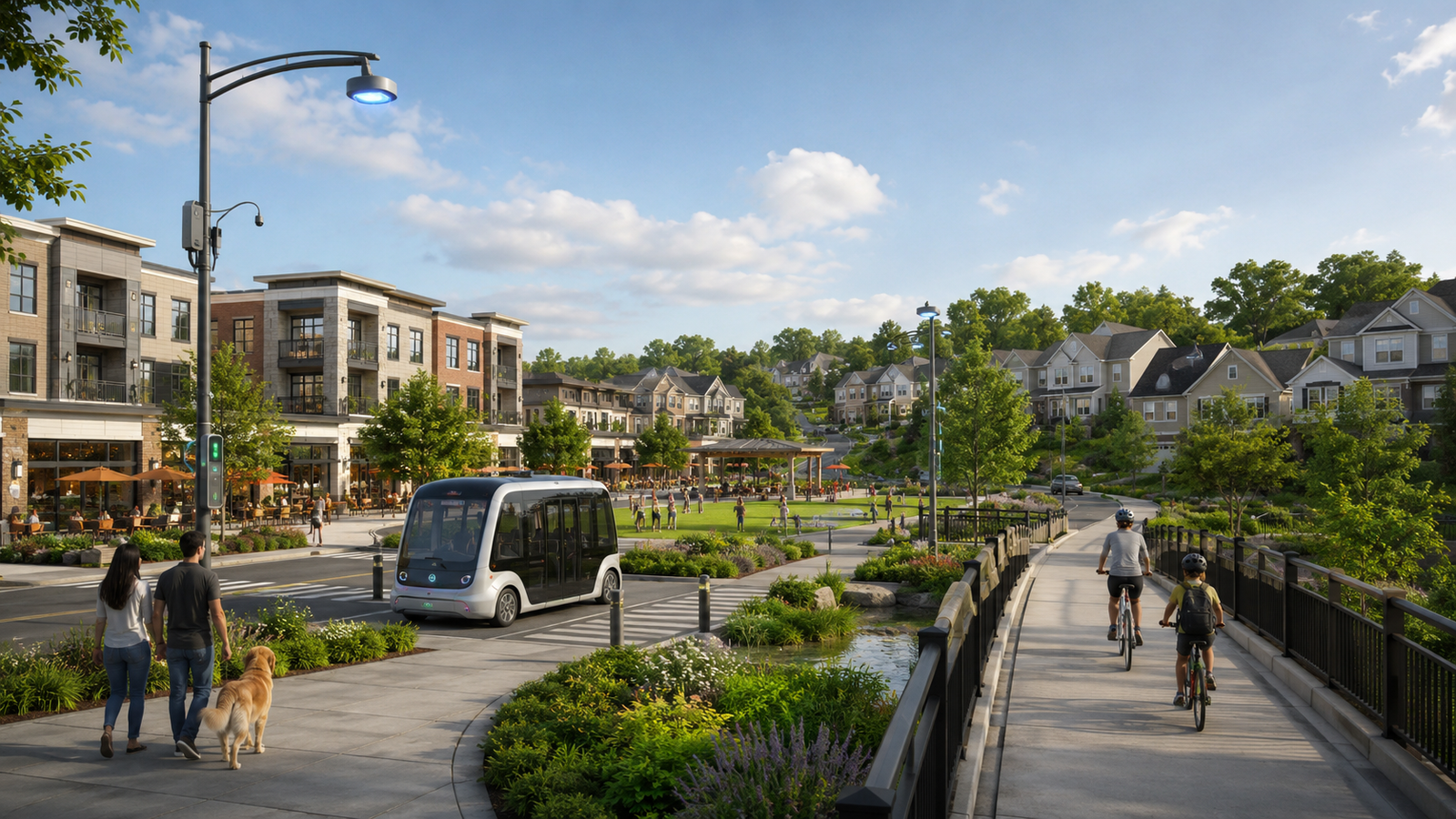
Peachtree Corners: Georgia’s First Smart City as a Residential Suburb

North Metro Field Notes Address-to-Routine Edition Peachtree Corners

Relocation • Smart-City Identity • Daily-Life Fit

Peachtree Corners Relocation Guide: Is This Smart-City Suburb Right for You?

Last reviewed:

The city blends established neighborhoods, Technology Park, Town Center activity, river access, growing trail links, and a nationally visible innovation district—but the right home still depends on school assignment, road exposure, house condition, and how often your family will use those amenities.

Activity center Town Green, Town Center, the Forum, restaurants, events, and the pedestrian bridge.
Daily route Peachtree Parkway, Holcomb Bridge, Peachtree Industrial, Spalding, schools, and work.
Address reality Exact cluster, home age, HOA, traffic exposure, drainage, trees, and trail proximity.

Peachtree Corners relocation guide decisions should begin with the family’s routine, not the smart-city label. Peachtree Corners offers a rare combination of established suburban housing, a city-owned technology laboratory, a visible town-center node, Chattahoochee-area recreation, and a trail network still being built.

The city can fit households whose lives point toward western Gwinnett, North Fulton, Norcross, Duluth, Technology Park, or Perimeter. It is less convincing when buyers skip school, commute, road-exposure, or maintenance checks. Peachtree Corners is a collection of distinct pockets, not one uniform lifestyle.

Editorial scope: this guide supports relocation and home-search research. It does not rank individual schools, predict property appreciation, guarantee safety, estimate a commute, or replace inspection, flood, title, HOA, lending, insurance, and legal review. Verify every address through current official tools.
FIELD 01 • RELOCATION VERDICT

Peachtree Corners Relocation Guide: Who Is the City Best For?

Best overall fit: buyers who want an established, business-connected suburb with a usable community center, access to several north-metro job corridors, mixed housing choices, and a city government that treats technology and infrastructure as part of its identity. The tradeoff is variation: home age, road feel, walkability, school path, and neighborhood character can change quickly by address.

Put it high on the shortlist

Your work and activities are spread across Gwinnett, North Fulton, Norcross, Duluth, or Perimeter; you prefer mature neighborhoods to a uniformly new subdivision; and Town Center events, restaurants, trails, parks, or Technology Park would be part of your real routine.

Compare more carefully

You want a fully walkable city, a simple one-cluster school identity, a consistently new housing stock, or a commute that points far south or west every weekday. The city has walkable nodes, but most households should still plan around a car-first suburban routine.

Its appeal is balance: established housing, office employment, parks, shopping, and access without an outer-ring location. That middle position fits some families and feels too varied for others.

FIELD 02 • THE DAILY ORBIT

Read Peachtree Corners as a Network of Nodes, Not One Downtown

Peachtree Corners occupies the southwest corner of Gwinnett County, with the Chattahoochee River forming part of its western edge. The city’s daily geography is shaped less by a traditional street grid than by major corridors, residential entrances, office parks, retail centers, schools, and river-adjacent recreation. A map can make two addresses look close while traffic patterns make their routines feel different.

Home node Start with the subdivision or building. Note entrances, turn restrictions, sidewalks, school traffic, HOA controls, parking, and corridor exposure.
Weekday node Map work, daycare, school, grocery, medical care, and recurring activities. The best address may be the one that removes a difficult turn or cross-city trip.
Weekend node Decide whether Town Green, the Forum, parks, river access, or restaurants would become habits. Unused amenities add little relocation value.
Regional node Test access toward I-285, I-85, GA 400, North Fulton, Duluth, Norcross, and Perimeter. Never convert map position into an assumed commute time.
FIELD 03 • INNOVATION WITHOUT HYPE

The Smart-City Identity Is Real—but It Is an Economic and Civic Layer

The city describes Curiosity Lab as a city-owned and operated living laboratory for connected mobility, infrastructure, logistics, and emerging technologies. Its current facilities include a 5G-enabled three-mile autonomous-vehicle test route within an existing 500-acre Technology Park.

What residents may notice

City identity Innovation appears through partnerships, demonstrations, infrastructure experiments, and Technology Park activity.
Business ecosystem The lab attracts companies, visitors, and collaborations that distinguish the city from a typical suburb.

What the label does not prove

Home-level value It does not guarantee commute, school fit, ownership cost, appreciation, or internet quality at a specific home.
Everyday futurism Most family routines still involve suburban roads, school traffic, errands, maintenance, and car trips.
Useful buyer filter: choose Peachtree Corners because the address works now. Treat Curiosity Lab and the innovation ecosystem as an additional civic and employment advantage—not as a substitute for property-level due diligence.
FIELD 04 • THE ACTIVITY CENTER

Town Center Creates a Real Gathering Node, Not Citywide Walkability

The official Town Green page describes a two-plus-acre lawn within the 21-acre Town Center, with more than 15 restaurants, retail, offices, townhomes, concerts, movies, and seasonal events. A landmark pedestrian bridge crosses Peachtree Parkway and connects the Town Center with the Forum and the Corners Connector trail system.

Town Green A community-event lawn with a stage, pavilions, seating, fire pit, and Wi-Fi. Visit during both a quiet weekday and a major event.
Town Center dining Restaurants support dinner-and-event routines, but distance, crossings, and parking still matter.
The Forum connection The bridge links two activity areas. Decide whether proximity feels convenient or too commercially active.

The correct claim is that Peachtree Corners has a walkable activity node and improving connections—not that every neighborhood is walkable. Before paying a premium for “near Town Center,” walk the actual route, inspect crossings, elevation, lighting, construction, and the final distance from the front door.

FIELD 05 • TRAILS, PARKS, AND RIVER

Measure Outdoor Access From the Address, Not the City Brochure

The city is developing the Corners Connector as an 11.5-mile multi-use trail system intended to link residents with shops, restaurants, offices, and other destinations. Because construction is segmented, “near the trail” may mean an open route, a future link, or a segment that does not reach a useful destination.

Trail buyer check

Current segment Identify the nearest completed access point and walk it in both directions.
Practical destination Confirm whether the segment reaches a park, restaurant, office, school, or shopping area the family would use.

Park and river check

Official options City resources point residents to Jones Bridge Park, Simpsonwood Park, Holcomb Bridge Park, Chattahoochee River recreation, and other county amenities.
Home tradeoff River and wooded-area proximity can add recreation value while also making drainage, flood, tree, slope, mosquito, and insurance review more important.
FIELD 06 • HOUSING MIX

Established Housing Creates Choice—and More Inspection Questions

The housing stock spans older detached homes, renovations, swim-and-tennis communities, townhomes, condos, apartments, and mixed-use housing. Broad claims about “Peachtree Corners homes” are unreliable.

MATURE SINGLE-FAMILY
Inspect roof age, plumbing, electrical panels, drainage, retaining walls, decks, crawlspaces or basements, sewer or septic status, trees, additions, permits, and renovation quality. Mature landscaping can be an asset and a maintenance liability.
SWIM-TENNIS HOA
Review dues, reserves, special assessments, rental restrictions, exterior rules, amenity condition, insurance, and whether the family will use what it pays for.
TOWNHOME OR CONDO
Separate the owner policy from the association master policy. Verify exterior responsibility, roof, water losses, deductibles, loss assessment, parking, guest access, and pending capital work.
CORRIDOR-ADJACENT HOME
Visit during rush hour and after dark. Listen for traffic, event noise, loading activity, emergency routes, and cut-through movement. Convenience and quiet often pull in opposite directions.

Use the Georgia home inspection checklist and mature tree liability guide before comparing an updated interior with a less polished home that may have stronger systems, drainage, or lot placement.

FIELD 07 • SCHOOL PATH

Peachtree Corners Uses More Than One GCPS Cluster

The city’s official education page states that Peachtree Corners is served by both the Norcross and Duluth clusters. GCPS also warns that cluster maps are general guides and directs families to verify attendance for the specific address. A city name, ZIP code, subdivision sign, or listing description is not a school assignment.

Verify all grade levels Enter the exact address in the GCPS school locator and record elementary, middle, and high school. Ask the GCPS Planning Department about any discrepancy.
Separate assigned and choice options A nearby magnet, charter, STEM, private, or specialty program may involve eligibility, transfer, transportation, application, or capacity rules.
Test the family logistics Drive school routes at arrival and dismissal. Add daycare, sports, tutoring, therapy, work, sibling schedules, and school-calendar differences.
Recheck before closing Boundaries and programs can change. Save the result, but verify again before signing a lease or purchasing a home.

Families needing individualized services should contact the assigned school and GCPS directly. Use the Atlanta suburbs school districts guide without reducing the decision to ratings.

FIELD 08 • THE ROUTE TEST

A Central-Looking Address Can Still Produce a Difficult Week

Peachtree Parkway, Holcomb Bridge Road, Peachtree Industrial Boulevard, Spalding Drive, and local connectors shape everyday travel. Weather, school dismissal, event nights, lane access, and the direction of the commute can matter more than the distance shown by a listing portal.

THREE-DAY ADDRESS ROUTE TEST

Weekday morning: leave the target home at the actual work or school time. Record difficult turns, backups, sun glare, school traffic, and highway access.
Weekday evening: return from work, then drive to grocery, pharmacy, daycare, and the family’s most common activity.
Weekend afternoon: visit Town Center, the Forum, a park, and the target neighborhood while restaurant, shopping, and event activity are visible.
Night return: evaluate lighting, road geometry, parking, commercial activity, noise, and personal comfort without labeling the area “safe” or “unsafe” from one visit.

Compare the result with the Atlanta suburbs for commuting guide . The best Peachtree Corners home may not be the closest to a highway; it may be the address that makes five weekly destinations easier.

FIELD 09 • CIVIC OPERATIONS

Zero City Millage Does Not Mean Zero Property Tax

Municipal tax structure

The city currently maintains a zero millage rate and imposes no city property tax. Owners still pay Gwinnett County, school, and applicable service-district charges.

Police and fire

The city provides police and fire services through intergovernmental and public-private arrangements that include Gwinnett County. The city also has a marshal function focused on local needs. Verify current precinct, emergency, code, and non-emergency contacts through official pages.

Address verification

A Peachtree Corners postal address does not by itself prove that a parcel lies inside city limits. Use the city’s GIS maps and county property records before relying on municipal services, zoning, permitting, or tax assumptions.

Safety research should combine official data when available, repeated visits, lighting and traffic observations, nearby land uses, and household comfort. Reputation is not address-level evidence.

FIELD 10 • NEARBY COMPASS

Use Nearby Suburbs to Clarify What You Value

JOHNS CREEK
Compare when you prefer a more consistently residential, Fulton-oriented, school-and-neighborhood identity. Peachtree Corners may offer a stronger Technology Park and mixed-use connection but a more varied address feel.
DULUTH
Compare when international dining and an established downtown are major priorities. Peachtree Corners centers more visibly on Town Center, the Forum, and its innovation corridor.
SUWANEE
Compare when parks, family events, newer suburban growth, and a farther-north routine are attractive. Peachtree Corners can feel closer to western Gwinnett, North Fulton, Norcross, and Perimeter destinations.
NORCROSS
Compare when historic downtown character, different housing-price pockets, and closer-in access matter. Peachtree Corners often presents a more planned town-center and technology identity.

These are decision lenses, not rankings. Compare exact homes, taxes, insurance, HOA, schools, routes, and repairs using the Gwinnett County suburbs guide and housing affordability guide .

FIELD 11 • NINE ADDRESS CHECKS

9 Smart Checks Before Moving to Peachtree Corners

ADDRESS-TO-ROUTINE CONTROL SHEET

1. Confirm city limits. Use official GIS and county parcel records rather than the mailing address alone.
2. Verify every assigned school. Save the GCPS locator result and recheck before closing.
3. Run real commute routes. Test morning, evening, weekend, and night conditions from the exact driveway.
4. Measure amenity use. Walk the actual route to Town Center, the Forum, trail access, or parks rather than measuring a straight line.
5. Inspect older systems. Review roof, water, electrical, drainage, trees, basement or crawlspace, permits, and renovation quality.
6. Read the HOA file. Check dues, reserves, insurance, rental rules, pending work, and special assessments.
7. Research water and terrain. Review flood mapping, stormwater flow, grading, creeks, retaining walls, trees, and insurance.
8. Price the full ownership cost. Include county and school taxes, insurance, utilities, HOA, maintenance, commute, and childcare.
9. Compare the routine, not the brand. Choose the city only when the home, school path, routes, and weekly destinations work together.
FIELD 12 • QUICK ANSWERS

Peachtree Corners Relocation Guide FAQ

Is Peachtree Corners a walkable suburb?
It has walkable activity nodes and growing trail connections, especially around Town Center and the Forum, but most households should expect a car-oriented routine. Verify the route from the exact home.
Does Peachtree Corners have its own public school system?
No. Public schools are part of Gwinnett County Public Schools. The city is served by both Norcross and Duluth cluster areas, so use the GCPS locator for the specific address.
Does Peachtree Corners charge city property tax?
The city currently maintains a zero municipal millage rate, but homeowners still pay Gwinnett County, school, and applicable service-related property taxes. Verify the actual parcel bill.
Is Curiosity Lab part of normal residential life?
It is a real city-owned innovation and economic-development platform inside Technology Park. Its direct effect varies by resident; the practical value is stronger city identity, partnerships, business activity, and technology testing.
What is the biggest relocation mistake here?
Treating the city as uniform. A short distance can change school assignment, road exposure, home age, HOA, trail usefulness, commercial activity, and commute.

Official Peachtree Corners Research Desk

  1. City Welcome — verify geography, river boundary, and Technology Park.
  2. City Curiosity Lab — review the living laboratory and economic purpose.
  3. Curiosity Lab Testing — review the three-mile route and 500-acre setting.
  4. Town Green — verify size, amenities, bridge, and events.
  5. Corners Connector — review the planned 11.5-mile network.
  6. Points of Interest — find parks, river recreation, library, and amenities.
  7. Education and Schools — confirm the Norcross and Duluth clusters.
  8. GCPS Locator — verify schools for the exact address.
  9. Property-Tax FAQ — verify zero city millage and county obligations.
  10. Emergency Services — review service structure and contacts.
  11. Maps and Open Data — verify limits, trails, zoning, and infrastructure.
FINAL FIELD DECISION

Choose Peachtree Corners for the Routine It Creates

Peachtree Corners relocation guide research should leave the buyer with a clear conclusion: the city’s value comes from the combination of established housing, strategic north-metro access, a real innovation district, Town Center activity, river recreation, growing trails, and a distinctive civic model—not from one slogan.

The right address is the one where the assigned schools, road pattern, home condition, ownership cost, activity nodes, and work routes support the family’s week. Verify those details and Peachtree Corners can feel unusually connected for a mature suburb. Ignore them and the smart-city brand can distract from an ordinary mismatch.

Written and fact-checked by the ATL Local Insider Editorial Team. Current City of Peachtree Corners, Curiosity Lab, and Gwinnett County Public Schools resources were reviewed on July 6, 2026.

Editorial method: the guide separates citywide identity from address-level fit. It evaluates official civic infrastructure, school verification, amenity proximity, housing due diligence, route testing, municipal taxes, and daily family operations without publishing unsupported safety, school, or appreciation rankings.

Editorial note: School boundaries, technology projects, trails, construction, events, taxes, services, zoning, traffic, amenities, insurance, HOA rules, and property conditions can change. Verify the exact address and current documents with official agencies and qualified local professionals before buying or renting.