Metro Atlanta Relocation JournalIndependent decision guides built around the address, commute, school path and monthly household cost.
Georgia Pet Move Planner • Records • Registration • Care • Emergency Reserve • 2026
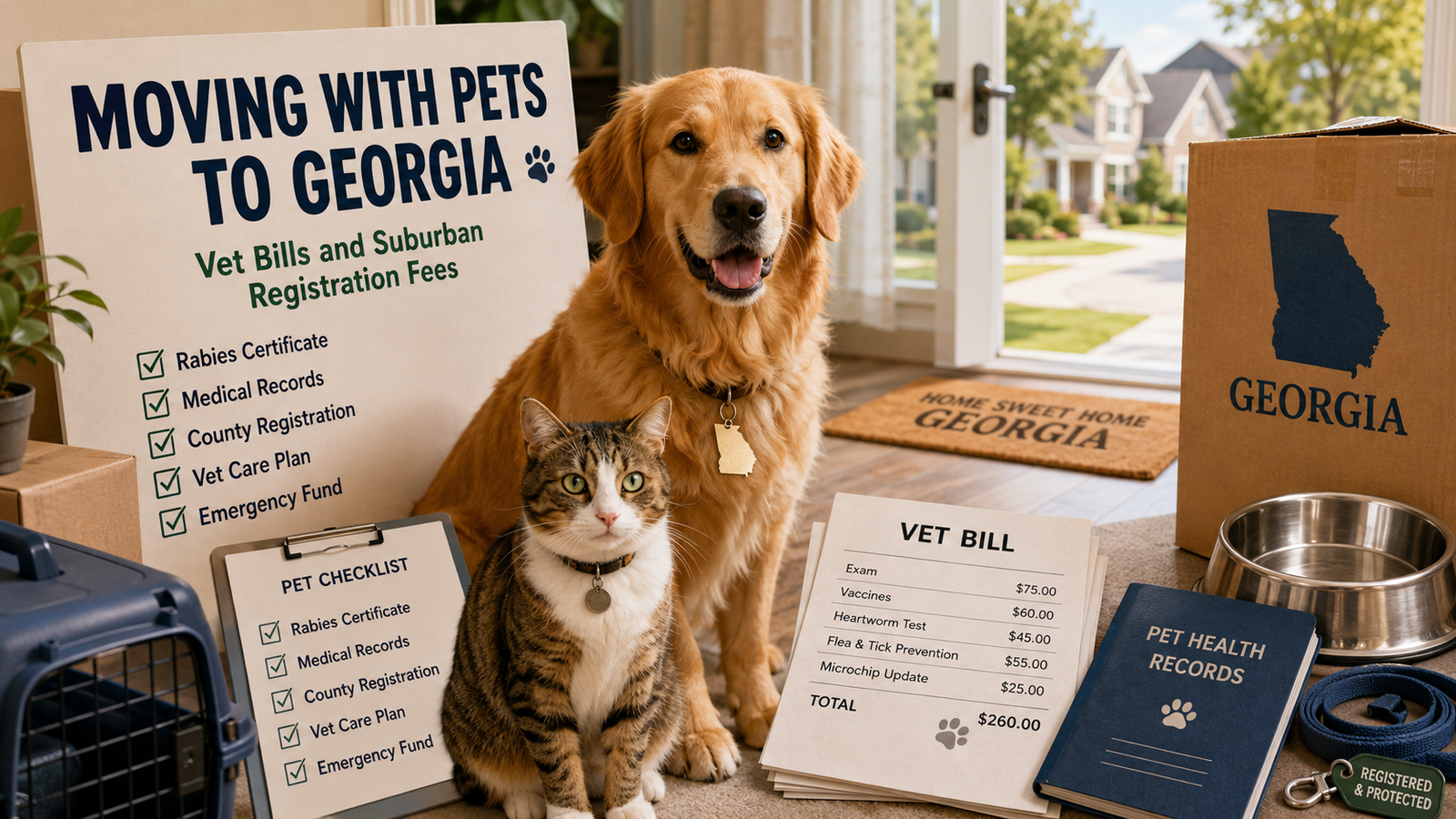
Moving with Pets to Georgia: Vet Bills and Suburban Registration Fees
The cheapest line item may be the county tag. The larger relocation
budget usually comes from veterinary records, vaccines, preventive care,
housing charges, and the first unexpected sick visit after the move.
$10
One-year altered-pet license in Fulton or DeKalb
$25
Three-year altered-pet license with qualifying rabies vaccination
$30
Fulton County Animal Services rabies vaccination example
30 days
A practical window to establish local records and care
Moving with pets to Georgia
requires more than updating a microchip address. Dogs and cats entering
the state must have proof of a current approved rabies vaccination, and
the county where you settle may require a local license or current rabies
tag. The registration charge can be only $10 for a spayed or neutered pet
in Fulton or DeKalb County, but the first veterinary bill may include an
exam, vaccines, testing, medication, and Georgia-specific preventive
planning.
Last reviewed: July 17, 2026.
This guide separates state entry rules, county registration, veterinary
care, and private housing charges. Prices vary by animal, clinic, county,
and service; treat the figures as documented examples, not guaranteed
quotes.
ROUTE 01 • QUICK ANSWER
Moving with Pets to Georgia: What Should You Budget First?
For a healthy adult dog or cat with current records, the county license
may be the smallest cost. Use four separate envelopes: travel records,
local registration, veterinary setup, and emergency capacity.
State entry file
Current rabies certificate, medical history, prescriptions, microchip
information, and any carrier-specific travel documents.
County compliance
A license, registration, or current rabies tag depending on the county
and pet category.
Local veterinary baseline
Exam, overdue vaccines, tests selected by the veterinarian, parasite
prevention, and medication refills.
Housing and emergency reserve
Pet deposits or rent, plus accessible funds or insurance for urgent care.
CareCredit’s national ranges place routine visits at roughly $70–$174
for dogs and $53–$124 for cats before added services. These are not
Atlanta quotes, but they show why the first clinic visit can exceed
registration.
ROUTE 02 • STATE ENTRY FILE
What Georgia Requires Before Your Pet Crosses the State Line
R
Rabies proof for dogs and cats
The Georgia Department of Agriculture says dogs and cats entering
Georgia must have proof of a current approved rabies vaccination.
Its travel FAQ specifies the requirement for dogs and cats twelve
weeks of age or older.
CVI
Do not assume every personal move needs a health certificate
A Certificate of Veterinary Inspection is an official veterinary
examination document. Georgia requires one for animals entering for
sale, trade, or compensation; carriers or international rules may
require one in other situations.
ID
Carry records that identify the actual animal
Bring the rabies certificate, vaccine history, medication list,
recent results, microchip number, and former clinic contact.
A tag photo may be insufficient.
RX
Protect continuity of treatment
Request refills before departure, keep original labels, and ask
whether a new examination is required before prescriptions continue.
International move:
Georgia directs international arrivals to federal CDC and USDA APHIS
requirements. Airline rules, country-of-origin documents, endorsements,
dog-import rules, and timing can be stricter than the state’s domestic
entry summary. Start that process well before booking a flight.
ROUTE 03 • SUBURBAN REGISTRATION
Pet Registration Fees in Atlanta-Area Counties
Local rules are not uniform across metro Atlanta. The address may say
Alpharetta, Atlanta, Chamblee, Lawrenceville, Marietta, or another city
while county government handles some animal-control functions. Confirm
the jurisdiction attached to the exact home rather than relying on a
neighborhood name.
Fulton County
Dogs and cats must be licensed
Altered: $10 for 1 year • $25 for 3 years
Unaltered pets are $25 for one year or $60 for three years.
A three-year license requires a three-year rabies vaccination.
Fulton lists a $10 late fee when a license is more than 60 days overdue.
DeKalb County
Dogs, cats, and ferrets must register
Altered: $10 for 1 year • $25 for 3 years
Unaltered pets are $25 for one year or $60 for three years.
DeKalb says registration is required when moving into the county and
within 60 days of rabies vaccination; a late fee may apply.
Classified dangerous or vicious animal registration is $250.
Gwinnett County
Current rabies tag required for cats and dogs
Verify the current tag process and charge directly
Gwinnett’s official rabies page emphasizes that all cats and dogs,
including indoor pets, must have a current rabies tag. Its public
page does not present the same general pet-license fee table shown
by Fulton and DeKalb, so contact Animal Welfare for the exact current
process.
Cobb, Forsyth, and other suburbs
Do not infer “no fee” from a missing online table
Check county, city, and property-specific rules
Websites organize rabies tags, licenses, dangerous-dog registrations,
and enforcement differently. Ask the animal-services office whether
the pet needs a county license, municipal tag, proof-only compliance,
or a special classification registration.
Keep proof of spay or neuter status available, and do not assume a former
county tag transfers automatically.
ROUTE 04 • VET BILL LEDGER
Why the First Georgia Vet Bill Can Be Larger Than Expected
A new-clinic invoice may combine the examination with vaccines, tests,
preventives, medication, and record review. Ask for an itemized estimate
and clarify what is urgent.
New-patient or wellness exam
Variable
The clinical assessment that may be required before prescriptions,
vaccines, or treatment.
Rabies and core vaccines
Per vaccine or package
Depends on age, prior records, vaccine duration, lifestyle, and
clinic model.
Heartworm or feline testing
Added service
A veterinarian may recommend testing before prevention or based on
history and risk.
Fecal, blood, or urine testing
Added service
Often selected by age, symptoms, travel history, and preventive-care
plan.
Flea, tick, and heartworm prevention
Recurring
Product, species, weight, prescription requirements, and quantity
affect cost.
Microchip registration update
Often low or free
Updating the database is different from implanting a new microchip.
Send records before the appointment and ask what is missing.
The veterinarian must decide whether any vaccine or test should be repeated.
ROUTE 05 • DOCUMENTED LOCAL PRICES
Current and Recent Low-Cost Care Examples Around Atlanta
Low-cost clinics can reduce routine expenses, but may not provide
comprehensive exams, illness treatment, diagnostics, or follow-up care.
Fulton County Animal Services: $30 rabies vaccination
The county page lists $30 rabies vaccinations for Fulton residents
with identification during its stated weekday walk-in window.
Verify hours and availability before traveling.
Atlanta Humane Marietta clinics: $20 vaccines
The organization’s current resource page advertises $20 dog and cat
vaccines, plus microchips and flea prevention at selected clinics.
Appointment dates and services can change.
Atlanta Humane spay/neuter: $150 cats and $225 dogs
The current low-cost program states that necessary vaccinations and a
microchip are included. Eligibility, medical suitability, scheduling,
and additional charges should be confirmed.
Historical local package benchmark:
A Fulton County announcement for a January 2025 LifeLine clinic listed
$55 puppy or kitten packages, $75 basic dog or cat packages, and $105
deluxe packages. Those prices demonstrate how bundled preventive care
can work, but they should not be treated as a current 2026 quote.
ROUTE 06 • GEORGIA HEALTH PLAN
Ask the New Veterinarian About Georgia-Specific Prevention
Rabies and wildlife exposure
Keep rabies proof current and report bites or direct wildlife contact
through the appropriate public-health or animal-control channel.
Heartworm prevention
Discuss year-round heartworm prevention and any testing needed before
starting or changing medication.
Fleas and ticks
Use only flea and tick products appropriate for the pet’s species,
age, weight, and health.
Heat and car safety
Plan water, climate control, and cooler travel times; never leave a pet
in a parked vehicle.
Boarding and daycare rules
Facilities may require Bordetella, canine influenza, fecal testing, or
other records beyond county licensing. Obtain the facility’s written
requirements before move week.
Medication and pharmacy continuity
Transfer prescriptions early, identify a nearby emergency hospital,
and save the poison-control and local bite-reporting contacts before an
urgent situation occurs.
ROUTE 07 • 30-DAY ARRIVAL PLAN
A Practical Timeline After Moving with Pets to Georgia
Before departure
Obtain complete medical and rabies records, refill medication,
photograph identification, update the microchip contact, and confirm
airline or carrier requirements.
Move day
Keep records, medication, food, water, leash, carrier, waste supplies,
and a recent pet photo with you—not in an inaccessible moving truck.
First 72 hours
Secure doors, gates, screens, and fences before giving the pet full
access. Update the microchip address and locate the nearest emergency
veterinary hospital.
First two weeks
Confirm the county’s registration or tag process, register when
required, transfer prescriptions, and schedule a local appointment
if records, vaccines, or preventives need review.
By day 30
Finish the annual care plan, document recurring costs, verify boarding
requirements, and place license, rabies, microchip, insurer, and
emergency information in one household file.
ROUTE 08 • PRIVATE HOUSING COSTS
County Registration Is Not the Same as an Apartment or HOA Pet Fee
Rental charges and restrictions
One-time pet fee or refundable deposit
Monthly pet rent
Breed, weight, number, or species limits
Pet-screening or DNA-waste-program charges
Required vaccination, photo, or insurance records
HOA and neighborhood rules
Leash and nuisance provisions
Fence, enclosure, and common-area restrictions
Limits on livestock, birds, or unusual species
Violation fines separate from county penalties
Dog-park or amenity access rules
A $10 county license does not satisfy a landlord’s pet-screening process,
and an apartment pet fee does not replace county registration. Obtain both
sets of rules before signing. For a full household comparison, place pet
costs beside rent, mortgage, utilities, commuting, and childcare using the
Atlanta suburbs cost guide
and
housing affordability guide
.
Homebuyers should read the actual declaration and rules; even a fenced
yard may have design or kennel restrictions.
ROUTE 09 • FINANCIAL SAFETY NET
Prepare for the Bill That Is Not on the Moving Checklist
An emergency exam is only the entry point; diagnostics, treatment,
hospitalization, and specialty care can raise the total quickly.
Ask about deposits, estimates, and payment methods in advance.
Cash reserve
Keep an accessible pet emergency amount separate from the moving
budget and routine wellness fund.
Pet insurance
Compare waiting periods, exclusions, reimbursement, deductibles,
annual limits, exam-fee coverage, direct-pay options, and
pre-existing-condition rules before purchase.
Clinic financing or payment options
Ask in advance; approval is not guaranteed, and promotional financing
is still debt.
Written treatment estimate
Request the recommended plan, alternatives, urgency, and expected
range without delaying emergency stabilization.
Senior or chronically ill pet
Transfer recent diagnostics, specialist notes, prescription
authorizations, diet information, and monitoring schedule before the move.
Anxious traveler
Discuss travel medication and trial dosing with the current veterinarian
early. Do not improvise with human medication or a first dose on
departure day.
Multiple pets
Calculate every fee per animal. County licenses, deposits, pet rent,
vaccines, preventives, and boarding can multiply rather than bundle.
ROUTE 10 • MOVE-IN CHECKLIST
Georgia Pet Relocation Checklist
✓
Current rabies certificate with vaccine date, duration, product,
veterinarian, and pet identity
✓
Complete medical records and recent diagnostic results sent to the
new clinic
✓
Medication supply, written prescriptions where appropriate, and
original labels
✓
Microchip database updated with new address, phone number, and backup
contact
✓
County and city animal-control requirements confirmed for the exact
address
✓
Landlord, apartment, HOA, and insurance pet rules reviewed in writing
✓
Local primary-care veterinarian and emergency hospital selected
✓
First-month routine-care fund and separate emergency strategy
established
✓
Boarding, daycare, groomer, and dog-park vaccine requirements checked
before use
ROUTE 11 • FAQ
Moving with Pets to Georgia: Frequently Asked Questions
Does Georgia require a health certificate for my dog or cat?
Georgia requires current approved rabies proof for dogs and cats
entering the state. A CVI is required in certain circumstances,
including animals entering for sale, trade, or compensation, while
carriers, destinations, and international travel can impose additional
rules. Confirm the exact trip with the Georgia Department of
Agriculture and the carrier.
How much is a pet license in Fulton County?
Fulton lists $10 for a one-year license or $25 for a three-year
license for a spayed or neutered dog or cat. Unaltered rates are
$25 and $60. The three-year option requires a qualifying three-year
rabies vaccination.
How much is DeKalb County pet registration?
DeKalb publishes the same $10/$25 altered-pet and $25/$60
unaltered-pet schedule for one- and three-year registration.
Dogs, cats, and ferrets must register, and a $10 late fee may apply
after the stated deadline.
Does an indoor cat need rabies documentation?
Do not assume indoor status creates an exemption. Georgia requires
current approved rabies proof for cats entering the state, and local
pages such as Gwinnett’s explicitly include indoor pets in the
current-rabies guidance.
What is the cheapest way to establish veterinary care?
Start with complete records, ask for an itemized estimate, compare
nonprofit or county preventive clinics with full-service hospitals,
and avoid duplicating services when valid documentation exists.
Low-cost vaccine clinics may not replace a comprehensive exam or
sick-care relationship.
Should I buy pet insurance before or after moving?
Compare policies before the move when possible because waiting periods
and pre-existing-condition rules matter. Insurance is not the same as
a wellness plan and may reimburse after payment rather than paying the
clinic directly.
Make the Pet Move a Records Project Before It Becomes a Medical Emergency
Moving with pets to Georgia
is easiest when rabies proof, medical history, prescriptions, microchip
data, county registration, and housing rules are resolved as separate
tasks. Fulton and DeKalb’s basic altered-pet licenses are inexpensive,
but they do not represent the full cost of establishing care.
Build a first-month veterinary allowance, verify low-cost options without
assuming they provide full-service care, and maintain an emergency plan
that survives the rest of the moving budget. The best arrival outcome is
not merely a completed tag—it is a pet whose identity, prevention,
treatment, housing, and emergency contacts continue without interruption.
Use the Final Pet-Move Check: if the registration fee disappeared from the comparison, could you still explain the move from rabies records, veterinary continuity, housing rules, recurring prevention, and emergency capacity?