Last reviewed: June 2026. Trash rates, recycling rules, sanitation billing, cart fees, private hauler contracts, yard waste policies, bulk pickup rules, and city or county service areas can change. Always verify current information directly with your city, county, HOA, landlord, property manager, private hauler, or local sanitation office before signing a housing contract or starting service.
When you move to Georgia, your monthly housing budget is not just rent or mortgage. Small local services like Georgia trash and recycling costs represent a distinct operational layer that varies significantly from house to house. While families mapping out a cross-country relocation frequently focus on macro variables like county property tax rates, school board districts, and broad cost-of-living index numbers, the micro infrastructure of regional waste management routinely introduces unexpected variations into the first-month relocation budget.
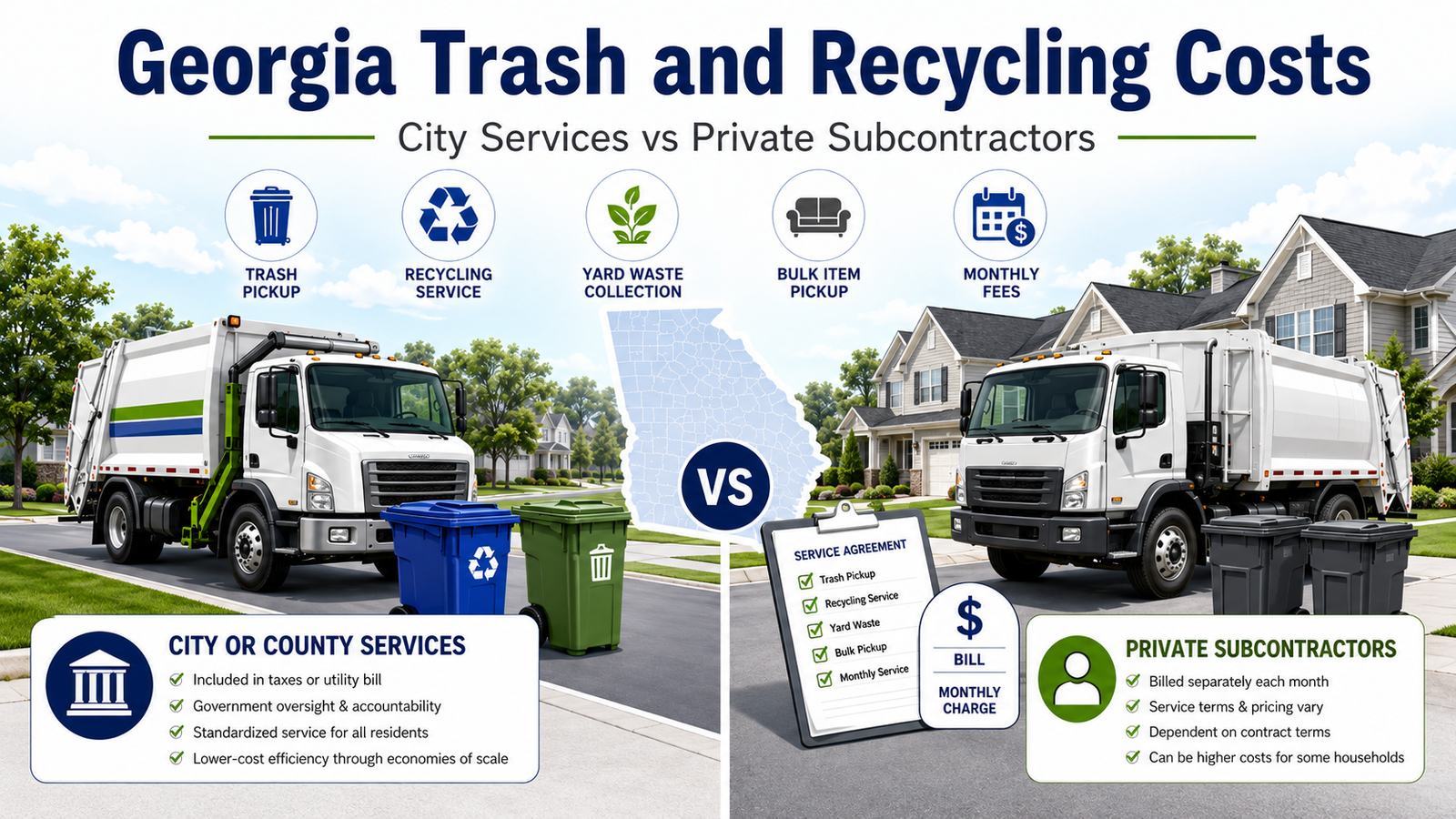
Some Georgia residents receive trash and recycling through a city or county sanitation department. Others must choose a private hauler. Some neighborhoods have HOA-negotiated contracts. Some cities use private subcontractors behind the scenes while residents still experience the service as “city trash pickup.” In other places, the city does not provide residential trash collection at all, leaving residents to contract directly with private waste providers.
This guide explains how Georgia trash and recycling costs work, why city services and private subcontractors can produce different bills, what hidden fees new movers should ask about, and how to compare sanitation costs before choosing a home. The goal is not to provide one statewide trash rate, because Georgia does not operate under one statewide residential sanitation price. Instead, this article gives you a practical framework for understanding the cost structure before move-in.
Quick Insider Summary
- City service model: A city or county may bill residents directly or include sanitation charges through a municipal billing system.
- Private hauler model: Residents may contract directly with a private trash company, especially in cities that do not provide municipal collection.
- HOA model: Some communities bundle trash and recycling into HOA dues, which can hide the true monthly cost.
- Hidden costs: Extra carts, bulk pickup, yard waste, recycling contamination, fuel surcharges, late fees, and missed-cart penalties can change the real cost.
- Best move: Ask whether trash, recycling, yard waste, bulk pickup, and cart replacement are included before signing a lease or purchase contract.
Why Trash and Recycling Costs Vary So Much in Georgia
The biggest reason Georgia trash and recycling costs vary is that sanitation is usually a local service. Electric service may be tied to a utility territory, natural gas may involve certified marketers in some areas, and water is usually handled by a city or county. Trash collection is even more fragmented. Depending on your address, sanitation may be handled by a city department, county department, private hauler, HOA vendor, or municipal contractor.
This is why two homes that are only ten minutes apart can have different trash systems. One homeowner may receive a city bill for sanitation. Another may pay a private hauler quarterly. A renter may never see a trash bill because the landlord includes it in rent. A homeowner in an HOA may pay through association dues. A resident in an unincorporated area may have a county-managed system or may need to select a private company.
For a realistic Georgia move-in budget, trash and recycling should be reviewed together with hidden utility setup fees in Georgia, broad Atlanta suburbs cost comparisons, homeowners insurance, property taxes, HOA dues, and your trailing Georgia tag program and car registration costs.
Georgia Trash Service Models at a Glance
| Service Model | How It Usually Works | What to Watch |
|---|---|---|
| City sanitation | City provides or manages residential collection and bills residents through a municipal system. | Annual fees, cart rules, bulk pickup charges, special collection fees. |
| County sanitation | County manages service, assigns haulers, or bills eligible residents by service area. | Service area boundaries, collection day, recycling opt-in, cart limits. |
| Private hauler | Resident contracts directly with a private waste company. | Monthly/quarterly rate, fuel fee, cancellation fee, cart rental, missed pickup policy. |
| HOA contract | Association negotiates a neighborhood-wide contract and includes cost in dues. | Whether recycling, yard waste, bulk pickup, and extra carts are included. |
| Hybrid contractor model | City or county manages the program but contracts collection to a private company. | Who handles billing, missed pickup complaints, and service changes. |
City Services: Predictable but Not Always Cheaper
City or county trash service can feel easier because residents usually do not need to shop for a provider. The government or sanitation department defines the service area, cart rules, collection schedule, billing process, recycling rules, and bulk pickup policy. For new residents, this can reduce confusion because there is one official place to ask questions.
The City of Atlanta, for example, operates the Office of Solid Waste Services under its Department of Public Works. Its residential service frameworks outline weekly collection parameters and city-provided roll carts for eligible residential properties. Atlanta also coordinates separate solid waste billing platforms through the official ATL311 Solid Waste Portal, which details how solid waste service fees are structured and where residents can process payments.
The DeKalb County Sanitation Division offers another example of a government-operated sanitation structure. It describes itself as a self-sustaining enterprise fund operation serving unincorporated DeKalb County and several cities, including Brookhaven, Decatur, Dunwoody, Lithonia, Pine Lake, Stonecrest, Stone Mountain, and Tucker. That structure is different from a city where each household independently selects a private hauler.
The advantage of city or county service is predictability. The disadvantage is that residents may have less flexibility. You may not be able to choose a cheaper hauler, negotiate a different collection frequency, or avoid certain fixed sanitation charges. You also need to understand whether the fee is billed monthly, quarterly, annually, through the tax commissioner, through a utility bill, or through a separate sanitation account.
Private Subcontractors: Flexible but Easier to Misprice
Private trash service can be convenient, but it requires more comparison. In affluent northern communities covered under our Alpharetta relocation guide and specialized Johns Creek relocation breakdown, corporate professionals often discover a completely decentralized marketplace. For example, Sandy Springs Garbage & Recycling notes that the city does not provide direct trash collection services, requiring residents and businesses to contract directly with private waste collection providers. That means the resident must check prices, service days, recycling availability, yard waste policy, cart rental, cancellation terms, and customer service reputation.
Private service may look cheaper at first because the advertised monthly price can be clear and simple. But the real cost may include add-ons: administrative fees, fuel or environmental surcharges, extra cart charges, recycling fees, yard waste subscriptions, bulk pickup charges, seasonal cleanup fees, and late payment penalties. Some private companies bill monthly, while others bill quarterly or annually. A low monthly price can feel less attractive if the first bill includes cart delivery, setup, or prepaid service.
Private hauler areas are also more sensitive to neighborhood logistics. A provider may serve one subdivision but not another. A rural or low-density area may have fewer choices. A private hauler may offer recycling in one ZIP code and trash-only service in another. Before choosing a home, ask the seller, landlord, or HOA who currently provides trash and recycling and whether the service is optional or mandatory.
Gwinnett County: County-Managed Service with Assigned Haulers
Gwinnett County is a useful example because it shows how a county-managed system can still involve haulers. The county’s official Gwinnett Solid Waste Management Authority residential framework explains that the base service includes weekly pickup of one 95-gallon trash cart and one 65-gallon recycling cart. It also includes pickup of bulky items and white goods when scheduled in advance with the hauler.
For residents moving to Lawrenceville, Suwanee, Duluth, Peachtree Corners, or other Gwinnett communities, this kind of structure can be easier than shopping for a private hauler. But residents still need to understand which hauler serves the property, what day collection occurs, how missed pickups are reported, and what items require advance scheduling.
If you are comparing Gwinnett neighborhoods, pair this sanitation review with our Gwinnett County suburbs profile. Local service structure can matter just as much as commute time, school district, property tax, and housing cost.
What Is Actually Included in the Trash Bill?
The most important question is not simply “How much is trash pickup?” The better question is “What is included in the fee?” A low trash bill may include only one cart of weekly household waste. A higher bill may include recycling, yard waste, bulk pickup, appliance pickup, white goods, and a customer service call center. Some city services include more than a private basic plan, while some private plans offer premium add-ons that a city service does not provide.
| Fee Component | Questions to Ask |
|---|---|
| Trash cart | Is one cart included? What size? What does an extra cart cost? |
| Recycling cart | Is recycling included, optional, or charged separately? |
| Yard waste | Is it included weekly, seasonal, separate, or not offered? |
| Bulk pickup | How many items are included? Is scheduling required? |
| Appliances and white goods | Are refrigerators, freezers, or freon-containing items extra? |
| Administrative fees | Are there fuel, environmental, franchise, or billing fees? |
Hidden Trash and Recycling Costs New Movers Miss
- Cart delivery fee: A provider may charge for delivering or replacing a trash or recycling cart.
- Extra cart fee: Large households may need a second trash cart, which may cost more.
- Bulk pickup fee: Furniture, mattresses, appliances, and large items may need special scheduling.
- Yard waste fee: Leaves, branches, grass clippings, and storm debris may not be included in basic service.
- Recycling fee: Some plans include recycling, while others charge separately or require opt-in.
- Contamination issue: Incorrect recycling may result in rejected pickup or warnings.
- Late fee: Private haulers may charge late fees or pause service for unpaid balances.
- Cancellation fee: Some contracts may require notice before termination.
- Fuel or environmental surcharge: Private bills may include extra line items beyond the base rate.
- HOA pass-through: Trash may be embedded in HOA dues, making the real cost less visible.
City Services vs Private Haulers: Which Is Better?
There is no universal winner. City service is often easier because residents have one official system, one schedule, and one complaint path. It can be especially helpful for people who do not want to compare multiple haulers after moving. But city service may not always be the cheapest, and residents may have limited flexibility.
Private service may offer more choice. You may be able to compare price, cart size, pickup frequency, customer reviews, recycling options, and cancellation terms. Private service can be a better fit for residents who want flexibility or who live in cities that do not provide municipal trash collection. But it can also be more confusing because the advertised price may not include every fee.
HOA service can be convenient because the association handles the vendor relationship. But buyers should review HOA documents carefully. Ask whether trash is included, whether recycling is included, whether bulk pickup is allowed, whether missed pickups go through the HOA or the hauler, and whether future contract increases can raise dues.
New Mover Warning
Do not compare trash services by the monthly base price alone. Ask what happens when you need a second cart, miss a payment, schedule a bulk pickup, dispose of yard debris, change providers, or move out before the billing period ends.
Sample Monthly Trash and Recycling Budget
Because Georgia sanitation costs vary by city, county, HOA, and private hauler, the safest approach is to build a planning range rather than assume one number. Use this table to compare your actual options before move-in.
| Budget Item | Typical Cost Behavior | Planning Question |
|---|---|---|
| Base trash service | May be billed monthly, quarterly, annually, or through HOA dues. | Who bills you and how often? |
| Recycling | May be included, optional, or unavailable. | Is recycling included in the base fee? |
| Yard waste | May be included, seasonal, or separately billed. | Does the home have a large yard or trees? |
| Bulk pickup | Often requires scheduling and may have item limits. | What happens when you dispose of furniture? |
| Move-in cleanup | May require extra bags, special pickup, or a dump run. | Will your first month generate more trash than normal? |
Questions to Ask Before Signing a Lease or Purchase Contract
- Is trash collection provided by the city, county, HOA, or a private company?
- Is recycling included, optional, or unavailable?
- Are trash and recycling billed separately from water, sewer, and utilities?
- Is the fee paid monthly, quarterly, annually, through taxes, or through HOA dues?
- Is yard waste included?
- Are bulk items included or billed separately?
- How many carts are included?
- What is the fee for extra carts or replacement carts?
- Who handles missed pickup complaints?
- Is there a cancellation fee or minimum contract period?
- Are fuel, environmental, franchise, or administrative fees added?
- Does the seller, landlord, or HOA have recent sanitation bills you can review?
How Renters Should Compare Trash Costs
Renters should be careful because trash fees can be hidden inside rent, billed separately by the landlord, passed through as a utility reimbursement, or handled directly by a private hauler. Before signing a lease, ask whether trash, recycling, pest control, lawn care, water, sewer, and stormwater are included. If the property manager says “utilities are separate,” ask for a written list.
Apartment residents should also ask about valet trash. Some apartment communities charge mandatory valet trash or doorstep collection fees. This may be convenient, but it is not the same as standard curbside municipal service. Ask whether recycling is available and whether valet trash is optional or mandatory.
How Homebuyers Should Compare Trash Costs
Homebuyers should ask the seller or listing agent for recent sanitation bills, HOA documents, and city or county service information. A beautiful home with a low mortgage payment may still have HOA dues that include trash service, separate yard waste costs, and strict bulk pickup rules. A home in an unincorporated area may require private hauler selection, while a nearby city home may have a municipal sanitation fee.
When comparing homes, sanitation cost should be reviewed together with your broad calculations for long-term housing affordability, property taxes, homeowners insurance, commute cost, and utility setup charges. Trash service alone will not decide whether a home is affordable, but it is part of the monthly ownership picture.
Frequently Asked Questions
Does every Georgia city provide trash pickup?
No. Some cities provide or manage trash service, while others require residents to contract directly with private waste collection providers. Always verify the service model by exact address.
Is recycling included in Georgia trash service?
It depends on the city, county, HOA, or private hauler. Some systems include recycling, some require opt-in, and some private plans may charge separately.
Are bulk items included?
Sometimes. Some local systems include scheduled bulk pickup, while others charge extra or limit the number of items. Appliances, mattresses, furniture, and freon-containing items may have special rules.
Why does my neighbor pay a different trash fee?
Your neighbor may be in a different city, HOA, service district, or hauler territory. Billing frequency and included services can also differ.
Should I choose the cheapest private hauler?
Not always. Compare cart size, recycling, yard waste, customer service, missed pickup policy, cancellation terms, and extra fees before choosing a provider.
Final Takeaway
Georgia trash and recycling costs depend heavily on where you live and how your local service is structured. City services may offer predictability, county systems may include assigned haulers, private providers may offer flexibility, and HOA contracts may hide the true cost inside monthly dues.
The key is to compare the full service package, not just the base price. Ask whether trash, recycling, yard waste, bulk pickup, extra carts, cart replacement, administrative fees, and cancellation terms are included. Then compare sanitation costs with your full Georgia cost-of-living budget.
For new residents moving to Atlanta suburbs, trash and recycling are not the largest household expense. But they are exactly the kind of small recurring cost that can make a budget feel less predictable when ignored. A few questions before move-in can prevent billing surprises later.
🔗 Related Georgia Cost of Living Guides
Use these guides to build a complete Georgia move-in budget:
➔ Hidden Utility Setup Fees in Georgia: Electric, Gas, and Water Costs Explained➔ Georgia State Income Tax vs California: True Take-Home Pay Simulator➔ Atlanta Suburbs Cost: Smart 4-County Comparison➔ Moving to Georgia with a Car? The Hidden Tag & TAVT Cost➔ Gwinnett County Suburbs and Local Living Infrastructure➔ Best Atlanta Suburbs for Families: 2026 Relocation Guide
Data and Editorial Note
This article is an editorial relocation and cost-of-living guide, not legal, tax, utility-billing, municipal-code, HOA, or consumer-rights advice. Trash rates, recycling rules, sanitation billing, cart fees, private hauler contracts, yard waste policies, bulk pickup rules, and city or county service areas can change. Always verify current information directly with your city, county, HOA, landlord, property manager, private hauler, or local sanitation office before signing a housing contract or starting service.