Elementary School
Compare grade-level Language Arts, Mathematics, Science, and Social Studies expectations. Ask where the class is in the current unit and whether the student missed a prerequisite taught earlier in the year.
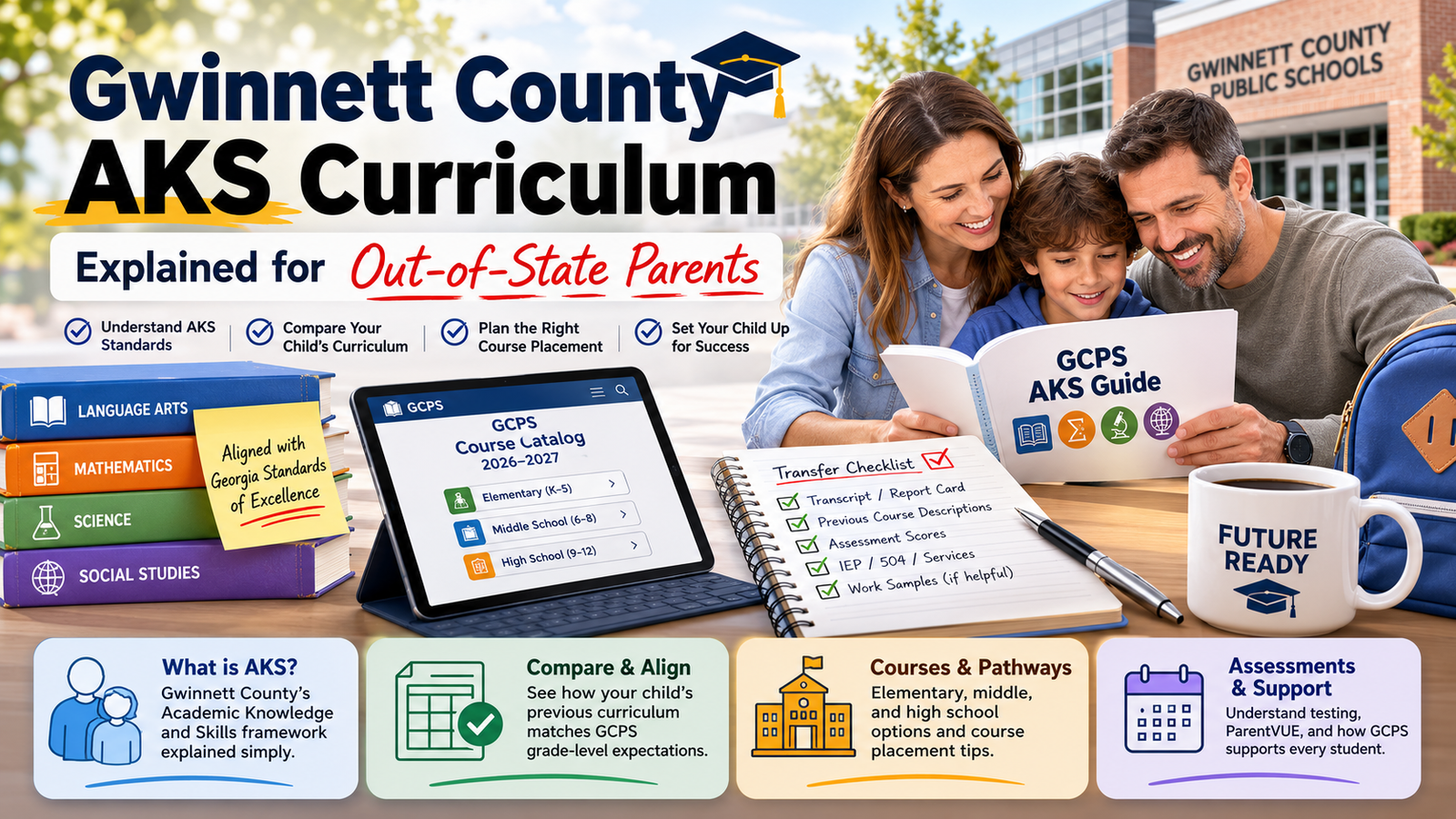
Families arriving from another state often recognize the school subjects but not the sequence, terminology, pace, or course-placement process. This guide explains how Gwinnett County Public Schools uses Academic Knowledge and Skills—and how to compare that framework with the curriculum your student is leaving.
Gwinnett County AKS curriculum is one of the first academic systems out-of-state parents should understand before enrolling a child in Gwinnett County Public Schools. AKS stands for Academic Knowledge and Skills, the district framework that describes what students are expected to know and be able to do in each grade, subject, or course. Last reviewed: July 14, 2026.
This guide explains how the Gwinnett County AKS curriculum works, how it relates to Georgia standards, how families can compare previous coursework, and what to ask about grade or course placement. The useful question is not simply, “Is Gwinnett ahead or behind?” It is: Which skills has my child already learned, which expectations come next, and which placement creates the smoothest academic transition?
GCPS uses the term Academic Knowledge and Skills for the learning expectations attached to a grade level, subject, or course. Teachers build lessons, assignments, discussions, projects, intervention, and enrichment around those expectations.
AKS is not a single textbook.
It is also not a school ranking, a daily teaching calendar, a guarantee that every classroom covers material on exactly the same date, or a complete description of the support an individual student will receive.
Students can work toward the same AKS through different texts, examples, projects, accommodations, intervention, and enrichment.
This distinction matters for relocation families. A student may have used a different textbook or course name while mastering comparable skills. Conversely, a familiar course title can conceal differences in sequence, prerequisite knowledge, writing demands, mathematical depth, or assessment.
Georgia establishes statewide academic standards. GCPS aligns its AKS with those state expectations and organizes them into district grade-level and course frameworks. Individual schools create schedules and offer courses, while teachers turn the framework into daily instruction.
Course titles alone are therefore insufficient. “Grade 7 Math,” “Advanced Math,” “Biology,” or “English 10” may overlap with a prior course but differ in pacing, sequence, prerequisites, academic vocabulary, and expected depth.
Georgia fully implemented its revised K–12 Language Arts standards during the 2025–26 school year, alongside revised assessments. GCPS reflected those state changes in updated AKS materials. Families should use the current 2026–27 GCPS Course Catalog rather than relying on a brochure or course outline from an earlier school year.
Begin with the school year, grade or course title, and course description. Understand the overall shape of the course before reviewing every individual standard.
Standards and course sequences can change. Confirm that the material belongs to the current school year and matches the proposed course—not merely a similarly named class.
A course description identifies major concepts and progression. A math course may emphasize proportional reasoning, equations, geometry, and statistics. Language Arts may combine reading, writing, speaking, listening, and language use.
Words such as identify, explain, compare, analyze, construct, justify, model, evaluate, and revise indicate expected depth. Recognizing a fact and using evidence to defend a conclusion are not equivalent tasks.
Create three categories: already mastered, partially familiar, and not yet taught. Share those specific notes with the teacher or counselor rather than asking whether the entire curriculum is ahead or behind.
The GCPS catalog is a districtwide reference. A course appearing in the catalog does not guarantee that every school offers it during every year or scheduling period. Verify availability with the assigned school before making relocation or academic-pathway assumptions.
Compare grade-level Language Arts, Mathematics, Science, and Social Studies expectations. Ask where the class is in the current unit and whether the student missed a prerequisite taught earlier in the year.
Placement and pathways become more important. Compare standard, advanced, accelerated, enrichment, world-language, and high-school-credit options by content and prerequisite—not by label alone.
Transcript treatment, credit value, sequence, graduation requirements, and access to the next course all matter. Content similarity is only one part of placement.
An elementary student transferring in January may have covered similar annual standards in a different order. The immediate issue may be one missed unit, not general readiness. Ask which prerequisite skills the current unit assumes and whether focused practice is available.
Middle school placement can influence later mathematics, science, world-language, and high-school-credit opportunities. Bring previous course descriptions and evidence of completed work. Terms such as honors, advanced, accelerated, and gifted do not necessarily mean the same thing in every state.
High school families should request a course-by-course review of the incoming transcript. Ask how previous credits will be recorded, which graduation requirements remain, and whether the proposed schedule preserves access to the next course. The question is not only, “Did my child take chemistry?” It is also, “How will that course appear in GCPS records, and what course does it unlock next?”
Two courses may share a title while expecting different levels of analysis, writing, mathematical modeling, laboratory work, or independent reading.
A student may have completed material GCPS schedules later while missing a skill Gwinnett classes addressed earlier in the year.
Advanced placement may depend on prerequisites, local procedures, records, assessment evidence, or available course sections—not solely on the previous course title.
Gifted services, advanced content, enrichment, multilingual-learner support, special education services, and intervention may use unfamiliar names or eligibility processes.
A mismatch does not prove that one state is universally ahead. Alignment can vary by subject, strand, and unit. A student may be ahead in one area, aligned in another, and missing a prerequisite in a third.
GCPS provides an online registration process for new students. Enrollment records establish eligibility and student history, but academic-placement discussions are more productive when families also supply clear evidence of previous learning.
DOCUMENT CHECK — ACADEMIC PLACEMENT FILE
Documentation does not guarantee a particular placement. It gives the school a stronger basis for evaluating course equivalency, current readiness, support needs, and the next academic step. If your student carries an IEP or Section 504 plan, review the special education services comparison for Fulton and Gwinnett alongside this checklist, since service names and eligibility processes can differ between districts.
Begin with the official GCPS New Student Enrollment page and use the district’s official address-based school locator before relying on a home listing, subdivision name, or third-party school website. For broader relocation context, review the Atlanta suburbs school-district guide .
GCPS explains that district assessments are aligned with AKS and district instructional calendars in Language Arts, Mathematics, Science, and Social Studies. Schools use classroom and district evidence to understand student progress and identify possible support or extension.
An assessment score is not the curriculum itself. A low early result may reflect a skill gap, unfamiliar question format, different sequencing, language demands, incomplete previous instruction, or adjustment to a new school.
Use ParentVUE to review schedules, assignments, grades, report cards, transcripts, and course history. Patterns across several assignments are generally more useful than reacting to a single early score.
Week 1 — Confirm the academic route.
Verify exact course names, teacher contacts, schedule, digital access, and the applicable AKS materials for each core subject.
Week 2 — Look for repetition and missing prerequisites.
Ask what feels familiar, completely new, or confusing because the class assumes prior knowledge.
Week 3 — Review actual classroom evidence.
Check assignments, teacher comments, quizzes, reading demands, work completion, and pacing—not only the overall average.
Week 4 — Hold a focused conversation.
Discuss one subject at a time. Bring specific examples and ask whether the issue calls for short-term practice, intervention, enrichment, or a formal placement review.
Do not wait an entire semester when a mismatch is serious. At the same time, changing a course after one difficult assignment can create a different gap. The strongest conversation combines prior records, current AKS expectations, and evidence from the new classroom.
Families researching advanced pathways can also review the Georgia gifted and talented program guide . Families considering language pathways can use the GCPS dual-language immersion guide .
Subject: AKS alignment question for a new transfer student
Student: [Name, grade, and course]
Hello [Teacher or Counselor Name],
Our student recently transferred from [state or district]. We reviewed the current GCPS AKS for [grade or course] and would like to understand how the previous curriculum aligns with the class’s current unit.
The student has previously completed [specific topic or course], but may not have covered [specific skill or unit]. Could you let us know which prerequisite skills are most important right now and what evidence we should review during the next few weeks?
We can provide the previous course description, report card, transcript, assessment results, or work samples if helpful. Thank you for supporting a smooth transition.
Sincerely,
[Parent or Guardian Name]
AKS stands for Academic Knowledge and Skills. It’s GCPS’s framework describing what students should know and be able to do at each grade, subject, or course, aligned with Georgia’s state standards—not a single textbook, a school ranking, or a shared daily teaching calendar.
Not necessarily. This guide’s four common mismatches show that a shared course title can still differ in depth, sequence, pathway rules, or the terminology used for support and enrichment services.
The academic placement file in this guide lists eight items worth gathering: the latest report card or transcript, previous course descriptions or syllabi, recent assessment results, work samples, IEP/504 records, gifted or advanced documentation, English-language service records, and a one-page parent summary.
Use the first-30-days approach in this guide: confirm the academic route in week one, look for gaps in week two, review actual classroom evidence in week three, and hold a focused conversation in week four. Don’t wait a full semester if a mismatch looks serious, but don’t react to one difficult assignment either.
ParentVUE shows schedules, assignments, grades, report cards, transcripts, and course history. GCPS’s District Assessments and Test Dates pages explain how district assessments align with AKS and when they’re scheduled.
No. Documentation gives the school a stronger basis for evaluating course equivalency, current readiness, and support needs, but it doesn’t guarantee a particular course, level, or program placement.
A useful curriculum comparison identifies what the student has mastered, what the new class expects, where sequencing differs, and which support or placement allows continued progress.
Treat the Gwinnett County AKS curriculum as a map rather than a verdict. Combine current standards with the previous transcript, actual student work, teacher feedback, and classroom evidence from the first month. That approach produces a more accurate placement conversation than comparing school reputations or state labels alone. Use the Placement Evidence Check: if the familiar course title disappeared, could you still justify placement from standards, prerequisites, prior work, transcript evidence, and current classroom performance?