Metro Atlanta Relocation JournalIndependent decision guides built around the address, commute, school path and monthly household cost.
ATL Local Insider • Employer-State Exposure File
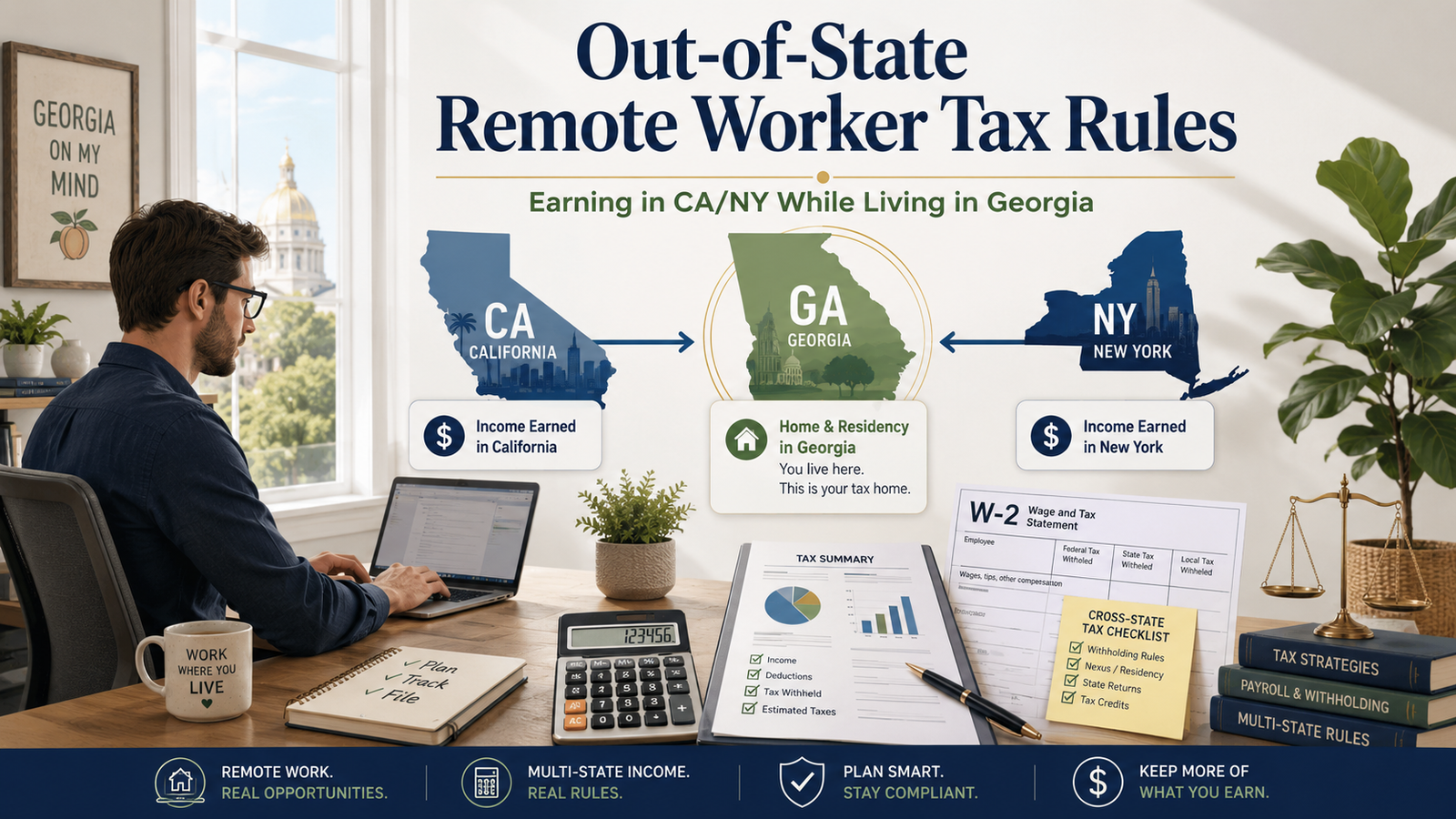
Out-of-State Remote Worker Tax Rules: California vs New York for Georgia Residents
A Georgia home address does not answer every remote-work tax question. The useful file connects Georgia residency, the employer’s assigned office, physical workdays, payroll coding, compensation type, other-state tax exposure, and the records needed to explain the final return.
Last reviewed: June 2026
Do not start with the employer’s headquarters. Start with the worker. Where is the worker a resident? What office is the employee assigned to? Where are services actually performed? What does payroll report? What income was earned over more than one state or period? California and New York can produce different answers to those questions.
File 01
Residence
Establish when Georgia became the worker’s home state.
File 02
Assigned Office
Record the employer’s official primary or assigned work location.
File 03
Workdays
Track where services are actually performed throughout the year.
File 04
Payroll
Compare HR coding, withholding, and W-2 state wage reporting.
File 05
Income Type
Separate wages, bonuses, commissions, equity, and business income.
Keep the documents supporting the household’s final tax position.
Employer-State Exposure File
Start With Georgia as the Home State
For a household that has established Georgia residency, Georgia becomes the starting point for the resident income-tax file.
The fact that an employer is headquartered in California or New York does not by itself determine the complete state-tax result.
Residence
Where does the worker live?
Document when Georgia became the worker’s residence and whether the tax year is full-year or part-year.
Other State
Why might another state still tax the income?
Workdays, an assigned office, property, business activity, or compensation earned across multiple periods can preserve another state’s connection.
Return
How many state filings may be needed?
A Georgia resident may still need a nonresident or part-year return elsewhere when that state has taxable source income.
The goal is not to avoid another state’s withholding simply because the worker moved. The goal is to determine whether that state actually has taxable income and then make payroll and filing records match the facts as closely as possible.
Do Not Treat California and New York the Same
California and New York create different remote-worker problems.
California File
Source of the Income
For a California nonresident employee, the work-location question focuses heavily on whether services were physically performed in California.
Deferred or equity-based compensation can require a separate allocation because part of the earning period may relate to prior California services.
New York File
Assigned Office + Convenience Rule
For a nonresident whose assigned or primary office remains in New York, telework from Georgia can require a different analysis under New York’s convenience-of-the-employer framework.
The employee therefore needs to know not only where the work occurred, but how the employer officially structured the work location.
Same Georgia home office, different state analysis.
A Georgia resident working for a California employer and a Georgia resident working for a New York employer should not assume the same remote-work sourcing rule applies to both paychecks.
California Employer: Follow the Source of the Income
A California employer does not automatically make every post-move paycheck California-source income.
For an employee who is a California nonresident, California’s current guidance generally looks to services performed in California when determining California-source wages.
Step 01
Confirm nonresident or part-year status.
The relocation year may contain one period when the worker was a California resident and another period when the worker was a nonresident.
Step 02
Track California workdays after the move.
Business trips, training, office visits, client meetings, and other services physically performed in California should be documented.
Step 03
Separate ordinary wages from deferred compensation.
An ordinary post-move wage stream can have a different sourcing analysis from compensation earned across a longer service period.
Step 04
Review equity compensation separately.
RSUs, restricted stock, and stock options can retain a California-source component when the relevant service period included California work.
This is why a vesting event after the move does not necessarily mean the entire award belongs only to Georgia.
Use the Georgia State Income Tax vs California guide for the broader California-to-Georgia transition. This article focuses on the continuing employer-state exposure after the worker is based in Georgia.
New York Employer: Check the Assigned Office First
New York requires a different starting question:
Where is the employee’s assigned or primary office?
For a New York nonresident whose assigned or primary office remains in New York State, New York’s current telecommuting guidance can treat normal workdays at an out-of-state home office as New York workdays unless the home office qualifies under the state’s bona fide employer-office framework.
Office
Assigned or primary location
Record the work location the employer officially assigns to the employee rather than relying only on the employee’s mailing address.
Employer Need
Why is the work performed outside New York?
Employer requirements and the structure of the remote position can matter when reviewing New York’s allocation rules.
Home Office
Is it an employer office?
New York applies specific factors when evaluating whether an out-of-state home office qualifies as a bona fide employer office.
A Georgia address alone does not resolve the New York issue.
If the employer still assigns the employee to a New York office, obtain the telework agreement, office assignment, HR records, and payroll treatment before assuming the Georgia home office removes New York wage exposure.
Make Payroll Part of the Tax File
Payroll does not decide tax law, but payroll records can create a major practical problem when they do not match the employee’s actual arrangement.
HR Record
Where does the employer say you work?
Confirm whether the system shows Georgia, California, New York, or another primary work state.
Withholding
Which state taxes are coming out?
Review post-move pay stubs rather than waiting until the W-2 arrives.
W-2
Do the state wage boxes fit the work file?
Unexpected California or New York wages should be reviewed early with payroll and the tax professional.
Save remote-work approvals, HR location changes, offer letters, office assignments, telework agreements, payroll screenshots, and any correspondence explaining why the employer coded the position in a particular state.
Separate Wages, Equity and Contractor Income
The same worker can have several income streams with different sourcing questions.
Mobile: swipe horizontally to review the complete income file.
Income Type
Main Question
California Issue
New York Issue
Regular W-2 wages
Where and under what office assignment were services performed?
California workdays can create California-source wages.
Assigned office and convenience rules may affect allocation.
Bonus
What service or performance period produced it?
A pre-move or California service period may matter.
Review the employment and allocation period.
RSUs / restricted stock
What service period is attached to the award?
California allocation can apply when the service period included California work.
Review New York nonresident compensation rules with the tax professional.
Stock options
When granted, earned, exercised, and where were services performed?
California provides separate equity-based compensation guidance.
Separate New York equity sourcing review may be required.
1099 / sole proprietor income
How does each state source business or service income?
For California, current guidance for independent contractors can look to where the customer receives the benefit of the service rather than simply where the contractor sits.
Business-income sourcing is different from the employee wage analysis and requires separate review.
Do not apply a W-2 remote-employee rule automatically to a 1099 contractor. Employee wages and business or independent-contractor income can use different sourcing frameworks.
Check Georgia’s Other-State Tax Credit
Paying tax to another state does not always mean the household simply pays both state liabilities with no relief.
Georgia provides an Other States Tax Credit framework for qualifying income that is taxable to Georgia and another state.
Same Income
Is the income taxable in both states?
The credit analysis starts by identifying the income that overlaps between Georgia and the other jurisdiction.
Resident Status
Full-year or part-year?
Georgia’s calculation depends in part on the taxpayer’s applicable filing status and instructions.
Calculation
Credit is not the same as a refund.
Use the Georgia return instructions and professional review rather than assuming every dollar withheld elsewhere offsets Georgia dollar for dollar.
This makes a clean source-income file especially important. The taxpayer needs to know what the other state actually taxed before calculating the Georgia treatment.
Compare Five Multi-State Work Scenarios
Mobile: swipe horizontally to review all scenarios.
Scenario
Main Exposure
Documents to Keep
Professional Question
Georgia resident + California employer + all post-move work in Georgia
Check whether ordinary wages remain California-source and whether deferred or equity compensation changes the result.
Move records, work calendar, payroll change, W-2.
Is any post-move income still California-source?
Georgia resident + California employer + California business trips
California service days may create California-source wage allocation.
Travel calendar, receipts, meeting dates, payroll.
What portion should be allocated to California?
Georgia resident + New York assigned office + Georgia telework
1099 / Business Income
Yes / No / Needs Separate Review
Other-State Credit Review
Completed / Pending / Not Applicable
Expected State Returns
________________________________________
CPA / Tax Review Date
________________________________________
Run the Employer-Name Removal Test
Final remote-worker question
If the employer’s company name and headquarters disappeared, could you still explain which states may tax each income stream using your residence, assigned office, physical workdays, payroll records, and compensation history?
If the answer is yes, the tax file is based on the actual employment arrangement.
If the answer is no, the household may still be relying too heavily on “California employer,” “New York employer,” or “Georgia resident” as shortcuts for a multi-state sourcing question.
Frequently Asked Questions
If I live in Georgia and work for a California company, do I automatically owe California tax?
No. Employer headquarters alone does not automatically make every wage California-source income. California-source services, residency periods, business activity, deferred compensation, and equity compensation can still create California exposure.
If I live in Georgia and work for a New York company, can New York still tax remote wages?
Possibly. If the employee’s assigned or primary office remains in New York, New York’s convenience-of-the-employer framework can affect how telework days are treated. Review the current New York rules and the employer’s office assignment.
Does Georgia give credit for tax paid to another state?
Georgia provides an Other States Tax Credit for qualifying tax paid to another state on income taxable by both jurisdictions. The amount is determined under Georgia’s current calculation rules rather than assumed dollar for dollar.
Does changing my driver’s license to Georgia solve the remote-work tax issue?
No. It can be one piece of residence documentation, but it does not determine employer office assignment, W-2 reporting, another state’s source income, or equity-compensation allocation.
Are California rules the same for a 1099 contractor and a W-2 employee?
No. California’s current guidance distinguishes employee wage sourcing from independent-contractor and sole-proprietor service sourcing. A contractor should not apply the ordinary W-2 physical-workday rule without separate review.
What records should a Georgia remote worker keep?
Keep residency and move records, payroll work-location confirmation, assigned-office records, telework agreements, workday and travel calendars, pay stubs, W-2 state wage boxes, bonus plans, equity records, and relevant correspondence with HR or payroll.