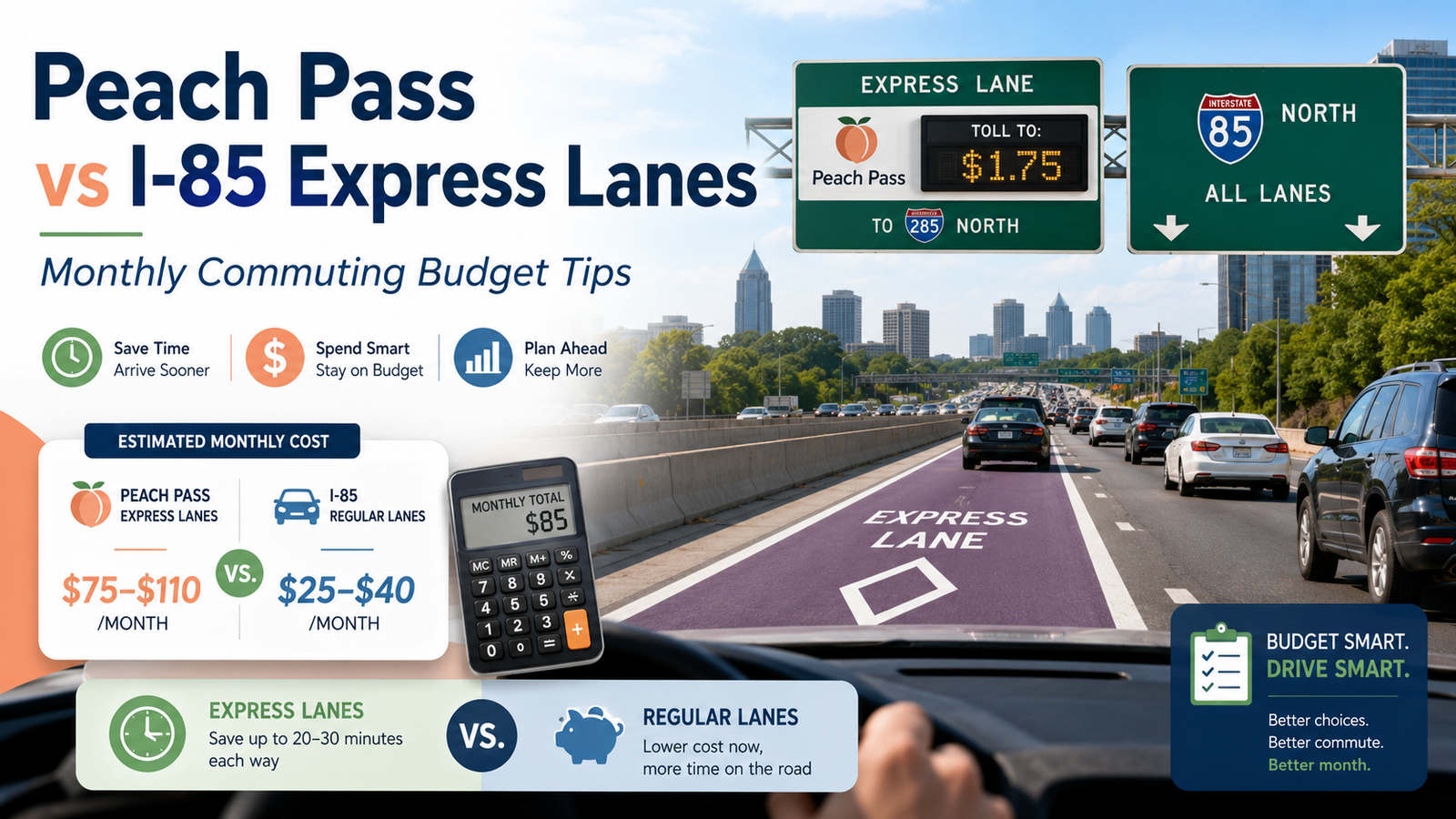
Peach Pass vs I-85 Express Lanes • Toll Cost, Carpool Rules, and Commute Value
Peach Pass vs I-85 Express Lanes: What North Atlanta Commuters Actually Pay
Updated:
Peach Pass is the payment system. I-85 Express Lanes are the road product. The real decision is whether the toll shown for a specific trip buys enough time and reliability to justify the cost.
Peach Pass vs I-85 Express Lanes is not really an either-or comparison. Peach Pass is Georgia’s electronic toll account and transponder system. The I-85 Express Lanes and I-85 Extension are optional High Occupancy Toll facilities that drivers can access under current account and vehicle rules.
For a North Atlanta household, the useful question is simpler: when is paying the displayed toll worth it? The answer depends on which segments are used, how many minutes the lane is likely to save, what being late would cost, and how much the household has already spent on tolls that month.
Peach Pass vs I-85 Express Lanes: The Difference That Matters
Peach Pass
Georgia currently lists a $20 initial prepaid toll balance for a standard Peach Pass account. The transponder is provided at no charge. Account tools allow drivers to manage vehicles, plates, balances, funding, alerts, and transaction history.
I-85 Express Lanes
The original I-85 Express Lanes run about 15 miles from Chamblee Tucker Road to Old Peachtree Road. The I-85 Extension continues about 10 miles north from Old Peachtree Road to Hamilton Mill Road.
That creates two separate household controls: keep the toll account accurate enough to avoid preventable problems, and create a trip rule so a bad traffic day does not automatically become a paid commute.
Using the Full I-85 Corridor Can Create Two Separate Toll Charges
Peach Pass identifies the original I-85 Express Lanes as 85A and the Extension as 85B. They are priced separately because congestion can differ between the two facilities. A driver using both can see two separate charges on the Peach Pass account.
This matters especially when evaluating homes in northern Gwinnett. A commute budget should use the total amount posted to the account for the completed trip, not only the first toll sign remembered by the driver.
How Much Can I-85 Express Lane Use Cost Per Month?
There is no responsible fixed monthly answer because toll rates change and household use varies. The examples below are illustrations only. Replace them with the average paid cost shown in your own Peach Pass history.
Automatic replenishment can make this cost easy to overlook. Before using express-lane access to justify a farther-out home, review at least four weeks of actual toll transactions and annualize the pattern.
Calculate the Cost per Hour Saved Before Making Toll Use Routine
One useful comparison is to convert the toll into a price for time: toll paid ÷ minutes saved × 60. This does not determine what your time is worth. It simply makes the trade visible.
$4 toll • 20 minutes saved
$12 per hour saved. Potentially strong value when the time estimate is credible and the trip protects a real obligation.
$6 toll • 15 minutes saved
$24 per hour saved. The trade may make sense for a pressured workday, appointment, or pickup window.
$8 toll • 10 minutes saved
$48 per hour saved. This begins to look more like selective schedule insurance than a default commute.
$10 toll • 8 minutes saved
$75 per hour saved. A meaningful consequence of lateness would usually be needed to make the trade compelling.
The same toll can be valuable before a flight, child pickup, medical appointment, or important work obligation and poor value on an ordinary trip with no meaningful deadline. That is why trip purpose belongs in the budget.
The $20 Initial Peach Pass Balance Is Not a Monthly Toll Budget
Georgia currently requires a $20 initial prepaid toll balance when opening a standard Peach Pass account. That is setup funding, not evidence that monthly commuting will cost $20.
Set your own monthly ceiling
Choose a household limit based on income, commute frequency, and the consequences that justify paid trips.
Read transaction history
During the first month, review the actual 85A and 85B charges rather than estimating from memory.
Keep the account current
Keep vehicle, license-plate, contact, and payment information accurate and watch the available prepaid balance.
Watch replenishment frequency
More frequent reloads can reveal that occasional schedule insurance has quietly become an everyday transportation cost.
Three-Person Carpools Can Ride Toll-Free Only When Current Rules Are Met
The I-85 and I-85 Extension are High Occupancy Toll lanes. Current Peach Pass rules allow qualifying carpools with at least three people including the driver to receive toll-free benefits, but occupancy alone is not enough.
Before treating a carpool as a guaranteed zero-toll commute, test the actual account, vehicle, balance, occupancy, app, and verification process.
Use I-85 Express Lanes for Consequences, Not Automatically for Congestion
Read the full displayed price
Remember that a trip continuing between 85A and 85B can involve separate facility charges.
Estimate the realistic time advantage
Use current navigation information, visible traffic conditions, and past trips rather than assuming a fixed time saving.
Name the cost of being late
A child pickup, appointment, work obligation, airport deadline, or other defined consequence creates a stronger reason to buy time.
Check the monthly toll budget
A worthwhile individual trip can still become an expensive habit when repeated every workday.
A household might create its own rule such as using the lane only when a meaningful deadline is at risk or the estimated time saving crosses a chosen threshold. The important part is deciding before frustration makes the decision.
Add Peach Pass Tolls to the Full Cost of the Home’s Commute
Express-lane spending should not be evaluated alone when choosing a home. The address creates the commute, and the commute creates several recurring costs.
MONTHLY COMMUTE CONTROL SHEET
Add actual Peach Pass transactions, including 85A and 85B. $_____
Monthly commute miles ÷ vehicle MPG × current fuel price. $_____
Include employer, station, garage, airport, or other recurring costs. $_____
Account for maintenance, tires, repairs, depreciation, and replacement mileage. $_____
Include late pickup charges, backup transportation, meals, or missed work. $_____
Record monthly commuting hours after any express-lane savings. _____ hrs
Compare that stack with the housing savings created by the farther-out address. A less expensive home can still be the better decision, but the express lanes should be treated as a variable commuting expense rather than free reliability.
Compare Carpool, Vanpool, Transit, and Schedule Changes
Regular toll users should periodically compare alternatives. Georgia Commute Options provides commute-matching resources and Guaranteed Ride Home support for qualifying clean commuters. The regional vanpool program also currently states that eligible vanpool expenses receive a 40% regional subsidy within the 13-county metro program.
Verified carpool
Three-person carpools that satisfy the current Peach Pass Verify rules can change the economics of the I-85 commute substantially.
Regional vanpool
Compare the rider contribution with tolls, fuel, parking, mileage, and wear on a personally owned vehicle.
Transit
Compare current routes, schedules, park-and-ride access, employer connections, and last-mile requirements for the actual home and job.
Hybrid or shifted schedule
Even one avoided peak commute per week can reduce tolls, fuel, mileage, and exposure to schedule risk.
For a home search, pair this with the Atlanta Suburbs for Commuting Guide , Gwinnett County Suburbs Guide , and Atlanta Housing Affordability Guide .
9 Checks Before Making Peach Pass a Daily Commute Habit
I-85 TIME PURCHASE CONTROL SHEET
Peach Pass vs I-85 Express Lanes FAQ
Is Peach Pass the same as the I-85 Express Lanes?
Can one I-85 commute create two toll charges?
How much does Peach Pass cost to open?
Do three people automatically ride I-85 toll-free?
How much should I budget each month for I-85 tolls?
Is daily Peach Pass use worth it?
Research Notes and Official Sources
- Georgia.gov — Get Peach Pass — current account setup, prepaid balance, transponder, and required customer information.
- Peach Pass — I-85 and I-85 Extension Express Lanes — corridor limits, 85A/85B pricing, vehicle restrictions, and toll-free benefit requirements.
- Peach Pass — Real-Time I-85 Toll Rates — current I-85 facility pricing displays.
- Peach Pass — Real-Time I-85 Extension Toll Rates — current Extension pricing displays.
- Peach Pass Verify — current three-person carpool verification requirements.
- Peach Pass — I-85 Toll-Free Benefits — current carpool and motorcycle benefit rules.
- Georgia Commute Options — current carpool, vanpool, transit, commute matching, and commuter support resources.
- Georgia Commute Options — Guaranteed Ride Home — current Guaranteed Ride Home program information.
- Regional Vanpool Program — current 13-county vanpool information and regional subsidy.
Use Peach Pass as Schedule Insurance, Not an Invisible Subscription
Peach Pass vs I-85 Express Lanes becomes easier to evaluate once the account and the road are separated. Peach Pass handles toll access and payment; the express lanes sell an optional travel-time advantage at a variable price.
Track actual 85A and 85B charges, calculate the price of the time saved, set a monthly ceiling, and reserve paid trips for the situations where reliability has real value. If daily toll dependence begins erasing the housing savings created by the home location, the problem may no longer be the toll — it may be the commute itself.