Skip to content
Metro Atlanta • Georgia Relocation • Suburbs • Housing • Schools • Cost
Metro Atlanta Relocation Journal Independent decision guides built around the address, commute, school path and monthly household cost.
North Atlanta Pantry Lab Three-Store Basket Test Family Grocery Guide

Publix vs Kroger vs Walmart • Price, Promotions, and Convenience

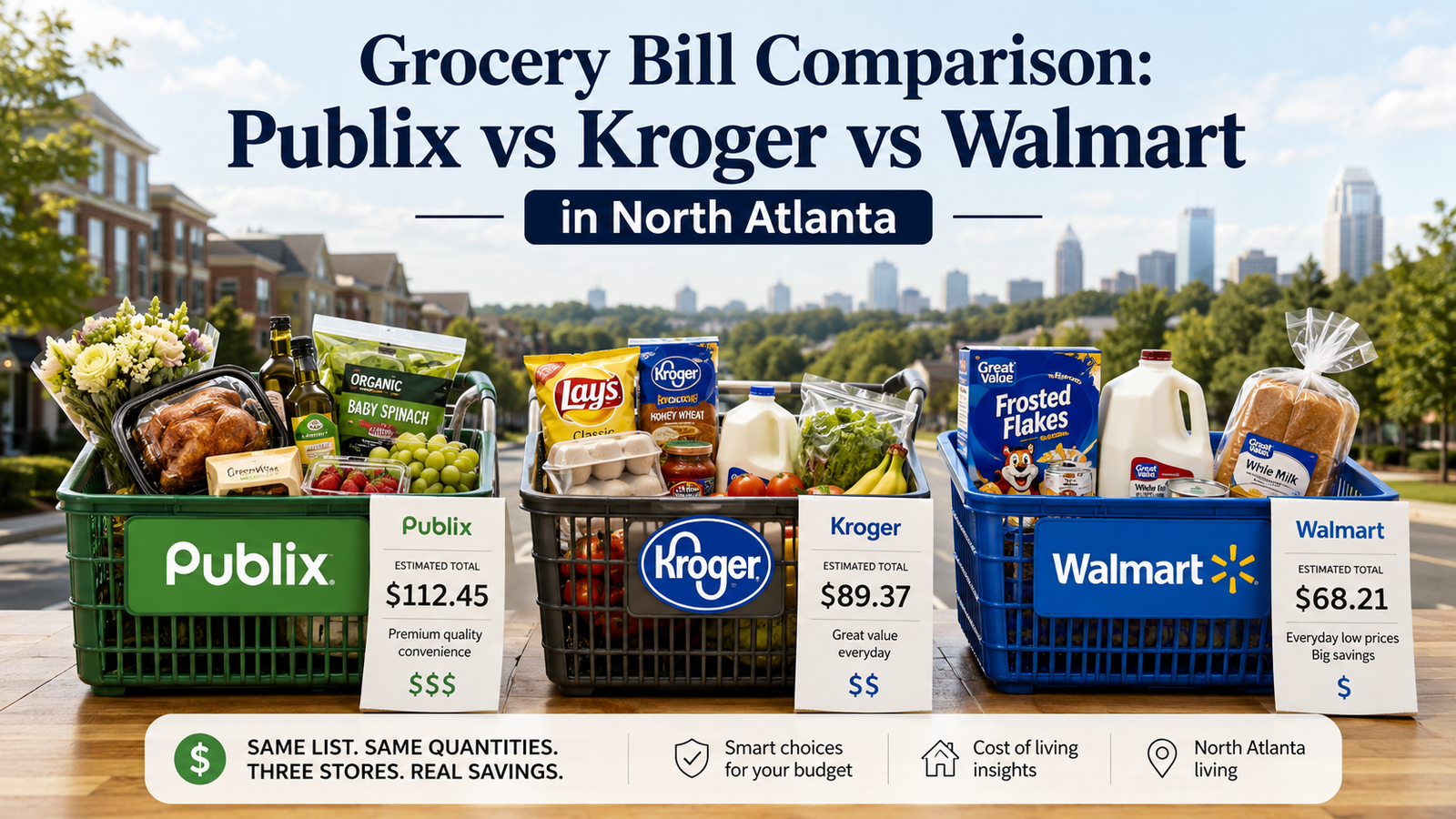
Publix vs Kroger vs Walmart in North Atlanta: Which Store Saves Families More?

Updated:

Walmart can serve as the price anchor, Kroger can win promotion-heavy weeks, and Publix can earn its place through BOGOs and convenience. The useful comparison is the cost of completing an entire family shopping week.

Walmart: price anchor Establish the baseline for repeat pantry, dairy, frozen, snack, and household categories.
Kroger: promotion engine Test weekly deals, digital coupons, private labels, and Points against the complete cart.
Publix: convenience specialist Use selected BOGOs, deli and bakery purchases, fresh categories, and fill-in trips where convenience has real household value.

Publix vs Kroger vs Walmart in North Atlanta is best treated as a household budget decision rather than a loyalty contest. The three chains use different pricing, promotion, rewards, pickup, delivery, and convenience models, so the cheapest choice can change with the basket and the way a family shops.

Grocery prices are also moving quickly. The Bureau of Labor Statistics reported that Atlanta-area food-at-home prices were 5.2% higher in June 2026 than a year earlier. Instead of relying on an old receipt or a store’s general reputation, compare a small repeatable local basket that can be checked again when prices change.

AISLE 01 • PRACTICAL VERDICT

Publix vs Kroger vs Walmart in North Atlanta: The Budgeting Answer

Best starting structure: use Walmart to establish a repeatable staple-cart baseline, Kroger when promotions and Points materially lower products already on the list, and Publix selectively for BOGOs, prepared-food rescue, fresh categories, and convenience purchases.

This is not a permanent ranking. A Walmart cart can become expensive when unrelated household purchases enter the order. A Kroger promotion can cost more when the deal changes the meal plan. A Publix purchase can create value when a convenient prepared meal prevents a much larger restaurant expense.

The better comparison is the lowest completed-week cost. Include groceries actually eaten, unavoidable fees, extra trips, food waste, substitutions, household products, and restaurant spending caused by an incomplete grocery plan.

AISLE 02 • HOUSEHOLD BENCHMARK

Use USDA Food Plans as a Benchmark, Not a Store Quote

USDA publishes monthly food-at-home plans for different ages and spending levels. Those tables are useful as a national reference, but they are not North Atlanta retailer quotes and do not include restaurant meals, most household supplies, pet products, delivery tips, or every convenience purchase.

LOW-COST PLAN
A useful comparison point for households cooking most meals at home, controlling convenience food, using store brands, and keeping waste low.
Check current USDA table
MODERATE PLAN
A broader reference for households that want more variety while still preparing most meals and snacks at home.
Check current USDA table
YOUR BASELINE
Add four complete weeks of food-only spending, then separate restaurant, delivery, household, pet, and other nonfood costs.
$_____ per month

Teenagers, allergies, organic preferences, athletic schedules, specialty diets, entertaining, and prepared foods can move a household above a national reference. The useful question is not whether the number is higher, but why.

AISLE 03 • THREE-STORE BASKET TEST

Compare the Same Basket at the Same Time

Select the actual Walmart, Kroger, and Publix locations your household would realistically use. Build one fixed list and check those locations on the same day. Match package size, brand tier, fresh-versus-frozen format, organic status, and shopping channel as closely as possible.

Four-week basket test: choose 25 to 35 products your household repeatedly buys. Price the same list once a week for four weeks. Record promotions only when they apply to the planned basket, and separately record unavailable items, substitutions, online charges, and additional store trips.
STAPLES
Milk, eggs, rice, pasta, bread, cereal, canned tomatoes, beans, frozen vegetables, yogurt, and lunchbox basics.
FRESH CATEGORIES
Chicken, ground meat, one fish item, bananas, apples, berries, salad greens, onions, potatoes, and seasonal produce.
CONVENIENCE
One prepared dinner, frozen backup meal, bakery item, and after-school snack category.
SEPARATE CART
Paper towels, detergent, toiletries, medicine, school supplies, pet products, alcohol, décor, and other nonfood purchases.
AISLE 04 • STORE ROLES

Give Each Grocery Store a Job Before the Week Begins

Walmart: establish the baseline

Best use Pantry staples, frozen food, dairy, snacks, lunchbox products, and household categories where promotion hunting adds little value.
Main advantage A broad assortment makes it possible to price a large repeat cart from one location and establish a baseline before testing deals elsewhere.
Budget risk Grocery totals become difficult to judge when clothing, home goods, school supplies, beauty products, or other unrelated purchases enter the same cart.

Kroger: test the promotion stack

Best use Digital coupons, weekly specials, private labels, meat promotions, and rewards that already match the household meal plan.
Main advantage Kroger’s Points program can provide grocery or fuel value when Points are earned and redeemed under current program terms.
Budget risk A promotion is not savings when it creates an extra purchase, requires more food than the household will use, or is not actually applied at checkout.

Publix: buy convenience selectively

Best use BOGOs already on the list, bakery and deli needs, selected fresh categories, and prepared food that prevents a larger takeout expense.
Main advantage Weekly BOGOs, digital offers, deli, bakery, and convenience categories can make selected purchases valuable even when Publix is not the base store.
Budget risk A small rescue stop can turn into an unplanned full cart. Online prices and fees should also be checked before comparing them with another retailer’s in-store total.

Assigning roles prevents a common budget problem: entering the nearest store without a list and allowing that retailer’s assortment or promotions to reshape the entire week.

AISLE 05 • ROUTE VALUE

Should You Shop at Walmart, Kroger, and Publix in the Same Week?

Base cart

Put most routine products in one main order. The purpose is to reduce forgotten items, extra driving, and repeated opportunities for impulse purchases.

Promotion cart

Move a planned category to another store only when the net savings remain meaningful after quantity, storage, waste, and travel are counted.

Rescue cart

Keep a defined amount for prepared food, bakery, deli, frozen backup meals, or fill-in purchases that prevent a larger takeout bill.

A second store that saves $12 but adds forty minutes, extra driving, and several impulse purchases may not be saving the household anything. A larger planned promotion at a store already on the commute can be more useful.

Compare unit prices rather than package prices, and ask one more question before buying in bulk: will the household actually finish it?

AISLE 06 • TAX AND ONLINE ORDERS

The Shelf Price Is Not Always the Final Grocery Cost

Georgia’s sales-tax treatment differs by purchase type and locality. Qualifying food for home consumption does not simply receive one universal North Atlanta tax rate. The applicable total can depend on the store’s jurisdiction and the products in the cart.

Food at home Check the current Georgia Department of Revenue food-related rate chart for the selected location rather than applying one assumed percentage.
Prepared food Prepared and restaurant-style items may not receive the same treatment as qualifying groceries purchased for home consumption.
Nonfood products Separate paper, cleaning, personal-care, school, pet, and other household products when comparing grocery spending.
Pickup and delivery Review item pricing, service or delivery charges, memberships, tips, minimum orders, and substitution policies before comparing online carts.
AISLE 07 • HIDDEN COSTS

Six Ways a Cheap Grocery Cart Becomes Expensive

Online pricing and fees

Pickup and delivery can involve different pricing or service costs. Compare the completed checkout with the realistic in-store alternative.

Small emergency orders

Repeated fill-in orders add fees, travel, and more opportunities for impulse purchases.

Missed promotions

Only count a coupon, BOGO, or reward when the correct product qualifies and the savings appear on the final transaction.

Food waste

A BOGO or bulk package stops being a bargain when part of it is discarded. Give extra food a planned meal, freezer location, or later-use date.

Prepared-food drift

One deliberate rescue dinner may prevent restaurant spending. Several unplanned deli and bakery additions can quietly create the same expense inside the grocery budget.

Store-hopping

More stops mean more driving, time, and exposure to impulse purchases. The additional store should create a meaningful completed-week saving.

AISLE 08 • WEEKLY ROUTINE

Build a Grocery Routine That Survives a Busy North Atlanta Week

NORTH ATLANTA WEEKLY PANTRY ROUTINE

TH Check inventory. Review the refrigerator, freezer, pantry, school snacks, and the next seven evenings before adding anything to the list.
FR Plan difficult nights. Build dinners around late work, sports, tutoring, school activities, and evenings when takeout is most likely.
SA Price the basket. Check the actual Walmart, Kroger, and Publix locations you would use. Apply only promotions tied to the planned list.
SU Complete the base cart. Add another store only when expected savings are large enough to justify the additional stop.
WE Run a waste check. Move fragile food forward, freeze excess portions, and use the backup dinner before placing a restaurant order.
MO Close the month. Separate groceries, household goods, delivery charges, and restaurant spending before deciding which store performed best.
AISLE 09 • CONTROL SHEET

9 Checks Before Naming Your Cheapest Grocery Store

THREE-STORE CONTROL SHEET

1. Select exact locations. Compare stores you would realistically use rather than random locations across metro Atlanta.
2. Fix the basket. Match brands, sizes, quality tier, and shopping channel.
3. Separate food and household goods. A mixed supercenter cart can make groceries appear more expensive than they really are.
4. Count redeemed savings. A promotion matters only when it reduces the planned transaction.
5. Add online-order costs. Include applicable pricing differences, delivery or service charges, tips, memberships, and minimum-order fees.
6. Track waste. Record spoiled produce, unused bulk products, and abandoned leftovers.
7. Set a convenience allowance. Decide how much prepared food and emergency shopping the weekly budget can absorb.
8. Count the extra trip. Another store should save enough to justify its time and travel cost.
9. Judge four weeks, not one sale. Select the default shopping system from repeated household results.
AISLE 10 • QUICK ANSWERS

Publix vs Kroger vs Walmart in North Atlanta FAQ

Which is cheapest: Publix, Kroger, or Walmart?
No chain wins every product and every week. Walmart is useful as a baseline for repeat staples, Kroger can improve a planned basket through current promotions and Points, and Publix can create value through selected BOGOs and convenience purchases. Compare the same local basket before choosing a default store.
Is Walmart cheaper than Publix and Kroger?
Walmart can be a strong baseline for repeat products, but a complete household comparison should include product quality, substitutions, nonfood items, promotions, online-order costs, waste, and extra trips.
Is Kroger cheaper than Publix?
Kroger can be cheaper when weekly deals, digital coupons, private labels, and Points match products the household already intended to purchase. Compare the entire planned cart rather than one advertised item.
When can Publix be worth the extra cost?
Publix can make sense when a BOGO matches the existing list, a fresh or deli category matters to the household, or a convenient prepared meal prevents a larger restaurant expense.
How much should a family of four budget for groceries?
There is no single North Atlanta number that fits every family. Use the current USDA monthly food-plan table as a national reference and compare it with four weeks of your own food-only spending.
Should a family shop at all three stores every week?
Usually not. Start with one base store and add another only when a planned promotion or convenience purchase creates enough value to justify the additional trip.

Research Notes and Current Sources

  1. USDA Food Plans: Monthly Cost of Food Reports — national food-at-home benchmarks by household age and spending plan.
  2. U.S. Bureau of Labor Statistics — Atlanta Consumer Price Index — Atlanta-area food and food-at-home price trends.
  3. Georgia Department of Revenue — Food Sales-Tax Rate Charts — current locality-specific food-related sales-tax tables.
  4. Publix Savings — weekly ads, BOGOs, and current Publix offers.
  5. Kroger Points Program FAQ — current Points redemption rules.
  6. Kroger Digital Coupons — current account-based grocery promotions.
  7. Publix / Instacart Item Pricing — current online pricing-policy guidance.
  8. Walmart Help Center — current pickup, delivery, substitution, fee, and order information.
FINAL PANTRY DECISION

Choose the Cheapest Reliable Week, Not the Cheapest Store Reputation

Walmart, Kroger, and Publix can each play a useful role in a North Atlanta household. The mistake is choosing a winner from one advertised item or one unusually good promotional week.

Run the same basket for four weeks and include promotions actually redeemed, online charges, food waste, extra trips, household purchases, and restaurant spillover. Then ask the question that matters: which store system gave your family the lowest completed four-week cost without making the routine harder to maintain?