Matched-Address Decision File • Sugar Hill ↔ Suwanee
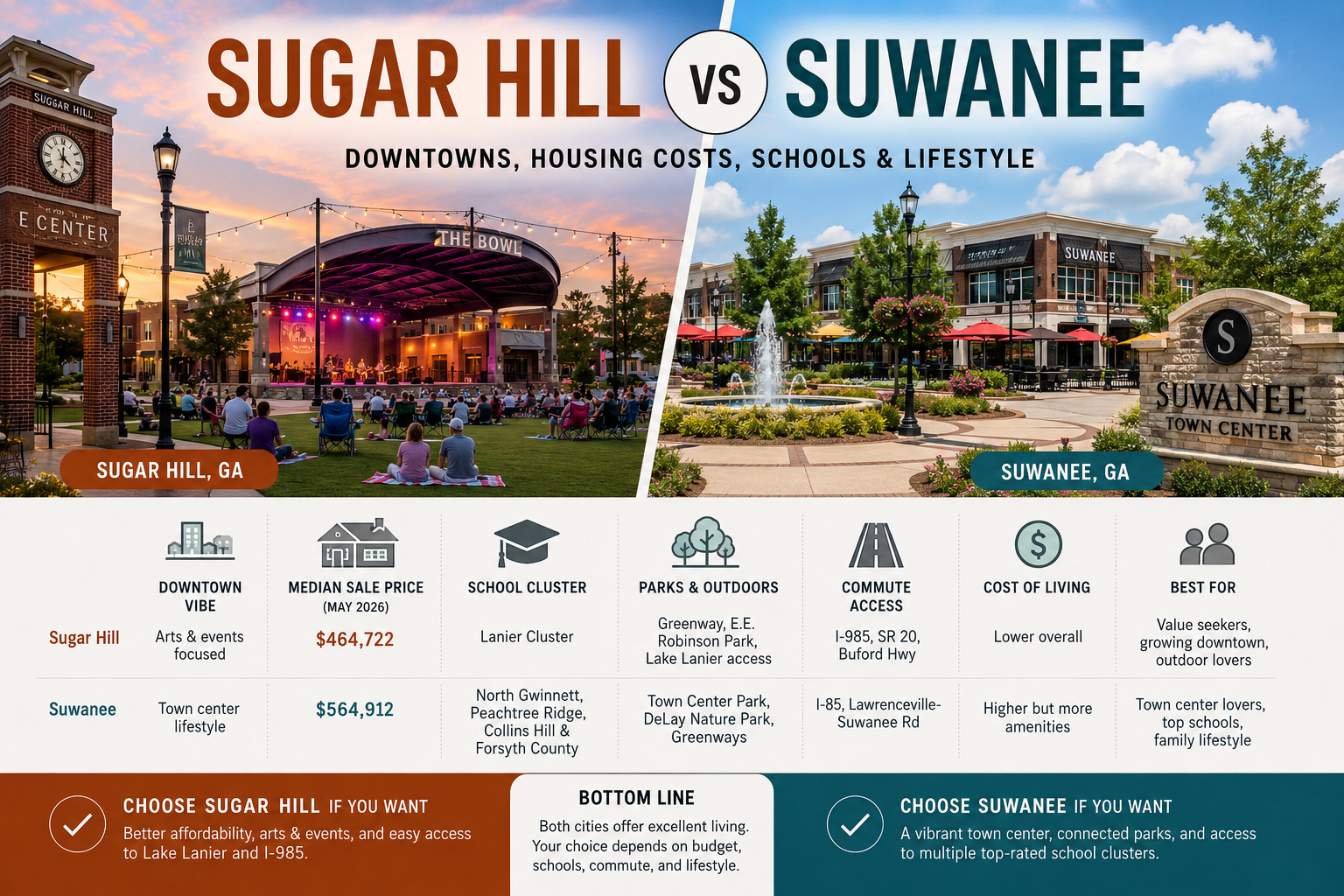
Sugar Hill vs Suwanee: Downtowns, Housing Costs, Schools & Lifestyle
Two neighboring Gwinnett County cities can produce very different daily routines. This field guide compares the places behind the mailing addresses, from downtown energy and home prices to school-zone risk, parks, traffic, and the kind of weekend each city makes easy.
Sugar Hill
Arts-led downtown, Greenway growth, and a more attainable recent median
Suwanee
Established Town Center, connected parks, and a higher recent median
Last reviewed: July 23, 2026
How this guide was reviewed
ATL Local Insider compared official city planning and parks information, Gwinnett County Public Schools cluster resources, current city-limit tools, and Redfin market data covering the three months ending May 2026. Prices and attendance zones can change, so every buyer should verify the exact property before relying on a listing description.
Quick Answer
Sugar Hill is usually the better starting point for buyers who want a lower recent citywide median sale price, an arts-and-recreation downtown, and access toward Lake Lanier, Buford, and I-985. Its downtown is compact and event-oriented, centered on the E Center, Eagle Theatre, The Bowl, and the expanding Sugar Hill Greenway.
Suwanee is usually the stronger fit for households that will pay more for an established mixed-use Town Center, a denser calendar of public-space activity, connected parks, and access to several sought-after school clusters. The catch is that “Suwanee” on an address does not guarantee City of Suwanee residency, Gwinnett County, or a particular school assignment.
Neither city wins every category. The better choice depends on your exact commute, housing budget, school address, and whether you want a developing cultural core or a more mature town-center lifestyle.
Sugar Hill vs Suwanee at a Glance
Decision lane
Sugar Hill
Suwanee
Best first look
Value-minded buyers, arts events, and Greenway access
Town Center lifestyle, parks, and school-zone choice
Downtown style
Compact cultural and recreation hub
Larger mixed-use park district
May 2026 median
About $465,000
About $565,000
School caution
Lanier Cluster is common, but verify the property
Multiple clusters and county lines require verification
Weekend rhythm
Concert, theater, gym, trail, and Lake Lanier direction
Park, market, event, public art, and dining loop
Main trade-off
Fewer walkable daily-use blocks
Higher purchase-price pressure
Do not compare ZIP codes as if they were city boundaries. A Suwanee mailing address can be outside the incorporated city and can even be in Forsyth County. Sugar Hill also provides a city-limit search because municipal services depend on the actual boundary. Start every comparison with the parcel address, not the marketing name.
Downtowns: Cultural Core vs Town-Center Ecosystem
Sugar Hill feels curated around arts, recreation, and events
Downtown Sugar Hill is built around a tight group of civic and entertainment anchors. The E Center combines recreation, community space, and local businesses. The Eagle Theatre adds an indoor performing-arts identity, while The Bowl creates an outdoor concert setting. Cornerstone Park begins the downtown segment of the Sugar Hill Greenway, giving the district a visible link to the city’s larger trail plan.
The result is a downtown that often works best when you have a reason to go: a performance, class, festival, workout, concert, meal, or Greenway walk. It feels intentional and increasingly polished, but most households will still drive from their subdivision and then explore the central blocks on foot. Buyers who like watching a downtown develop may find that momentum appealing.
Suwanee feels like a complete public-realm destination
Suwanee’s Town Center has had more time to mature as a regional gathering place. The original 10-acre Town Center Park combines lawns, a fountain, public art, event space, restaurants, and residences. Town Center on Main adds roughly 13 acres, while adjacent DeLay Nature Park contributes about 15 wooded acres and a Brushy Creek Greenway segment. Suwanee Circle, the food-truck area introduced in spring 2026, adds another reason to stay into the evening.
The practical difference is not that Suwanee eliminates driving. Most residents still need a car. The advantage is that once you park, a larger share of the outing can happen within one connected environment. A family can combine a playground, walk, meal, event, and public space without repeatedly moving the car. That is a meaningful lifestyle feature, not just a decorative downtown.
Housing Costs: Suwanee Carries the Higher Recent Median
Redfin’s city-level data showed a gap of roughly $100,000 between the two medians. That makes Sugar Hill the logical first search for buyers trying to preserve space or reduce the initial purchase price. It does not mean every Sugar Hill home is cheaper than every Suwanee home. New construction, lot size, renovation quality, school assignment, HOA amenities, and proximity to each downtown can reverse the comparison at the property level.
Suwanee’s higher median reflects a mix of established subdivisions, town-center demand, newer housing pockets, large homes, and addresses associated with several school clusters. Sugar Hill offers a broad mix as well, including older subdivisions, newer single-family communities, and townhomes. The strongest value comparison is not city median versus city median; it is the monthly cost of two homes that meet the same needs.
Compare principal and interest
Use the same down payment, loan type, and current rate for both homes.
Add ownership costs
Include property taxes, insurance, HOA dues, utilities, lawn care,
and likely repairs.
Price the commute
Fuel, tolls, parking, and time can erase part of a purchase-price
advantage.
Inspect the neighborhood
Amenity age, reserve funding, rental limits, and pending assessments
matter.
Recent market percentages also deserve caution. Sugar Hill’s median rose sharply year over year in Redfin’s May 2026 calculation, while Suwanee’s was slightly lower. Those movements can be influenced by which types of homes sold during the period. Treat them as a snapshot, not a forecast.
Schools: The Address Matters More Than the City Name
Both communities are closely associated with Gwinnett County Public Schools, but the comparison is not simply “Lanier versus North Gwinnett.” The Lanier Cluster includes Lanier High School, Lanier Middle School, Sugar Hill Elementary, Sycamore Elementary, and White Oak Elementary. Many Sugar Hill addresses fall into this pattern, yet buyers should still use the official locator for the exact parcel.
Suwanee is more complicated. North Gwinnett is a major cluster for the incorporated city, but the broader Suwanee mailing area includes addresses connected to North Gwinnett, Peachtree Ridge, and Collins Hill clusters. Suwanee addresses in south Forsyth County may be served by Forsyth County Schools. A listing can therefore say “Suwanee” while representing a different county, tax structure, school system, and daily route than a home near Town Center.
School quality should also be evaluated beyond a single rating. Review the assigned elementary, middle, and high school; transportation time; enrollment; specialized programs; after-school logistics; and the child’s learning needs. Boundaries can change, and proximity does not establish eligibility. Before making an offer, save the official locator result and confirm it with the district when school assignment is a decisive condition.
Buyer rule:
Never rely solely on an MLS school field, map pin, or agent shorthand.
GCPS states that attendance is determined by designated boundaries and
provides its SchoolLocator for address verification.
Commute: Test the Route You Will Actually Drive
Suwanee generally offers a more direct relationship with I-85 through Lawrenceville-Suwanee Road and nearby interchanges. That can help households commuting toward Duluth, Norcross, the I-85 employment corridor, or northeast Atlanta. It can also create concentrated congestion around the same access points, especially when school traffic, incidents, or major events overlap.
Sugar Hill routines often depend more heavily on Peachtree Industrial Boulevard, Buford Highway, State Route 20, and connections toward I-985 and I-85. That orientation can be useful for Buford, Lake Lanier, Gainesville, or northern Gwinnett destinations. A downtown Atlanta commuter may find the trip more sensitive to the exact neighborhood entrance and the path used to reach the freeway.
Do not choose from a weekend map. Drive from the candidate house to work, school, or daycare at your real departure time on at least two weekdays. Repeat the return trip. Check the final ten minutes near the subdivision, because a short distance can feel long when a left turn, school queue, or two-lane road becomes the daily bottleneck.
Parks and Outdoor Life: Both Cities Invest Heavily, Differently
Sugar Hill’s signature outdoor story is connectivity. The city reports five completed miles of a planned 16.5-mile Greenway, with links among downtown, neighborhoods, schools, and parks. E.E. Robinson Park, Gold Mine Park, and Cornerstone Park broaden the recreation mix, while Lake Lanier and Buford-area destinations sit naturally in the city’s northern orbit. The appeal is a growing network that can become more useful as additional segments connect.
Suwanee’s advantage is the concentration and layering of public spaces. Town Center Park, Town Center on Main, DeLay Nature Park, PlayTown Suwanee, and the Suwanee Creek Greenway create multiple settings for different ages and moods. One outing can move from an active lawn to a wooded trail, public art, food, and a playground. This makes Suwanee especially compelling for households that use parks as a weekly social routine rather than an occasional amenity.
For either city, verify the distance from the house to the trail entrance, not just the distance to the park boundary. A neighborhood advertised as “near the Greenway” may still require loading bikes into a car or crossing a high-speed road.
Dining, Errands, and the Shape of Everyday Life
Suwanee has the stronger case for a park-centered meal or event night. Town Center’s mixed-use environment makes it easier to pair dining with a walk, fountain, market, or performance. The broader Suwanee area also reaches commercial corridors along Peachtree Industrial Boulevard, Lawrenceville-Suwanee Road, and toward I-85.
Sugar Hill’s center has a smaller dining footprint, but its cultural venues give downtown a distinct identity. Daily errands often spread across Sugar Hill, Buford, and Suwanee corridors rather than staying within one walkable core. For some households, that is a minor issue because their preferred grocery store, gym, or medical provider is already on the commute. For others, repeated short drives are the main lifestyle frustration.
Build a personal weekly map before choosing. Mark groceries, childcare, worship, medical care, youth sports, restaurants, parks, and the office. The winning city is often the one that shortens the five trips you make every week, not the one with the most impressive Saturday afternoon. Treat those five recurring trips as the Matched-Address Routine File: Home → School/Childcare → Work → Errands → Repeat-Use Place. Compare the two actual addresses on the same weekday assumptions before comparing city reputation.
Homes and Neighborhood Feel
Sugar Hill can appeal to buyers who want a conventional suburban house without paying the full Suwanee premium. Inventory may include established subdivisions, newer communities, townhomes, and homes with practical access to Buford or Lake Lanier. Buyers should compare topography, retaining walls, drainage, roof age, siding, HVAC systems, and HOA rules—issues that can change the ownership cost more than the city name.
Suwanee offers everything from town-center residences and townhomes to large swim-tennis subdivisions and higher-priced single-family homes. Established neighborhoods may provide mature trees and stronger amenity culture, but they can also bring aging pools, tennis courts, clubhouses, roofs, and mechanical systems. Newer properties reduce some age-related concerns while introducing builder quality, smaller lots, or higher density.
In both cities, neighborhood governance deserves close reading. Obtain the covenants, current budget, reserve information, meeting minutes, rental restrictions, and any pending special-assessment discussion. A beautiful entrance does not prove that the HOA is financially healthy.
Which City Fits Your Household?
Choose Sugar Hill when…
Your budget benefits from the lower recent city median; you value The Bowl, Eagle Theatre, the E Center, and a growing Greenway; your life points toward Buford, Lake Lanier, or I-985; or you prefer a downtown that still feels like it is building its next chapter.
Choose Suwanee when…
You will use Town Center and connected parks frequently; you want a more established mixed-use gathering district; you are comfortable paying more for the right neighborhood and school assignment; or your routine depends on the I-85 corridor, North Gwinnett, Peachtree Ridge, or nearby employment centers.
A split decision is common. A buyer may prefer Suwanee’s downtown but find a Sugar Hill home that produces a healthier monthly budget. Another household may save on the house in Sugar Hill but lose time on a southbound commute. The final answer should be property-specific, not reputation-driven. Finish with the City-Name Address Comparison Check: if “Sugar Hill” and “Suwanee” disappeared from both listings, which address still wins on verified school assignment, weekday routes, five-year ownership cost, home condition, HOA obligations, and repeat-use destinations?
Before You Make an Offer: 8 Address-Level Checks
- Confirm city limits. Use the official Sugar Hill or Suwanee boundary tool rather than the postal city.
- Verify the county. A Suwanee mailing address may be in Gwinnett or Forsyth County.
- Run the school locator. Save the result and confirm any uncertainty with the district.
- Drive the commute twice. Test morning and evening conditions from the actual subdivision entrance.
- Calculate total monthly cost. Add taxes, insurance, HOA, utilities, maintenance, and transportation.
- Walk the downtown you expect to use. Visit on a weekday and during a weekend event.
- Inspect drainage and slopes. North Gwinnett lots can hide erosion, retaining-wall, and water-management costs.
- Read HOA documents. Check reserves, assessments, rental rules, parking, and exterior restrictions.
Frequently Asked Questions
Is Sugar Hill cheaper than Suwanee?
Recent citywide data suggests a lower median sale price in Sugar Hill. For the three months ending May 2026, Redfin reported about $465,000 in Sugar Hill and $565,000 in Suwanee. Individual neighborhoods and school zones can produce very different results.
Which downtown is more walkable?
Suwanee offers the larger and more established park-centered district for walking between public space, dining, events, and residences. Sugar Hill’s downtown is compact and walkable once you arrive, but most residents still drive there and its daily-use footprint is smaller.
Does every Suwanee address attend North Gwinnett schools?
No. Suwanee mailing addresses can fall into multiple Gwinnett clusters and can also be in Forsyth County. Use the official district locator for the exact property.
What school cluster serves Sugar Hill?
The Lanier Cluster is the primary association and includes Lanier High, Lanier Middle, Sugar Hill Elementary, Sycamore Elementary, and White Oak Elementary. Exact assignments still depend on attendance boundaries.
Which city is better for commuting to Atlanta?
Suwanee often provides more direct I-85 access, but the best choice depends on the subdivision, destination, and departure time. A Sugar Hill home near a strong route may outperform a Suwanee address with a difficult interchange approach.
Which city is better for parks?
Suwanee has the advantage in concentrated, connected public spaces around Town Center. Sugar Hill offers a growing Greenway system and strong recreation assets with useful access toward Lake Lanier.
Can I trust the city listed on a real-estate website?
Use it as a mailing label, not proof of municipal residency. Confirm the parcel with the city-limit tool and county tax records before comparing services or taxes.
Which city is better for families?
Both can work well. Sugar Hill often supports a more budget-conscious search, while Suwanee may appeal to families prioritizing Town Center, parks, and specific school clusters. The child’s assigned schools, commute, and total housing cost should decide the fit.
Official and Local Sources
- City of Sugar Hill — Sugar Hill Greenway
- E Center at Sugar Hill
- City of Suwanee — Town Center
- City of Suwanee — Town Center on Main and DeLay Nature Park
- City of Suwanee — City-Limit Verification
- Gwinnett County Public Schools — Clusters and SchoolLocator
- Redfin — Sugar Hill Housing Market
- Redfin — Suwanee Housing Market