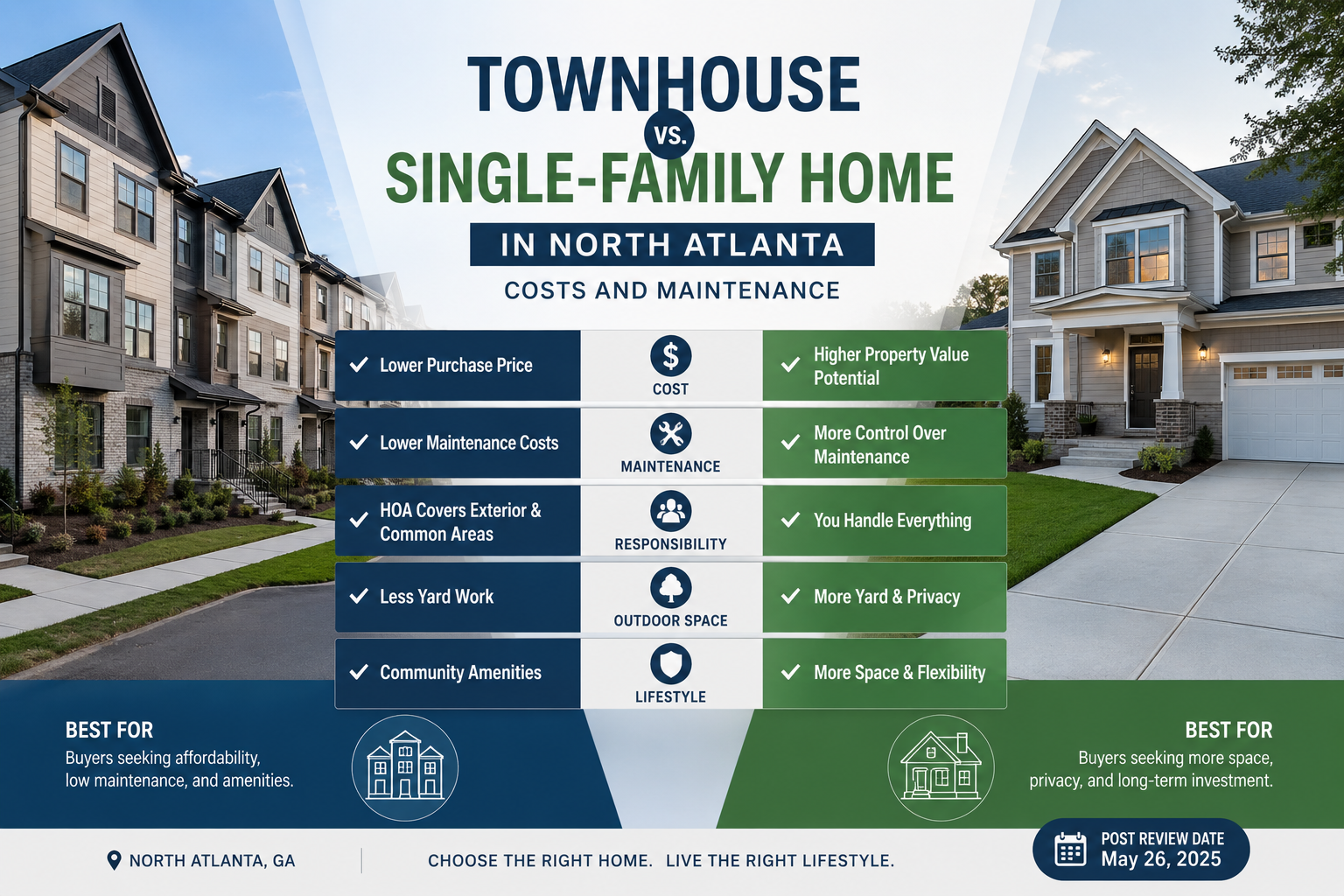
Townhouse vs Detached Ownership Review • Legal Form → Duties → Five-Year Cost → Exit
Townhouse vs Single-Family Home in North Atlanta: Costs and Maintenance
Compare mortgage cost with HOA obligations, exterior maintenance, insurance, utilities, special assessments, privacy, resale, and North Atlanta location trade-offs.
Last reviewed: July 23, 2026
ATL Local Insider reviewed Georgia property-tax guidance, Georgia consumer information on community associations, federal homebuyer guidance on HOA dues, insurance, reserves, and condominium project risk, and current North Atlanta ownership patterns. Because a townhouse can be fee-simple, condominium-form, or part of a planned development, the recorded documents for the exact property control every maintenance and insurance conclusion.
Quick Answer
A townhouse is often the better fit when location, lower entry price, and less hands-on yard work matter more than privacy and control. In North Atlanta, townhouses can open access to Alpharetta, Johns Creek, Roswell, Sandy Springs, Suwanee, Duluth, and Cumming locations where a comparable detached home may require a larger budget. The monthly HOA bill is not automatically wasted money if it replaces landscaping, exterior insurance, roof reserves, or shared amenities—but only the governing documents reveal what it actually buys.
A single-family home is usually the stronger fit when the buyer wants a private yard, fewer shared-wall concerns, more renovation freedom, and direct control over maintenance timing. The trade-off is that roof, siding, drainage, trees, gutters, lawn, pest control, and major exterior systems generally become the owner’s responsibility.
Townhouse vs Single-Family Home at a Glance
First Question: What Does “Townhouse” Mean on This Deed?
“Townhouse” describes an architectural form, not one universal ownership structure. Two attached homes can look identical but place very different legal, insurance, and maintenance obligations on the buyer. Before comparing monthly costs, determine how the property is titled and which documents govern it.
Fee-simple townhouse
The owner typically owns the home and the land beneath it, sometimes including a small front or rear lot. The association may maintain only common landscaping and amenities, or it may contract for roofs, exterior painting, or front-yard service. Do not assume that an attached exterior is automatically an HOA expense. Fee-simple townhome owners may still be individually responsible for roof sections, siding, windows, foundation components, driveways, decks, and insurance on the structure.
Condominium-form townhouse
The unit is legally part of a condominium even though it looks like a row house. The declaration defines the unit boundaries and common elements. The association commonly carries a master property policy and maintains specified structural or exterior components, while the owner insures the unit interior and personal property. The boundary can be described as “walls in,” but that phrase is too vague for a purchase decision; read the declaration and master policy.
Attached home in a planned development
Some communities use a homeowners association, a sub-association, or multiple layers of governance. A buyer may owe a neighborhood fee plus a master-community fee. Maintenance can be divided among the owner, townhome association, and master association. Ask the closing attorney and lender to identify every mandatory association before the due-diligence period expires.
The Real Cost Is Larger Than the Mortgage Payment
This formula prevents the most common comparison error. A townhouse may have a lower price but higher dues. A detached home may have no HOA but require the owner to save aggressively for roof, exterior, drainage, tree, and yard work. Run both addresses through the Atlanta Mortgage Calculator using their actual HOA, tax, insurance, and down-payment assumptions. The lower mortgage payment wins only when the other categories remain lower as well.
Property taxes are not inherently lower because a home is attached
Georgia generally assesses property at 40% of fair market value, and local millage rates are applied to the taxable assessed value after applicable exemptions. The housing type does not create a universal townhouse discount. A townhome can have a lower tax bill because its market value is lower, while a premium townhome near Avalon, Downtown Alpharetta, or a major mixed-use district may be assessed above a detached home farther away.
Compare the actual tax parcel, tax district, municipal status, current assessed value, and homestead eligibility. Use the Georgia Property Tax Estimator for an initial planning number, then replace it with the parcel-specific tax record. Do not copy the seller’s tax bill into your budget without checking whether the seller has exemptions that will not transfer to you.
HOA dues must be converted into services and liabilities
HOA dues are usually paid directly to the association rather than included in the mortgage servicer payment. Read the budget line by line. A $300 monthly fee that funds exterior insurance, landscaping, roof reserves, termite service, and a gate is not comparable to a $300 fee supporting only amenities and administration. Equally, low dues can be misleading when the association is postponing work.
Maintenance: Who Writes the Check When Something Fails?
A single-family home creates more direct work but also more control. You select the contractor, replacement date, material, and scope, subject to any neighborhood covenants. In a townhouse, the association may coordinate exterior work, but the owner has less control over timing and vendors and still shares the financial result.
HOA Health Can Matter More Than the Published Monthly Fee
The association is a financial partner in townhouse ownership. Review the current operating budget, reserve balance, recent financial statements, meeting minutes, insurance certificate, claims history if available, delinquency information, pending litigation, recent dues increases, and any proposed special assessment. Georgia consumer guidance notes that owners in associations subject to the Georgia Condominium Act or Property Owners’ Association Act can obtain financial and budget information through the applicable association process.
Lenders also examine project risk. Fannie Mae identifies insufficient master property insurance and unresolved critical repairs as major reasons a condominium project may be ineligible. That can affect financing and future resale even when the individual unit is attractive. Ask the lender to review the project early, not a few days before closing.
Insurance: The Legal Structure Determines the Policy
A detached home typically requires an individual homeowners policy covering the dwelling, personal property, liability, and listed perils subject to exclusions and deductibles. A fee-simple townhouse may require a similar structure-focused policy. A condominium-form townhouse commonly uses a master association policy for defined common property plus an individual unit-owner policy, often called HO-6 coverage, for the interior, belongings, liability, and gaps.
Do not compare only the individual premium. Request the master policy, coverage form, replacement-cost information, deductible schedule, and responsibility for deductibles after a loss. Ask an insurance agent whether the unit-owner policy should include building additions, water backup, sewer backup, loss assessment, and enough coverage for the master-policy deductible exposure.
Utilities and Energy: Shared Walls Help, but Layout Still Wins
Townhouses often expose fewer exterior walls than detached homes, which can reduce heating and cooling demand. Interior units may benefit more than end units. But square footage, ceiling height, window quality, insulation, orientation, ductwork, equipment age, and thermostat habits can outweigh the attached-wall advantage.
Also identify which services are included in dues. Some associations pay common-area water, exterior lighting, irrigation, trash, or gate power; others bill everything separately. Confirm internet-provider choices, guest parking, electric-vehicle charging rules, and whether the electrical panel can support a charger.
Privacy, Outdoor Space, Noise, and Daily Convenience
Townhouse lifestyle
The practical advantages are location, reduced yard responsibility, and a lock-and-leave routine. Buyers may reach employment corridors, downtowns, restaurants, parks, or mixed-use districts without paying for as much land. The trade-offs are stairs, shared walls, tighter parking, smaller outdoor areas, guest restrictions, and less freedom over exterior changes.
Single-family lifestyle
Detached homes usually provide more privacy, storage, driveway control, pet flexibility, gardening space, and room for additions. They can also create more weekend work, higher landscaping costs, longer internal subdivision drives, and a larger list of systems that the owner must monitor.
Shared-wall quality varies. Visit a townhouse during evening hours, stand quietly beside party walls, test garage and stair noise, and ask about wall construction. End units reduce one shared wall but often cost more and have additional exterior exposure. For detached homes, evaluate road noise, backyard privacy, drainage, neighboring fences, and the distance between structures.
Stairs deserve serious attention. Many North Atlanta townhouses place the garage and entry on the first level, living space on the second, and bedrooms on the third. This can work well for active households but may complicate aging in place, injuries, groceries, strollers, large dogs, and resale to buyers seeking one-level living.
Financing and Resale: The Project Can Be Part of the Underwriting
Fee-simple townhouses may be underwritten similarly to detached homes, while condominium-form properties can require project review. The lender may evaluate insurance, repairs, owner occupancy, commercial space, litigation, reserves, and other project characteristics. A buyer should disclose the legal structure at preapproval and send the lender the address as soon as a property becomes serious.
Review rental caps and leasing restrictions even when you plan to occupy the home. A future job move may turn rental flexibility into an important exit option. Also check whether the association has right-of-first-refusal provisions, transfer fees, buyer-approval procedures, or limits on corporate ownership.
North Atlanta Location Trade-Offs
Townhouses are often used to place buyers closer to expensive employment and lifestyle centers. In Alpharetta, Roswell, Johns Creek, Sandy Springs, Suwanee, Duluth, and Cumming, attached communities can offer a newer home or shorter commute at a lower entry point than nearby detached inventory. That advantage becomes less valuable if dues are high, the unit has poor parking, or the commute still depends on a congested local road.
Do not treat “North Atlanta” as one tax or school market. Fulton, Forsyth, Gwinnett, Cobb, and Cherokee counties have different tax districts, services, school systems, and development patterns. Municipal boundaries and mailing addresses can also differ. Verify the parcel, not just the city name in the listing.
Which Home Type Fits Your Budget and Routine?
Choose a townhouse when…
You value location over land; want less routine exterior work; prefer newer construction or a mixed-use setting; can live comfortably with stairs and shared walls; and have reviewed the legal structure, reserves, insurance, rules, and special-assessment exposure.
Choose a single-family home when…
You prioritize privacy, yard space, storage, pets, parking, renovation freedom, and long-term control; can fund irregular exterior repairs; and accept that more ownership freedom also creates more direct maintenance responsibility.
The strongest decision often comes from comparing two actual addresses rather than two housing labels. Build a five-year worksheet for each property, inspect the condition, read every association document, test the commute, and price the risks the seller’s listing does not show. Finish with the Housing-Type Decision Check: if the labels “townhouse” and “single-family” disappeared, which address still wins on legal ownership form, maintenance duties, insurance boundary, five-year capital exposure, commute, privacy, and exit flexibility?
Before You Make an Offer: 12 Buyer Checks
- Confirm the legal ownership form. Determine whether the property is fee-simple, condominium-form, or part of layered associations.
- Map every maintenance duty. Identify responsibility for roof, siding, windows, doors, foundation, decks, driveways, drainage, and landscaping.
- Calculate the full monthly cost. Include taxes, insurance, HOA dues, utilities, maintenance savings, and commute cost.
- Review reserves and assessments. Read budgets, financial statements, meeting minutes, reserve information, and planned projects.
- Verify insurance boundaries. Compare the master policy, individual policy, deductibles, exclusions, and loss-assessment exposure.
- Ask the lender about project review. Do this early for any condominium-form townhouse.
- Inspect water management. Check grading, gutters, drainage paths, retaining walls, crawl spaces, basements, and prior leaks.
- Test shared-wall noise. Visit during evening hours and listen from bedrooms, stairs, garages, and outdoor areas.
- Evaluate parking. Confirm garage dimensions, driveway rights, guest spaces, towing rules, and commercial-vehicle restrictions.
- Read rental and renovation rules. Check leasing caps, exterior approvals, pet limits, fencing, satellite dishes, and EV-charger procedures.
- Verify taxes and exemptions. Use the actual parcel and do not assume the seller’s bill will continue.
- Drive the real commute. Test the address at your normal departure and return times.
Frequently Asked Questions
Are townhouses cheaper than single-family homes in North Atlanta?
They are often cheaper within the same location because they use less land and share walls, but the final cost depends on HOA dues, insurance, taxes, repairs, size, condition, and commute. Compare equivalent properties with a full monthly and five-year ownership budget.
Does a townhouse HOA always maintain the roof?
No. Some associations maintain and replace roofs, while others leave roof sections to individual owners. The declaration, maintenance chart, budget, and insurance documents control.
Is townhouse insurance always cheaper?
Not necessarily. A condominium-form unit may have a smaller individual policy because the association insures defined building components, but the owner also pays a share of the master policy through dues and may face deductibles or loss assessments.
Are HOA dues included in the mortgage payment?
Usually not. They are commonly paid directly to the association, so buyers must add them separately when calculating affordability.
Which type has lower maintenance costs?
A townhouse can reduce hands-on exterior work, but the owner still pays through dues, reserves, and assessments. A detached owner pays more costs directly and controls the work. Condition and document quality matter more than the label.
Are townhouses harder to finance?
Fee-simple townhouses may finance much like detached homes. Condominium-form units may require project review, including insurance and repair considerations. Ask the lender to review the project early.
Official and Authoritative Sources
- Georgia Department of Revenue — Property Tax Valuation
- Georgia Department of Revenue — Property Tax Millage Rates
- Consumer Financial Protection Bureau — HOA Dues and Mortgage Payments
- Fannie Mae — What to Know When Buying a Condo
- Fannie Mae — Condo Project Risk and Eligibility
- Georgia Consumer Ed — Association Financial Information
- Georgia Office of Insurance and Safety Fire Commissioner — Home Insurance
- Consumer Financial Protection Bureau — Shopping for Homeowners Insurance
- Freddie Mac — Maintaining Your Home