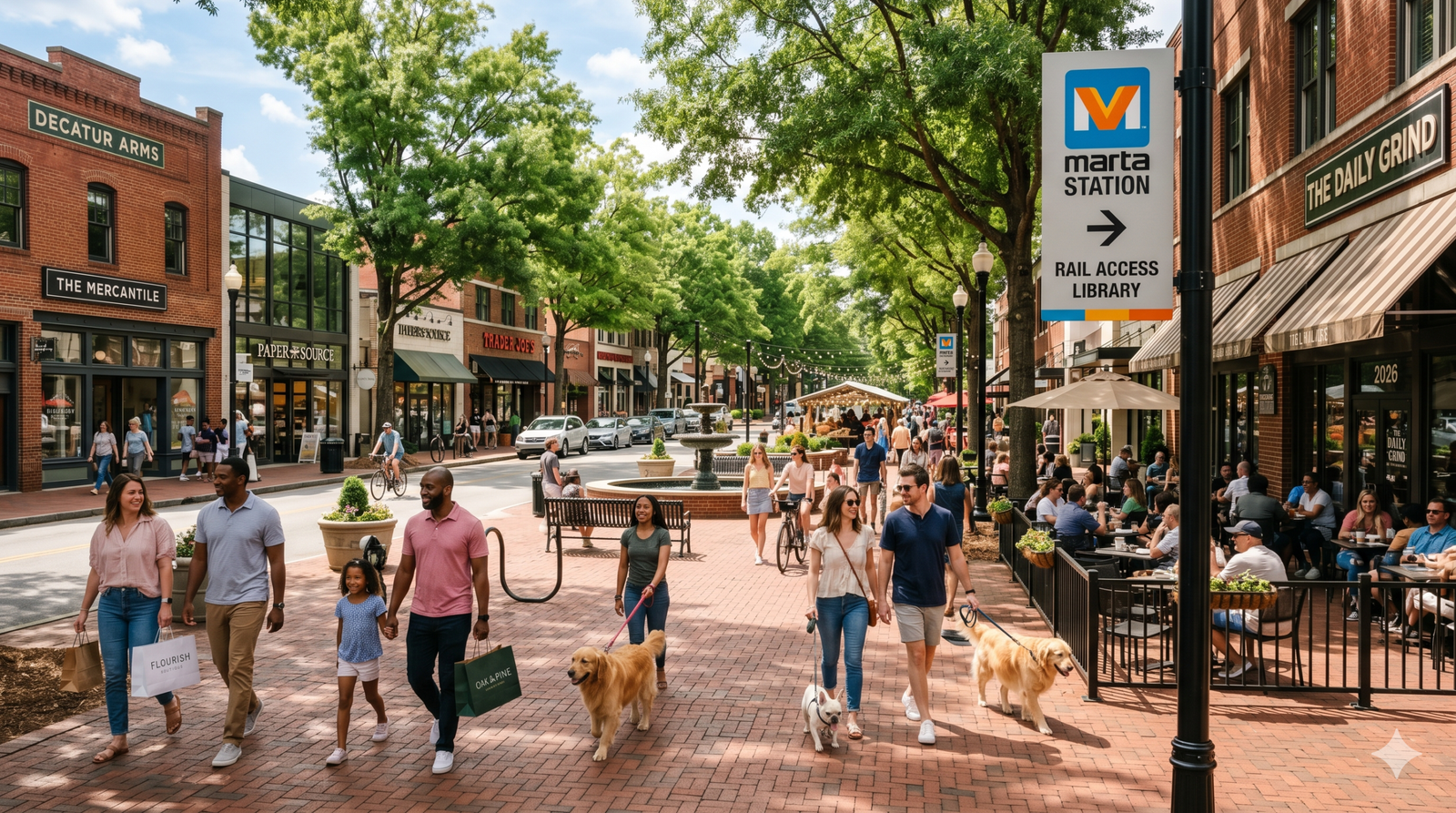
Atlanta Family Walkability Atlas
Most Walkable Atlanta Suburbs: 6 Best Areas Compared for Families
A charming town center is not the same thing as a walkable life. This guide separates daily walkability, transit-connected nodes, and “park once” districts so the decision is based on the actual home-to-destination network rather than a suburb-wide reputation.
Published and reviewed: June 11, 2026
Treat walkability as a property-level condition. A strong downtown, MARTA station, trail, or mixed-use district can improve daily life only when the candidate home connects to it comfortably. For every finalist property, test the route to the destinations the household will actually use rather than assuming the city label provides the same experience everywhere. ATL Local Insider is operated from South Korea and evaluates these locations through structured remote due diligence rather than claimed first-hand neighborhood experience; see our Research Methodology.
Most Walkable Atlanta Suburbs: Quick Answer
Decatur is one of the strongest starting points for households seeking a complete car-light suburban routine because downtown, MARTA, parks, restaurants, events, and nearby residential streets can overlap in one compact area.
Brookhaven and Chamblee become especially attractive when rail access and shorter Buckhead or Midtown trips matter. Sandy Springs and Dunwoody are more node-based, with useful walkability around Perimeter employment, MARTA, medical offices, retail, and selected shared-use paths.
Downtown Alpharetta and Avalon offer polished local walkability without rail. Historic Roswell works best for character, restaurants, and weekend strolling. Smyrna and Vinings provide selected west-side car-light pockets, although most households will still rely heavily on a vehicle.
The better choice is the property where the route to your real weekly destinations is continuous, comfortable, and valuable enough to justify any location premium.
Define “Walkable” Before You Fall in Love
The word “walkable” can be misleading in metro Atlanta because a strong town center can create a citywide impression that the specific property does not support. A suburb may have a charming downtown while most homes still require a car to reach it. Another may sit on MARTA rail while the surrounding streets are uncomfortable for a stroller, a child on a bike, or an evening walk.
A third area may be excellent for restaurants but weak for groceries, schools, childcare, or other ordinary errands. Those are different forms of walkability.
For a relocation buyer, the useful test is not whether the suburb contains a walkable district. It is whether the finalist home connects comfortably to the places the household uses every week. If walkability is only one part of the move, compare this guide with the Atlanta Suburbs Guide, Atlanta Suburbs for Commuting, and Atlanta Suburbs by Lifestyle.
Car-light rule
Do not buy a property because the suburb is described as walkable. Buy because the property creates a useful walking route to the destinations your household will actually use.
The 6 Best Walkable Atlanta Suburb Areas at a Glance
These six areas provide different kinds of walkability. Some are stronger for transit, some for downtown strolling, some for family activities, and some for a car-light weekend routine. Use the table as a first filter rather than a permanent one-through-six ranking.
| Walkable area | Best walkability strength | Best family fit | Main caution |
|---|---|---|---|
| Decatur | Downtown square, MARTA, restaurants, events and connected walking routes | Families seeking one of the more complete car-light suburban routines. | Housing cost, older homes, and city-boundary or school-system differences. |
| Brookhaven / Chamblee | MARTA Gold Line, restaurants, mixed-use nodes and closer-in access | Families who value rail access and shorter intown trips. | Walkability changes considerably by property and street. |
| Sandy Springs / Dunwoody | Perimeter jobs, MARTA, medical offices, retail and selected paths | Families seeking walkable work access or a transit backup. | Many residential areas remain car-dependent outside the major nodes. |
| Downtown Alpharetta / Avalon | Restaurants, shopping, events, pedestrian links and a park-once routine | Families wanting polished suburban walking districts and strong amenities. | No MARTA rail; regional mobility remains primarily road-based. |
| Historic Roswell / Canton Street | Dining, boutiques, historic character and weekend strolling | Families wanting restaurants, established neighborhoods and character. | The walkable district does not make the entire city walkable. |
| Smyrna / Vinings | Village-style nodes, parks, restaurants and west-side job access | Families wanting selected closer-in Cobb walking pockets. | No direct MARTA rail; practical walkability varies significantly by property. |
Mobile tip: swipe left to compare all columns in this table.
1. Decatur: The Strongest All-Around Car-Light Suburb
If walkability is a primary relocation requirement rather than a secondary amenity, Decatur deserves an early look. The downtown square, MARTA station, restaurants, coffee shops, bookstores, local events, and nearby residential streets can overlap into a more complete car-light routine than many suburban centers around Atlanta.
For households trying to combine dinner, transit, community events, parks, and selected local errands without turning every destination into a separate drive, that concentration can be valuable.
The caution is geographic precision. City of Decatur, North Decatur, and surrounding DeKalb properties can differ in school system, taxation, services, housing age, and actual walking access.
A property close to the square is not the same purchase as a home elsewhere in the larger Decatur postal area. Verify jurisdiction, school system, sidewalks, parking, crossings, housing condition, and how many ordinary weekly trips would still require a car.
If older-home maintenance is part of the tradeoff, use the Georgia Home Inspection Checklist. If the property has a crawlspace or basement, the Slab vs. Crawlspace vs. Full Basement Guide covers the additional due diligence.
Best for
Families seeking one of metro Atlanta’s strongest combinations of downtown life, transit, restaurants, community events and local walking.
2. Brookhaven and Chamblee: Rail-Access Walkability With City-Edge Convenience
Brookhaven and Chamblee deserve an early look for households that want shorter connections to Buckhead and Midtown while retaining a more suburban residential base. Brookhaven has village-style nodes around areas such as Dresden Drive, while Chamblee combines MARTA access, restaurants, international food, and a growing mixed-use environment.
The important distinction is property placement. A home with practical access to Brookhaven/Oglethorpe or Chamblee Station can support a very different weekday from a property that still requires a drive before every train or restaurant trip.
Walk the route during school-morning and evening conditions. Check sidewalks, crossings, station access, grocery options, daycare, parks, and the destinations the household would realistically use on foot.
For commute-focused families, pair this section with Atlanta Suburbs for Commuting.
Best for
Families prioritizing MARTA access, restaurants, shorter intown routes and a more urban-suburban daily pattern.
3. Sandy Springs and Dunwoody: Walkability Around Work, Transit, and Perimeter
Sandy Springs and Dunwoody are not uniformly walkable, but they matter for families who want car-light access around Perimeter Center. MARTA stations, employment, medical offices, retail, restaurants, trails, and pedestrian improvements create selected nodes where walking can replace meaningful weekday driving.
Think of this as node-based walkability, not citywide walkability. Living near a station, office, shopping area, or trail connection can substantially change the routine. Living several miles away in a residential subdivision may still mean driving almost everywhere.
From a finalist property, test the route to MARTA, parks, groceries, work, school, and after-school activities rather than assuming proximity to Perimeter provides all of them.
If this corridor is on the shortlist, use the Dunwoody vs Sandy Springs Guide for the deeper housing, commute, and school comparison.
Best for
Families with Perimeter jobs, transit needs, medical-office access, or a routine built around weekday convenience rather than classic downtown strolling.
4. Downtown Alpharetta and Avalon: Polished Walkability Without Rail
Downtown Alpharetta and Avalon are among North Fulton’s strongest examples of polished local walkability. Restaurants, shopping, coffee, events, offices, parks, current AlphaLoop connections, and nearby pedestrian links can create a lifestyle where the household parks once and spends meaningful time on foot.
That can be a real advantage for families that want suburban amenities without giving up every form of street life. The limitation appears when the household leaves the immediate district.
Alpharetta is not the same kind of car-light choice as Decatur or a Gold Line property because MARTA rail is not part of the local network. A household may walk to dinner, coffee, parks, or events while still driving to work, school, sports, the airport, and many routine errands.
That makes Alpharetta’s walkability highly local. The property needs to be evaluated against the specific destinations the household expects to reach on foot.
If childcare is part of the decision, use the Alpharetta and Johns Creek Preschool Tuition Guide. For the location itself, compare the Alpharetta Relocation Guide, Avalon vs Halcyon, and Atlanta Suburbs by Lifestyle.
Best for
Families who value restaurants, events, shopping and a high-quality suburban walking district more than fully car-light regional mobility.
5. Historic Roswell and Canton Street: Character-First Walkability
Historic Roswell, particularly around Canton Street, offers a different form of walkability. It is less transit-oriented and more focused on restaurants, boutiques, historic buildings, sidewalk dining, community events, and nearby established neighborhoods.
That gives families a recognizable center and strong weekend activity without requiring a dense urban environment.
The main caution is concentration. Roswell’s walkability is centered in specific areas rather than spread evenly through the city. A property close to Canton Street can support a very different routine from a home farther out along major suburban roads.
Test whether the candidate property is actually comfortable to walk from, rather than merely being a short drive from Historic Roswell.
For broader North Fulton tradeoffs, compare Roswell vs Alpharetta and North Fulton vs South Forsyth.
Best for
Families who value historic character, restaurants, established neighborhoods and weekend strolling more than rail access or full daily car independence.
6. Smyrna and Vinings: West-Side Car-Light Pockets
Smyrna and Vinings can fit households seeking closer-in Cobb access, restaurants, parks, village-style nodes, and a west-side base that is less geographically distant than deeper Cobb suburbs.
Smyrna’s downtown and Village Green area, together with Vinings’ village-style commercial core, can make selected local routines feel more concentrated.
This is not rail-based walkability. It is neighborhood-specific and destination-specific. Some homes provide a genuine walk to restaurants, a park, or coffee. Others still require a vehicle for almost every routine trip.
Compare sidewalks, crossings, parking, school routes, grocery access, and commute direction before paying a location premium.
For wider Cobb comparisons, use Kennesaw vs Marietta and the Atlanta Suburbs Cost Guide.
Best for
Families seeking west-side convenience, selected walkable village life, and closer access to Midtown, Buckhead, or Cumberland than farther-out Cobb communities.
Walkability Is Not One Thing: Use the Three-Layer Test
A suburb can work well for dinner and poorly for school. It can work well for MARTA and poorly for groceries. It can feel comfortable to one adult while becoming difficult with a stroller or young child.
Before paying for a walkability premium, separate the property into three layers.
| Walkability layer | What it means | What to test in person |
|---|---|---|
| Daily walkability | Can the household walk to coffee, groceries, school, daycare, pharmacy, parks, or a station? | Sidewalk continuity, crossings, lighting, hills, stroller comfort and weekday traffic. |
| Weekend walkability | Can the family walk to dinner, parks, events, trails, or a town center? | Crowds, parking spillover, restaurant noise, festival traffic and evening comfort. |
| Transit walkability | Can MARTA or another transit option replace a meaningful part of household driving? | Station distance, route frequency, parking, transfers, weather exposure and last-mile safety. |
Mobile tip: swipe left to compare all columns in this table.
Who Should Prioritize a Walkable Suburb?
Walkability tends to create the greatest value for households that dislike repeated short drives, operate with one vehicle, work hybrid, regularly use transit, spend time in restaurants and public spaces, or want more local independence for older children.
It can also be valuable when one adult works from home and wants routine errands or exercise without starting the car every time.
It may matter less when the household’s priorities are a large yard, new construction, maximum square footage, private subdivision amenities, or a specific school assignment located away from the walkable district.
Walkable locations can also carry a price, space, parking, or noise tradeoff. Before paying that premium, compare the complete budget with the Atlanta Housing Affordability Guide and review any HOA Capital Contribution Fees at Closing.
Strong fit
Hybrid workers, one-car households, transit users, restaurant-focused households, and families that value short local trips.
Needs testing
Families with young children, strollers, school pickup pressure, or pets that make sidewalk continuity and parks more important.
Possible mismatch
Buyers prioritizing maximum house size, quiet cul-de-sacs, larger private yards, or minimal activity near home.
Sources and Verification Tools
Use these resources to verify transit, pedestrian connections, trails, mobility projects, and the specific walkable district before relying on a listing description or general walkability score.
MARTA Train Stations & Schedules
Check station locations, rail lines, schedules, parking, and whether MARTA can realistically replace some trips from the finalist property.
MARTA Interactive System Map
Check bus and rail connections, transfers, and first-mile or last-mile gaps.
Walk There! Decatur
Review official walking routes, recreation access, and downtown connections.
City of Brookhaven
Review official city, parks, community, and local mobility information.
Brookhaven/Oglethorpe MARTA Station
Check Gold Line access, parking, bus connections, and the actual walking approach from the property.
Chamblee MARTA Station
Check Gold Line access, parking, local connections, and route planning around Chamblee.
Dunwoody Perimeter Center East Path
Review current pedestrian and bicycle improvements and Perimeter Center connectivity.
Alpharetta AlphaLoop
Check current connections, planned segments, Downtown Alpharetta access, Avalon access, and mobility updates.
Historic Canton Street
Review the district location, events, restaurants, and the relationship between the candidate property and the walkable core.
Downtown Smyrna Redevelopment
Review downtown mobility, connectivity changes, redevelopment, and future pedestrian conditions.
Frequently Asked Questions
What is the most walkable Atlanta suburb?
Decatur is one of the strongest places to begin because downtown, MARTA rail, restaurants, events, and nearby residential walking routes can overlap. The exact property location still determines whether that becomes a genuinely car-light routine.
Can you live in Atlanta suburbs without a car?
It is possible for some households near MARTA and daily services, but most suburban families still need a vehicle for school, larger errands, medical visits, activities, and regional trips.
Is Alpharetta walkable?
Parts of Downtown Alpharetta, Avalon, and AlphaLoop-connected areas support strong local walking. Alpharetta is better understood as locally walkable rather than broadly car-free.
What should families check before paying more for walkability?
Check sidewalk continuity, crossings, lighting, school routes, stroller comfort, transit access, parking, noise, grocery access, and whether the property still fits the complete household budget.
A Practical Walkability Test Before Making an Offer
ATL Local Insider Walkable-Routine Audit: do not score the suburb first. Score the exact address against the household’s recurring destinations. This audit separates attractive public space from walking that can actually replace vehicle trips.
| Weekly destination | Route evidence to verify | Car-light success test | Failure signal |
|---|---|---|---|
| School / childcare | Continuous sidewalk, crossings, entrance location, morning traffic | A normal drop-off or pickup can be completed safely without starting the car | The route requires an unsafe crossing, missing sidewalk, or impractical detour |
| Groceries / pharmacy | Actual door-to-door route, carrying distance, hills, major roads | At least routine small errands are realistically walkable | The store is nearby on a map but separated by a hostile road or parking field |
| Park / activity | Trail or sidewalk continuity, lighting, stroller/bike comfort | The family can reach a recurring activity without loading the vehicle | Walking works only for an occasional leisure outing |
| Work / MARTA | First-mile route, station entrance, schedule, transfer and last mile | Transit replaces a meaningful recurring drive | The station is close but the complete trip is slower or operationally fragile |
| Dinner / coffee / town center | Evening crossings, lighting, noise, return route | The district adds useful weekly walking rather than only weekend novelty | The household still drives there because the home-to-district connection is poor |
Use one copy of this audit for each finalist address. The useful comparison is address-to-address, not city-name-to-city-name.
Walk from the property to the destinations the household expects to use rather than walking only around the commercial district.
Repeat the route during morning, evening, and weekend conditions before deciding it is comfortable.
Check stroller access, child safety, school routes, pets, groceries, pharmacy, parks, hills, crossings, and lighting.
Compare the walkability premium with home size, parking, noise, taxes, HOA costs, property condition, and the regional commute.
Related topics to read next
Atlanta Suburbs by Lifestyle — compare restaurant, event, town-center, and public-life preferences.
Atlanta Suburbs for Commuting — use when walkability must also support Midtown, Buckhead, or Perimeter employment.
Living in Roswell vs Alpharetta — compare two North Fulton options with different forms of local walkability.
Dunwoody vs Sandy Springs — useful when MARTA and Perimeter geography matter as much as walkability.
Slab vs Crawlspace vs Full Basement — useful when location value comes with an older home.
Alpharetta and Johns Creek Preschool Tuition — relevant when Downtown Alpharetta or Avalon needs to fit around young-child logistics.
Final Takeaway
The six areas in this guide are not walkable in the same way. Decatur offers one of the strongest all-around car-light combinations. Brookhaven and Chamblee become especially compelling when MARTA and intown access matter. Sandy Springs and Dunwoody work best as node-based walkability around Perimeter employment and transit.
Downtown Alpharetta and Avalon offer polished local walkability. Historic Roswell offers character-first walkability. Smyrna and Vinings provide selected west-side car-light pockets.
The final decision belongs to the property. Walk from the candidate home to the destinations the household expects to use before paying a premium for walkability. In metro Atlanta, being near a walkable district is not the same thing as living a walkable routine.
Once a walkable candidate survives that test, the Moving to Atlanta Relocation Roadmap covers the school, budget, tax, utility, and arrival decisions that come next.
Research note: This guide treats walkability as a property-level relocation factor rather than a permanent citywide ranking. Transit service, pedestrian infrastructure, redevelopment, school assignments, traffic, housing conditions, and local connections can change. Verify current routes, projects, services, and walking conditions for any finalist property before buying or renting.