Meter-to-Drain Budget Guide
Gwinnett vs. Forsyth Water Bills: 2026 Rates, Sewer Fees, and Monthly Examples
Last reviewed:
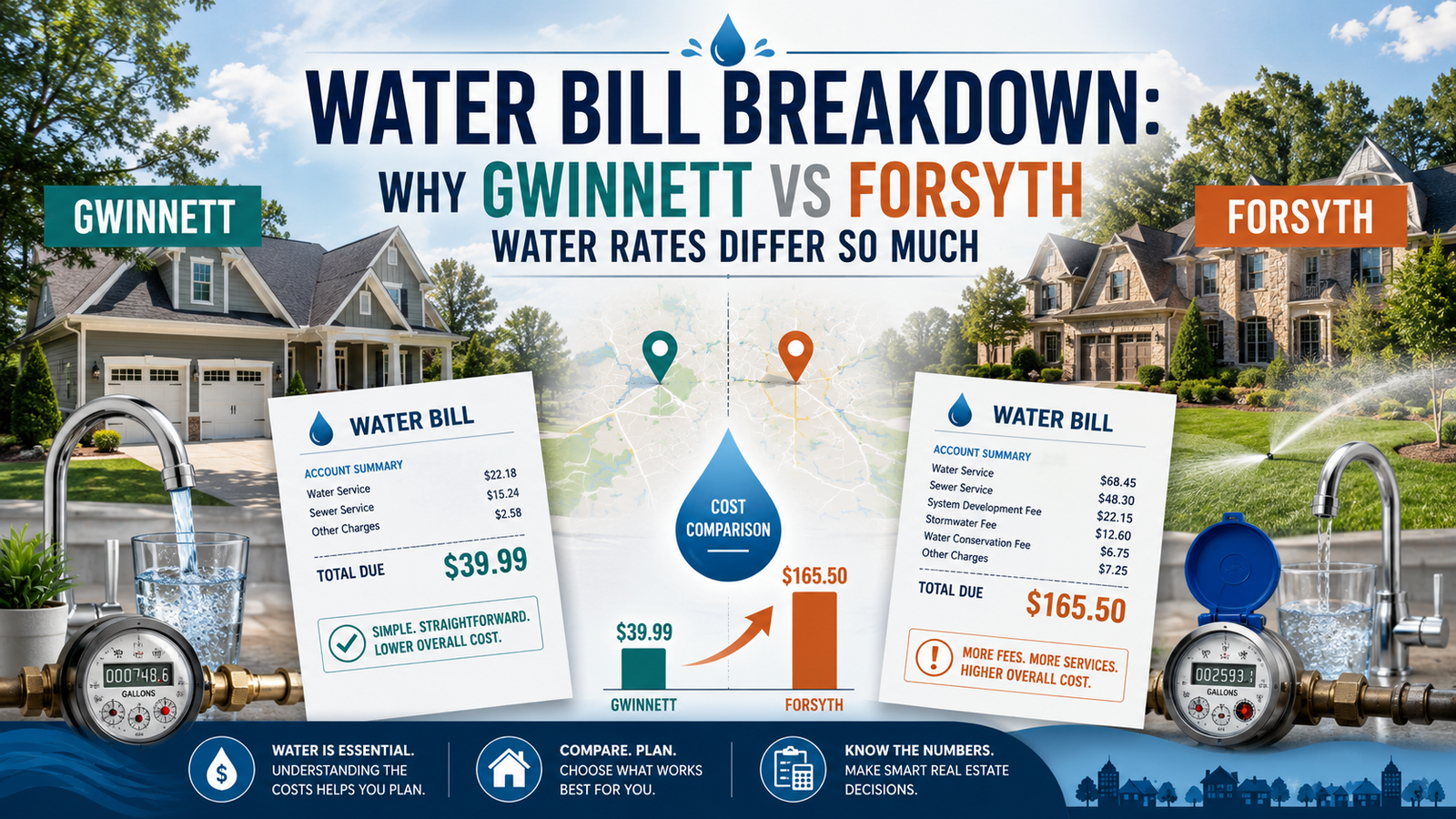
Run the numbers at 6,000 gallons and the two counties land about $3 apart — close enough that it barely matters. Crank up the sprinklers for a Georgia summer, though, and that gap can open up to hundreds of dollars. The real answer isn’t the county. It’s sewer versus septic, irrigation meters, acreage, a leak nobody’s found yet, and the exact provider that actually serves the house.
I’ve lost count of how many times a client has waved a Gwinnett or Forsyth water bill at me like it proves something. It usually doesn’t — not by itself. Gwinnett vs Forsyth water bills is one of those comparisons that looks simple from a distance and falls apart the moment you get specific. A household can be paying a water base, a tiered usage charge, a sewer base, a sewer volume charge, and a completely separate irrigation account — none of which shows up if you just glance at “the rate.” Two homes a few streets apart, similar families, can land on very different bills for reasons that have nothing to do with which county line they sit on.
What follows applies the actual 2026 rate schedules from both counties to a standard small residential meter, because that’s the question people actually bring to me: “What’s this house going to cost me every month?” If you’re weighing Suwanee, Cumming, South Forsyth, Lawrenceville, Duluth, Peachtree Corners, or the Buford and Johns Creek fringes, this is built for you. Treat the numbers as a transparent planning model, not a bill someone’s promising you.
WATER-COST ADDRESS FILE • Provider → Meter → Sewer/Septic → Summer Load
Start by Separating Indoor Water, Sewer, and Outdoor Use
Here’s the thing nobody tells new buyers: the exact same number of gallons can turn into two completely different bills depending on how the account is set up. Water that runs through a combined residential meter usually triggers both a water charge and a sewer charge. Water that runs through a properly classified dedicated irrigation meter skips the residential sewer math entirely and follows its own schedule instead. And a septic home might be paying the county for water while owing the public sewer system nothing at all.
So the real question was never “which county’s number is smaller.” It’s “who actually serves this parcel, what meters exist on it, where do the gallons go, and which fixed and variable charges apply to this specific house.”
Water Costs Matter More When the Home Price Already Stretches the Budget
This isn’t a casual question — the people asking it are usually already stretched thin on the mortgage math. Redfin put the median sale price at roughly $421,000 in Gwinnett County and about $642,000 in Forsyth County over the three months ending May 2026. Zillow’s data also showed a majority of recent Forsyth sales closing below list price. Put those two facts together and you get buyers with a little room to actually negotiate — which means the smart ones stop treating the water bill as an afterthought and start treating it as a line item worth fighting over.
A rate table alone won’t satisfy that instinct, and I don’t blame anyone for that. In a recent Gwinnett neighborhood thread, one five-person household described a bill that sat consistently above $200 a month, and several smaller households chimed in with much lower numbers and told the poster, basically, “go check your meter for a leak.” That’s the real content gap here — it was never “which county is cheaper.” It’s “why does my bill look nothing like my neighbor’s, and what should I actually check before I buy?”
The Two Counties Allocate the Bill Differently
Gwinnett starts cheap and stays fairly flat: lower small-meter bases, three residential water tiers. Forsyth starts higher — a bigger water base that already includes your first 1,000 gallons, a bigger sewer base, and five residential water tiers instead of three. Gwinnett charges more per gallon for sewer volume; Forsyth’s sewer base itself is the heavier line. Neither county is simply “the expensive one” — they’re just built differently.
Gwinnett County
Standard 3/4-inch residential meterForsyth County
Standard 5/8- or 3/4-inch residential meterOne more thing worth knowing if your move spans a calendar year: Forsyth’s published schedule has annual water and sewer increases baked in through 2028, unless the Board of Commissioners changes course. Gwinnett’s adopted structure has its own scheduled volumetric increases running through 2031. Pull the current-year document again before you close — don’t carry a 2026 model into a 2027 purchase and assume nothing moved.
At Moderate Usage, the Modeled Bills Are Close
These examples assume county water, public sewer, a standard small meter, no separate irrigation account, and every measured gallon flowing into the sewer-volume calculation. They’re here to show you how the rate structure actually behaves — not to predict what your particular family will pay.
Don’t walk away from that 20,000-gallon line thinking “Forsyth wins, period.” It only wins under this exact assumption — everything running through the residential account and getting billed for sewer. Add a separate irrigation meter, or swap in a Forsyth septic property, or land on an address served by yet another provider entirely, and the whole comparison resets.
One habit I’d genuinely recommend: normalize by billing days before you compare two houses. A 12,000-gallon bill over 33 days works out to about 364 gallons a day. The same 12,000 gallons over a 28-day cycle is closer to 429 gallons a day. That gap is exactly the kind of thing that separates “longer billing cycle” from “actual behavior change” or, worse, a leak nobody’s found yet.
Forsyth’s Higher Irrigation Tiers Create the Largest Difference
Gwinnett keeps it simple — one published irrigation rate, full stop. Forsyth uses four separate rates and widens the gallon bands depending on how much irrigated acreage is on record for the property. The Forsyth models below assume up to one acre of irrigation and a standard small dedicated meter. Both sets of numbers exclude sewer, since properly classified irrigation shouldn’t be carrying a sewer charge in the first place.
10,000 gallons — controlled landscape month
20,000 gallons — established summer lawn use
40,000 gallons — high-volume irrigation month
That $240 gap at 40,000 gallons isn’t some general “Forsyth costs more” rule — don’t repeat it that way at a dinner party. It’s what happens specifically under the up-to-one-acre allocation, once usage crosses 24,000 gallons and hits Forsyth’s top published irrigation rate. A property on record with more irrigated acreage gets wider gallon bands, and you’d need to model it off that property’s actual acreage classification, not this one.
Before you fall for a home with a big, lush lawn, ask for the separate irrigation statements. Find out how many zones the controller runs, what the schedule looks like, whether new sod or a pool fill inflated a recent month, and whether the HOA is the reason that lawn looks like a golf course in the first place. A dedicated meter keeps sewer charges off your outdoor water. It does not make watering a big yard cheap.
Septic Can Lower the Monthly Bill Without Eliminating Ownership Cost
Public sewer
- Means a recurring sewer base plus a volume charge, every month, no exceptions.
- Means you’re not the one responsible for a septic tank and drain field.
- Can get genuinely expensive if the household runs a lot of water through one meter.
- Doesn’t automatically make the private sewer lateral the utility’s problem to fix.
Private septic
- Usually keeps you off the county’s public-sewer bill entirely.
- Comes with its own quiet obligations: inspection, pumping, maintenance, eventual repair.
- Carries real drain-field and replacement risk if something goes wrong.
- Can quietly limit what you’re allowed to do — additions, a pool, regrading, even certain trees.
Under Forsyth’s standard 2026 schedule, a sewer-served home starts at an $18.29 sewer base and adds $8.84 for every 1,000 gallons on top of that. Take those charges off the bill entirely and the utility statement can look a lot friendlier — but weigh that against the fact that septic costs don’t show up monthly. They show up all at once, usually at the worst possible time, and you need to be honestly evaluating the condition of that exact system, not just the absence of a line item.
Confirm sewer or septic through the actual utility and property records — not the lot size, not what the listing implies. Our septic tank vs. public sewer guide goes deeper into the inspection and ownership side of this decision.
A Mailing Address Does Not Identify the Water Provider
A Suwanee, Cumming, Buford, Alpharetta, or Johns Creek-area mailing address tells you almost nothing about who actually supplies the water. County water, city water, public sewer, private septic, some separate community arrangement — any of those can be hiding behind the same postal city. Build the real bill from the seller’s actual account. Don’t build it from the envelope.
Read the full statement
Get the provider, account class, meter size, billing days, gallons used, water base, sewer base, every variable charge, and any irrigation account on the property.
Identify every water system
Track down the domestic meter, the irrigation meter if there is one, a pool auto-fill line, a well, a shared HOA system, any inactive meter, and whatever private service line connects the house.
Confirm sewer or septic separately
A public-water account proves nothing about sewer. Ask for the actual records and any inspection history before you assume either way.
Compare gallons per day
Use the actual service days to tell a long billing cycle apart from a genuine jump in household use — or a leak.
In my experience, a leak explains more tier jumps than anything else on this list. Check toilets, irrigation valves, underground lines, pressure regulators, pool equipment, and anywhere plumbing runs through a crawlspace. Gwinnett publishes its own meter-based leak test, and Forsyth’s WaterSmart portal will track usage and flag leaks for accounts that use it.
And keep the water number in context — it’s one piece of the ownership stack, not the whole thing. Line it up against hidden utility fees , Georgia trash and recycling costs , and housing affordability alongside the mortgage, taxes, insurance, HOA, and whatever repair reserve the house actually needs.
7 Checks Before You Budget the Home
WATER-COST PURCHASE FILE
Skip the annual average — it’s the wrong number to anchor on. An average can easily bury three cheap winter months under one brutal irrigation cycle and still come out looking reasonable. Pull the highest normal summer statement instead, and then decide honestly whether the lawn, the pool, and the landscaping expectations are worth carrying that number every year.
If you’re still weighing the two counties against each other, keep reading with the Suwanee vs. Cumming cost-per-square-foot guide , North Fulton vs. South Forsyth comparison , and Gwinnett County suburbs guide .
Gwinnett vs. Forsyth Water Bill FAQ
Is Gwinnett always cheaper than Forsyth?
No, and I’d stop anyone who says otherwise. The modeled bills are close at 6,000 gallons. Push to 12,000 or 20,000 gallons and the Forsyth model actually comes in lower under these assumptions. Turn on dedicated irrigation, though, and it can flip hard the other way once Forsyth’s higher tiers kick in.
Why is the 40,000-gallon Forsyth irrigation model so high?
That example assumes up to one acre of recorded irrigation area. Under that allocation, anything above 24,000 gallons hits Forsyth’s highest 2026 irrigation rate. A property with more recorded irrigated acreage gets wider tier bands than this model uses.
Does a dedicated irrigation meter avoid sewer charges?
A properly classified irrigation account is billed under the irrigation structure, not the residential water-and-sewer model used elsewhere in this guide. Double-check that every outdoor zone is actually tied to that meter, and confirm the provider’s current classification directly — don’t assume.
Is a $200 Gwinnett water bill automatically wrong?
No. Household size, sewer billing, irrigation, pool use, billing days, and a leak can all push a bill past $200 without anything being “broken.” Compare gallons per day against prior periods, shut off every fixture and watch the meter, and separate domestic from outdoor use before you decide the county got the math wrong.
What is the most useful document before closing?
Twelve months of complete domestic and irrigation statements — provider, meter size, account class, service dates, gallons, base charges, sewer status, and whichever month was the worst of the summer.
Official Rate and Billing Sources
- Gwinnett County 2026 DWR Rates and Fee Schedule — verify residential bases, escalating tiers, sewer rates, irrigation charges, billing-cycle notes, and account fees.
- Gwinnett Water Bill Calculator — compare the county calculator with the planning examples in this guide.
- Gwinnett Leak Detection — review the meter test and household leak checks.
- Forsyth County 2026 Water and Sewer Rate Schedule — verify residential, sewer, and acreage-based irrigation rates.
- Forsyth Billing Information — confirm meter-read frequency and current billing procedures.
- Forsyth WaterSmart — review usage tracking and leak-alert tools.
- Redfin Gwinnett County Housing Market — current price and sales context for buyers.
- Redfin Forsyth County Housing Market — current market context for Forsyth buyers.
- Gwinnett Community Water-Bill Discussion — household examples used to identify recurring questions, not an average bill.
The Outdoor Gallon Usually Creates the Bigger County Difference
There’s no clean winner between Gwinnett vs Forsyth water bills, and I’d be suspicious of anyone who tells you otherwise. Under standard 2026 assumptions, a moderate indoor water-and-sewer bill can come down to a few dollars either way. Push the household’s combined usage higher and the Forsyth model tends to pull ahead. Add heavy dedicated irrigation on a Forsyth account under the up-to-one-acre allocation, and that same county can turn into the more expensive one by a wide margin.
Pick the house only after you’ve nailed down the provider, the meter setup, sewer-or-septic status, the billing days, a real summer gallon figure, the irrigation acreage on record, what the pool and landscaping actually demand, and whether there’s a leak hiding somewhere. The county schedule sets the prices. The property decides which of those prices you’re actually going to pay.