Metro Atlanta Relocation JournalIndependent decision guides built around the address, commute, school path and monthly household cost.
ATL Local Insider • Matched-Home Comparison File
Suwanee vs Cumming: Compare the House, Not the City Average
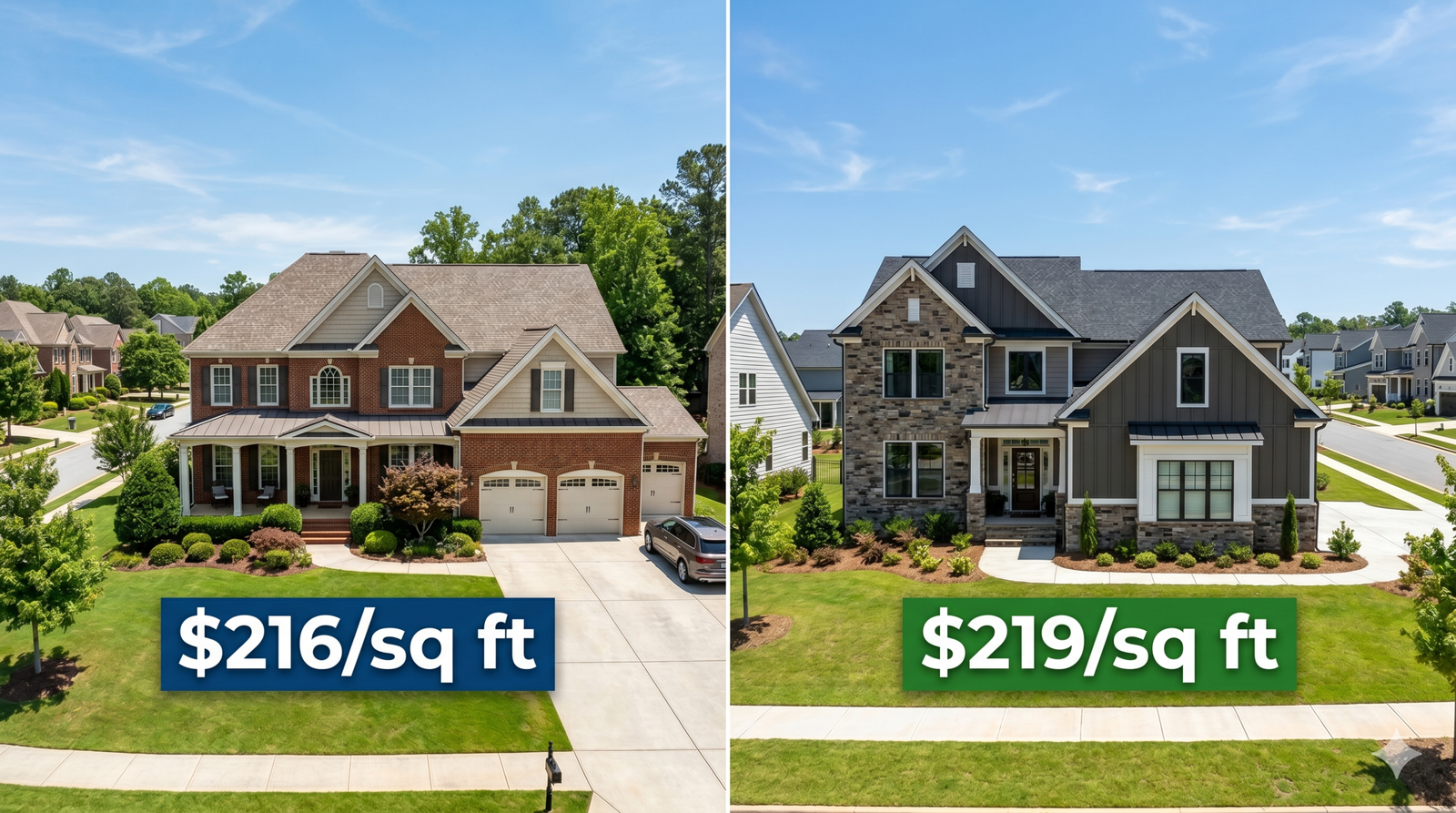
A useful Suwanee vs Cumming cost per square foot comparison does not begin with two citywide averages. It begins with two homes that solve the same household problem, then controls for square footage, school assignment, commute, condition, basement, lot, HOA obligations and ownership costs.
Last reviewed: June 21, 2026
MATCHED-HOME SEQUENCE
01 · NORMALIZE
Use the same square-foot definition.
02 · ADD
Repairs, routes, HOA, utilities and property costs.
03 · DECIDE
Compare two addresses—not two city brands.
VS
City averages are useful for orientation, not for choosing a house. Suwanee and Cumming contain different property types, school assignments, commute patterns, utility arrangements and incorporated-versus-unincorporated addresses. The closer the buyer gets to an offer, the less useful the city label becomes and the more important the exact parcel becomes.
Matched-Home Index
What Cost per Square Foot Can and Cannot Tell You
Price per square foot is useful as a screening metric. It tells you how much purchase price is being assigned to each square foot under the definition you choose.
It becomes unreliable when listings use different definitions. One property may emphasize above-grade living area, another may highlight finished basement space, and county records may reflect a different total again.
Rebuild the metric before comparing homes.
Record purchase price, above-grade finished area, finished basement area, unfinished basement area, garage, lot, year built, condition and known repairs separately. Use the same square-foot definition for both candidates.
A garage, screened porch, pool, renovated kitchen, premium lot, new roof or usable basement can influence market value without changing the above-grade square-foot denominator.
That is also why a citywide average should not settle a Suwanee-versus-Cumming purchase. The averages blend homes with different ages, property types, school zones, municipality status, lot sizes and locations.
Build a Matched Suwanee–Cumming Pair
Start with the same maximum purchase budget and financing assumptions. Then match the homes as closely as practical.
Suwanee Candidate
Same property type as the Cumming candidate.
Comparable construction era.
Verified GCPS school assignment.
Measured route to the actual employer.
City-of-Suwanee status confirmed.
Town Center, parks or other amenities counted only if the household will use them.
↔
Cumming Candidate
Same purchase budget and financing assumptions.
Comparable basement and interior finish level.
Verified Forsyth County school assignment.
Actual local route to GA-400 or other work corridor tested.
Municipal versus unincorporated status confirmed.
Water, sewer, septic, well and HOA structure confirmed.
A renovated Suwanee home near frequently used amenities should not be compared against an unfinished or much farther-out Cumming property as though the only difference were square footage.
The reverse is also true. A newer Cumming home with modern systems should not be compared with an older Suwanee property without pricing the Suwanee home’s near-term roof, HVAC, exterior or interior work.
Recalculate a Same-Budget Example
The numbers below are deliberately illustrative. They demonstrate the calculation method and are not current listings, closed sales, appraisals or forecasts.
Input
Illustrative Suwanee Home
Illustrative Cumming Home
Purchase price
$650,000
$650,000
Above-grade finished area
2,650 sq ft
3,050 sq ft
Raw price per above-grade sq ft
$245.28
$213.11
Illustrative immediate work
$24,000
$8,000
Illustrative five-year HOA total
$4,500
$9,000
Illustrative added route cost
$5,000
$16,000
Illustrative five-year comparison basis
$683,500
$683,000
Suwanee raw calculation
$650,000 ÷ 2,650 = $245.28
Cumming raw calculation
$650,000 ÷ 3,050 = $213.11
What changes after adjustment?
The space gap remains. The five-year household-cost gap may narrow.
The point is not that Cumming is always less expensive or Suwanee is always more efficient. The point is that a lower raw price per square foot can coexist with higher travel, HOA or property costs.
A remote-working household that needs additional bedrooms or office space might value the larger Cumming home heavily. A household repeatedly traveling through the I-85/Gwinnett network may assign more value to a particular Suwanee address.
Keep appraisal value and household value separate.
An appraiser determines market value using professional appraisal methods. This worksheet serves a different purpose: helping the household decide which property produces better use and cost over its expected ownership period.
Lock the School Assignment Before Comparing Value
School demand can influence housing demand, but the assignment belongs to the property rather than the postal city name.
Verify elementary, middle and high school assignments separately using the current district tools for each address.
Verify the exact parcel.
Do not substitute a ZIP code, subdivision name or nearby property.
Record all three school levels.
The household should know the full current path rather than only the elementary school.
Review boundary planning.
Growing districts may adjust assignments as enrollment and facilities change.
Verify special-program logistics separately.
Eligibility, transportation or application rules may not follow the ordinary neighborhood assignment.
Test the actual school-day route.
Include drop-off or bus logistics, the next adult destination and afternoon activities.
The relevant question is not simply how far each house sits from an interstate. The household needs to know how the entire weekly route system behaves.
Work Route
Test the trip from the exact driveway to the actual workplace during the required travel window.
School Route
Add drop-off, pickup, care arrangements and the next adult destination.
Service Route
Map grocery, healthcare, pharmacy, fuel and the services the household uses repeatedly.
Weekend Route
Compare access to the park, Town Center, sports field, lake, trail or family activity the household expects to use.
Suwanee candidates may depend on routes such as Peachtree Industrial Boulevard, Lawrenceville-Suwanee Road, Buford Highway or I-85. Cumming candidates may depend on GA-400 plus a longer local approach through roads such as McFarland Parkway, Browns Bridge Road or other Forsyth corridors.
Do not assume either route system is better without testing the exact pair.
A mailing address does not automatically tell you which government, utility or tax structure applies. Confirm the actual property before assigning city taxes, services or utility assumptions.
A Suwanee mailing address may sit inside or outside incorporated Suwanee. A Cumming mailing address may sit inside the City of Cumming or in unincorporated Forsyth County.
Build a twelve-month operating file.
For each candidate, collect available water, sewer, electricity, gas, sanitation, irrigation, pool and HOA information. When seller records are available, review seasonal variation rather than relying only on an annual average.
Also determine whether the property uses public sewer, septic, a well, an irrigation meter or another arrangement that changes the household’s future maintenance obligations.
HOA dues need context. A higher fee may pay for substantial shared amenities or private infrastructure. A lower fee may mean fewer services or more responsibilities shifted directly to the homeowner.
Review dues, reserves, insurance, pending assessments, transfer charges, rental rules and maintenance responsibilities before turning the HOA into one simple monthly number.
Interior square footage is only one part of the value file.
Track above-grade finished area and basement area separately. A finished basement can be highly useful, but its value depends on access, daylight, ceiling height, moisture history, HVAC, permits, bathroom configuration and the way the household will actually use the space.
Do the same with the lot. Record usable flat area, slope, drainage, easements, retaining walls, trees, irrigation, fences and exterior maintenance.
A larger lot can create privacy and recreation. It can also create additional mowing, tree, drainage or retaining-wall exposure.
Then normalize condition across both homes:
roof;
HVAC;
water heater;
windows;
plumbing and electrical;
exterior materials;
appliances;
kitchen and bathrooms;
flooring;
drainage;
unfinished work.
The lower price per square foot is not the better deal if the buyer must immediately spend the apparent savings restoring the property.
Stress-Test Five-Year Resale Flexibility
The best matched-home value is not necessarily the property with the lowest adjusted number. It is the property that serves the household without creating unnecessary pressure to sell early.
Suwanee Exit Test
Would location, established amenities, school access and road connections appeal to a sufficiently broad future buyer pool?
Cumming Exit Test
Will the additional size, newer construction or subdivision features remain distinctive if surrounding inventory continues to expand?
Record potential resale friction instead of assuming a fixed appreciation rate.
unusual floor plan;
steep or difficult lot;
deferred maintenance;
high HOA burden;
narrow school dependence;
road or noise exposure;
long commute;
competing new construction;
limited future buyer pool.
This gives the household a more defensible five-year comparison than forecasting appreciation percentages that cannot be guaranteed.
Complete the Matched-Home Decision File
Instead of assigning numerical scores, record whether each factor is confirmed, workable, or unresolved. An unresolved major factor should stay visible rather than being hidden inside an average score.
Matched Pair: ______________________________
Square Footage
Same definition used? __________________
Schools
Exact assignments verified? ____________
Work Route
Weekday route tested? __________________
Family Route
School / activities / services tested? ___
Taxes
Parcel-specific structure reviewed? ______
Utilities
Providers and likely use reviewed? _______
HOA
Responsibilities and reserves understood?
Property
Immediate work priced? _________________
Lot / Basement
Actual household utility verified? ______
Exit
Five-year buyer pool still makes sense? __
Final decision question
If both city names disappeared from the listing, which home would still give your household the better five-year life?
That question is the point of the entire comparison. Suwanee and Cumming are useful geographic labels. The household ultimately owns an address.
Frequently Asked Questions
Is Cumming always cheaper per square foot than Suwanee?
No. The result depends on property type, school assignment, location, age, basement treatment, lot, condition and current inventory. Recalculate the exact homes using the same square-foot definition.
Should finished basement space be included in price per square foot?
Track above-grade and basement space separately first. Finished basement utility can vary significantly based on light, access, permits, moisture, ceiling height and configuration.
Which is better for commuting: Suwanee or Cumming?
It depends on the employer and exact property. Suwanee may fit some I-85 and Gwinnett-oriented trips better, while Cumming may fit some GA-400-oriented employment patterns better. Test door-to-door routes.
How should school quality affect the comparison?
Verify the exact assignment first. Then compare school logistics, boundary exposure, programs and how much of the home’s price depends on the current assignment.
Are citywide price-per-square-foot averages useless?
No. They can provide broad market orientation. They should not decide between two specific homes because they combine properties with different locations, conditions, school paths and property types.
What documents should I collect for a matched-home comparison?
Useful materials can include listing information, parcel records, school-locator results, HOA documents, utility history where available, seller disclosures, inspection findings, repair estimates, insurance quotes and route notes.