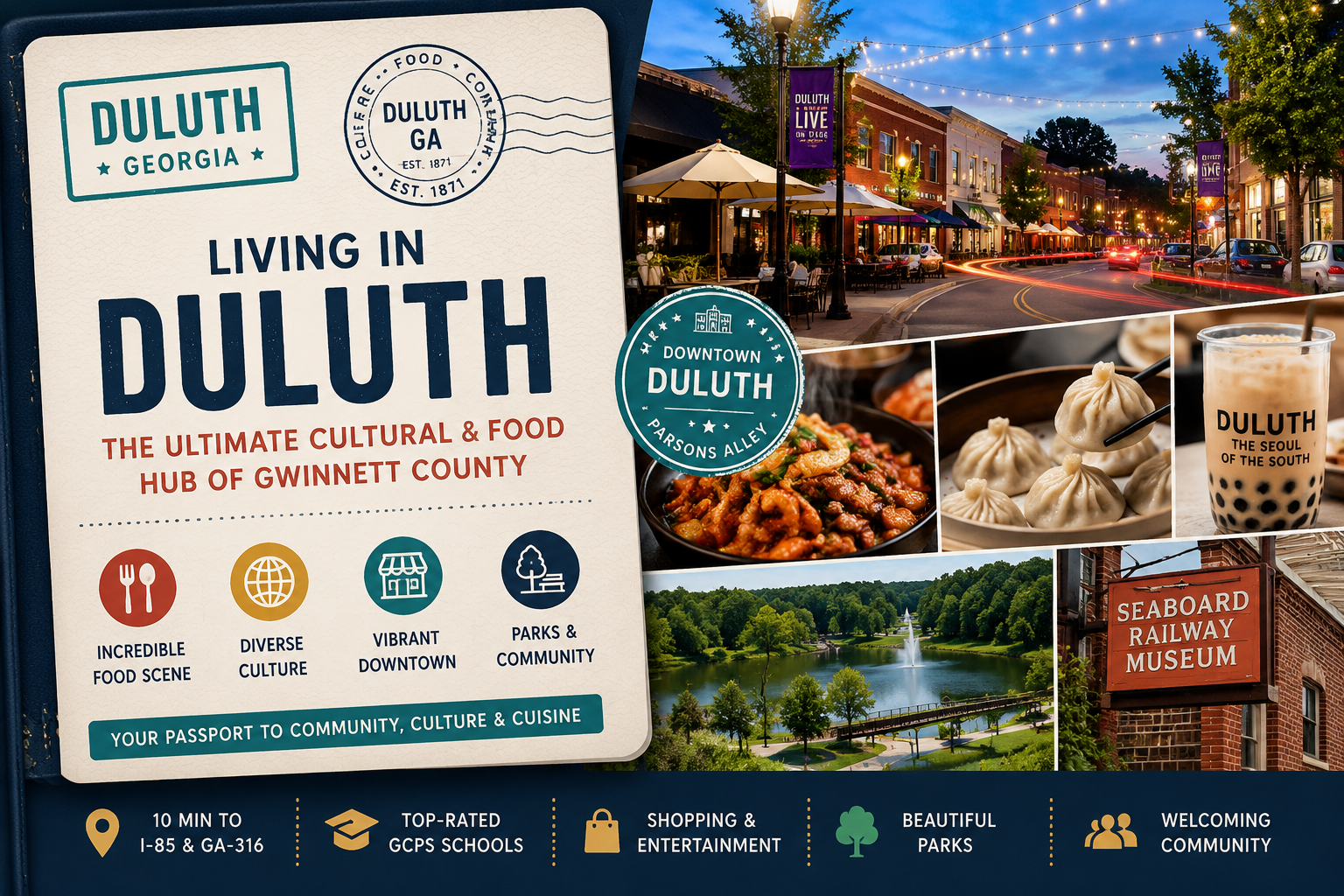
Downtown • Pleasant Hill • International Food • Parks • Schools • Commute • Housing
Living in Duluth: Gwinnett’s Cultural and Food Hub
Last reviewed:
Duluth works best when you understand its two connected identities: a walkable civic downtown and a much larger international dining and daily-life network spread across the surrounding Gwinnett corridors.
Downtown evenings, Pleasant Hill’s Korean corridor, global markets, bakeries, food courts, and family dining.
Town Green, Parsons Alley, festivals, live performances, parks, museums, and community events.
City limits, school cluster, commute route, transit access, housing condition, HOA, and full monthly cost.
Is Duluth a Good Place to Live?
Duluth’s advantage is variety: Town Green events, Parsons Alley, international markets, Korean dining, McDaniel Farm Park, and a state transportation museum. The tradeoff is complexity because downtown, Pleasant Hill, Gwinnett Place, Sugarloaf, and nearby unincorporated areas are not one uniform neighborhood.
The correct decision starts with the exact parcel. Verify city limits, school assignment, road access, transit route, housing condition, HOA obligations, and the weekly destinations the household will actually use.
Separate Incorporated Duluth From the Larger Duluth Address Area
“Duluth” can mean the incorporated city, postal area, school cluster, or larger commercial zone. Those boundaries overlap imperfectly, so a Duluth mailing address does not prove city services, downtown proximity, schools, taxes, or utilities.
Downtown Duluth
Town Green, Main Street, Parsons Alley, civic facilities, restaurants, festivals, and recurring live entertainment create the most walkable and visually identifiable version of Duluth.
Homes near downtown may trade lot size or newer construction for easier access to events, dining, trails, and a strong local identity.
Greater Duluth corridors
Pleasant Hill Road and nearby commercial areas form a major international dining, retail, market, spa, and service network. Explore Gwinnett highlights the corridor as central to its “Seoul of the South” cultural experience.
The strongest food access may sit outside the downtown walkable core, so households should decide which version of Duluth they intend to use weekly.
Use City of Duluth maps and Gwinnett parcel tools before assuming a listing is inside municipal limits. Then measure the actual drive to downtown, school, groceries, work, parks, and the food corridors.
Duluth’s Food Strength Comes From Layers, Not One Restaurant Row
Explore Gwinnett’s “Seoul of the South” program places Duluth near the center of a Korean cultural network of restaurants, bakeries, markets, spas, and karaoke. Pleasant Hill Road is essential, while the broader area also supports Chinese, Vietnamese, South Asian, Latin American, Southern, café, and family dining.
Downtown evening
Choose downtown when the goal is dinner plus Town Green, live music, an event, dessert, or a short walk. Parking and event closures should be checked during major weekends.
Pleasant Hill exploration
Use this corridor for Korean barbecue, stews, noodles, fried chicken, bakeries, markets, food courts, karaoke, and related services. Compare traffic and parking at the actual dining hour.
Family grocery network
International markets can change the household’s weekly menu and reduce the need to drive toward Atlanta for specialty ingredients, prepared foods, and culturally familiar products.
Low-pressure discovery
Start with a bakery, café, food court, lunch special, or tourism food guide when a cuisine feels unfamiliar. The value of Duluth is repeat access, not completing a checklist in one weekend.
Restaurant ownership, hours, menus, prices, and quality change frequently. Treat official tourism guides as discovery tools, then verify the current business directly before making a special trip.
Downtown Duluth Functions as the City’s Shared Living Room
The city calendar includes markets, festivals, concerts, and family programming. Duluth Live currently schedules Parsons Alley performances on Friday and Saturday evenings when another event does not replace them.
Duluth Offers More Housing Variety Than Its Downtown Image Suggests
Buyers can encounter older ranch homes, split levels, established subdivisions, swim-tennis communities, townhomes, condos, apartments, infill, and newer pockets. Downtown-adjacent housing may emphasize access and local identity. Other Duluth areas may offer larger lots, more square footage, stronger amenity packages, or easier access to I-85 and major commercial corridors.
Established single-family home
Inspect roof, HVAC, windows, plumbing, sewer line, electrical service, drainage, basement or crawlspace moisture, mature trees, decks, and renovation permits.
Swim-tennis subdivision
Review HOA finances, amenity condition, rental rules, architectural controls, social expectations, special assessments, and the route from the subdivision entrance to school and work.
Townhome or condo
Price dues, reserves, insurance structure, exterior responsibility, parking, guest access, package handling, noise transfer, rental limits, and future assessments.
Downtown-adjacent option
Measure actual walkability, event noise, guest parking, restaurant deliveries, traffic circulation, lot size, and whether the household will use downtown often enough to justify the premium.
Use the Georgia home inspection checklist and mature tree liabilities guide for established properties.
Duluth Is Connected, but Most Households Still Need a Car
Duluth connects to I-85 through Pleasant Hill, Sugarloaf, Satellite Boulevard, Buford Highway, and Peachtree Industrial. The commute value depends on the actual destination and schedule.
Check current Ride Gwinnett schedules and track the intended bus before relying on transit for work or school. Service can change because of conditions, holidays, or schedule revisions.
Use the GCPS Locator Instead of Assuming a Duluth School Assignment
Gwinnett County Public Schools organizes schools by attendance clusters. The current Duluth Cluster includes Duluth High School, Coleman Middle School, Duluth Middle School, and several elementary schools. A Duluth mailing address may also fall into another cluster, so the city name or nearby campus does not guarantee assignment.
ADDRESS-LEVEL SCHOOL FILE
The Atlanta suburbs school districts guide provides broader context, but the exact address controls the immediate decision.
Duluth’s Cultural Life Extends Beyond Restaurants and Festivals
Pair these resources with the Atlanta youth sports guide when children’s activities shape the relocation decision.
Living in Duluth Costs More Than the Mortgage and Restaurant Bill
Duluth’s local dining and activity access can be a benefit or a budget leak. Compare parcel taxes, insurance, HOA documents, utilities, and an age-appropriate maintenance reserve.
Use the Gwinnett County suburbs guide and housing affordability guide to compare Duluth with nearby alternatives on equal assumptions.
Run a Three-Day Duluth Test Before Choosing the Address
Drive work, school, grocery, dinner, and activity routes at the real hours. Test the subdivision exit, major intersection, and return after dark.
Attend a city event or Duluth Live date. Observe parking, noise, family use, crowd level, restaurant access, and the drive home.
Shop an international market, eat along Pleasant Hill, visit a park or museum, and decide whether the household enjoys the energy or finds the traffic exhausting.
A resident test should include the address’s least flattering conditions: rain, school traffic, a crowded event, a busy dining hour, and the route after dark. Finish with the Duluth-Name Daily-Life Check: if the word “Duluth” disappeared from the listing, could you still justify this address from its school assignment, weekday routes, housing condition, recurring destinations, monthly cost, and the cultural places your household will actually use?
Who Usually Thrives in Duluth—and Who May Prefer Another Suburb?
Strong fit: culturally curious family
The household values global food, markets, festivals, diverse services, and the ability to make ordinary errands culturally interesting.
Strong fit: Gwinnett-based professional
Work and family destinations remain near I-85, Peachtree Corners, Norcross, Sugarloaf, Lawrenceville, or other Gwinnett employment centers.
Compare carefully: Atlanta commuter
The home may work with hybrid hours, Ride Gwinnett connections, or a northern destination, but repeated peak travel toward central Atlanta needs a real test.
Possible mismatch: uniform-new-suburb buyer
A buyer seeking only new construction, wide predictable roads, one dominant community aesthetic, or a simple citywide school story may prefer another search area.
10 Checks Before Moving to Duluth, Georgia
DULUTH RESIDENT ENTRY CHECKLIST
Living in Duluth, Georgia FAQ
Is Duluth walkable?
Why is Duluth known for Korean food and culture?
Does every Duluth address attend Duluth Cluster schools?
Can residents commute without a car?
What is the biggest Duluth relocation mistake?
Official Duluth and Gwinnett Research Desk
- City of Duluth — verify city maps, municipal services, downtown information, planning, parks, and resident resources.
- Duluth Community Events — review the current city event calendar, locations, parking information, and schedule changes.
- Duluth Live — confirm current Parsons Alley performance dates and event conflicts.
- Explore Gwinnett Seoul of the South Food Tour — understand the current Korean cultural and dining experience centered in Gwinnett and Duluth.
- Explore Gwinnett Guide to Korean Culture — use current tourism resources to begin exploring markets, food, and cultural businesses.
- GCPS Duluth Cluster — review current cluster schools and access official district tools.
- Ride Gwinnett Routes and Schedules — verify current local routes, service days, tracking, transfers, and holiday changes.
- McDaniel Farm Park — review current entrances, trails, historic programming, facilities, and park information.
- Southeastern Railway Museum — verify current exhibits, hours, events, admission, and visitor requirements.
Duluth Rewards Residents Who Use More Than One Version of the City
Duluth’s strongest quality is not simply a charming downtown or a large restaurant count. It is the combination of civic events, international daily life, specialized attractions, established neighborhoods, Gwinnett employment access, and food culture that can become part of an ordinary week.
The best Duluth address connects the household to the parts it will genuinely use. Verify the parcel and schools, drive the commute, visit downtown during an event, shop and eat along the international corridors, inspect the home, and price the entire month. Duluth becomes a cultural hub only when its variety improves daily life.